
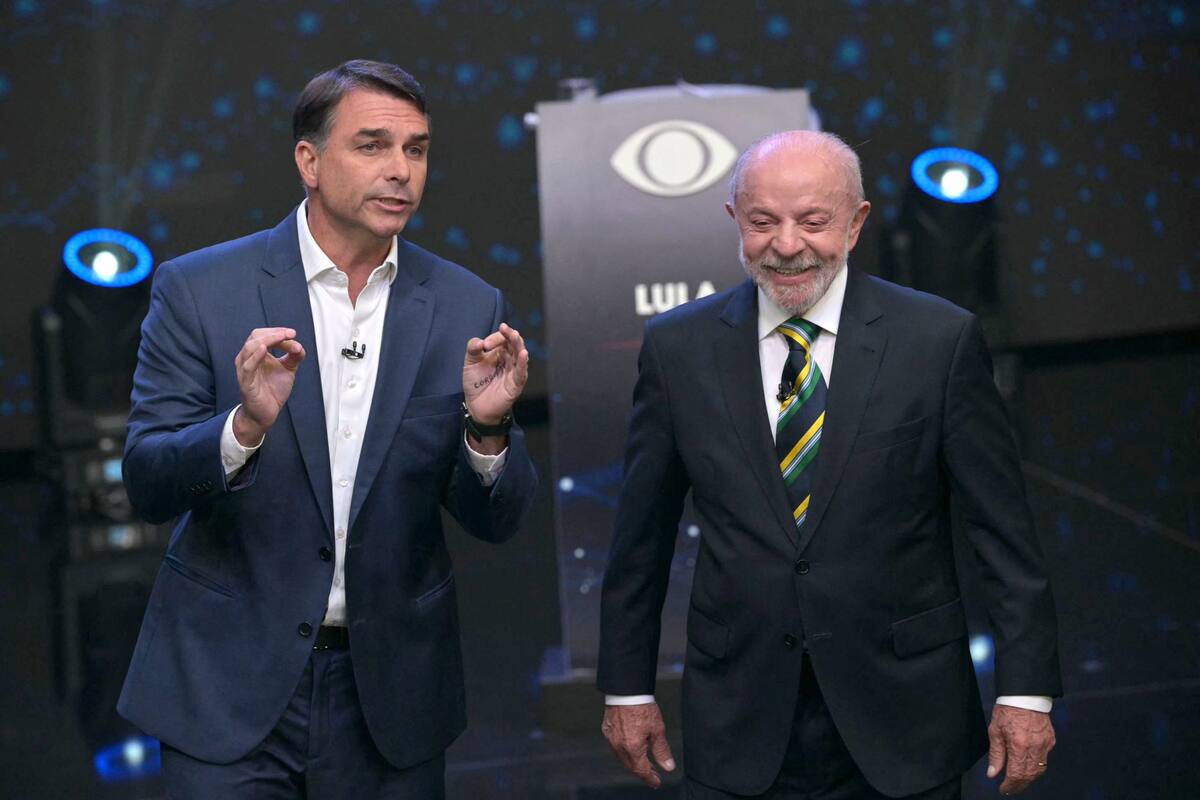
The first face-to-face debate between Luiz Inácio Lula da Silva and Flávio Bolsonaro, broadcast by the Band network on the Sunday before the Brazilian runoff, was marked by mutual accusations of corruption and by references to Argentine President Javier Milei. That is how La Nación described it in its coverage, calling the encounter an exchange of low blows with few proposals. The La Derecha Diario piece presents the same event with a different evaluative framing. Meanwhile, a statement from Argentina’s Ministry of Economy on the Fiscal Innocence regime does not mention the debate or its participants.
The clash over corruption according to the report
According to La Nación, Senator Flávio Bolsonaro of the Liberal Party confronted Lula with the accusations involving a lobbyist friend of his eldest son, Fabio Luis Lula da Silva, known as Lulinha. The report notes that the lobbyist, Roberta Luchsinger, had suggested without evidence in an interview with CNN Brasil that Lula could not have been unaware of his son’s business dealings, called him «senile» and announced she would seek a plea bargain. It adds that the Federal Police are investigating both of them for alleged influence peddling, among other things over a proposal to sell cannabidiol-based medicines to the Ministry of Health without a tender for up to 120 million dollars, which never went ahead. Lulinha’s defense denies any irregularities.
The president, again according to that report, responded that the case is in the hands of the police and that he does not protect his son «the way you were protected by your father.» He then went on the offensive and demanded explanations for the more than 130 million reais that Flávio requested from banker Daniel Vorcaro to finance Dark Horse, a film about his father. The text states that Flávio’s campaign denied he is under investigation and that hours earlier O Estado de S. Paulo revealed, and O Globo confirmed, that the Federal Police are investigating at the Supreme Court his relationship with lawyer Willer Tomaz over alleged money laundering linked to a betting house.
Milei’s place and the economic proposals
La Nación reports that Lula mocked his rival’s praise for Milei’s model. «Do you know how high poverty is in Argentina?» he asked, adding: «Are you going to choose Milei’s model? Are you going to borrow his chainsaw?» Flávio, whose economic spokeswoman, Daniella Marques, says she draws inspiration from Argentina, avoided naming the Argentine president and promised a «scissors cut» against corruption in the Workers’ Party government.
On economic matters, the senator promised to open a «budget space» of 200 billion reais without detailing how, and seized on the cost of living. Lula acknowledged that life is expensive, but said it was more expensive under Bolsonaro, defended minimum wage increases above inflation and fired back: «He never worked. For him, a worker is a thing of fiction.» On reducing the working day and ending the 6×1 schedule, Flávio first dodged and then denied he would propose changes.
Polls and the mood of the debate
La Nación‘s report notes that Quaest and Datafolha showed a technical tie the previous week, with Flávio ahead 51% to 49% of valid votes, and that on that Sunday Vox Brasil reversed the order: 51% for Lula and 49% for Flávio. The exact dates of those polls and their margins of error are not specified. The text also notes that columnists in the Brazilian press described the encounter as a «street fight» and one of the worst debates in history, and that the candidates interrupted each other and dodged questions.
The coverage by La Derecha Diario, by contrast, headlines that Flávio Bolsonaro «destroyed the dictator Lula da Silva» and mentions exchanges on security, corruption, the economy and Milei’s economic program, but provides no new verifiable data about the content of the debate. Its framing is explicitly evaluative and does not contrast the accusations with the other side’s responses.
What the sources do not say and what questions remain
The statement from Argentina’s Ministry of Economy, released in the context of a press conference by Minister Luis Caputo and Legal and Technical Secretary María Ibarzabal Murphy, announces changes to the Fiscal Innocence Bill. It details changes to the subjects who may adhere, the threshold for rebutting the presumption of accuracy, the possibility of filing an amended sworn statement and the refund of contributions. It does not mention the Brazilian debate, nor Lula, nor Flávio Bolsonaro, nor Milei in that context. Therefore, it does not allow any aspect of the encounter to be confirmed or denied.
None of the three sources provided offers the full text of the debate or an official transcript. La Nación is a secondary source recounting the event; La Derecha Diario is another secondary source with an editorial framing; the Ministry of Economy is a primary source on a different subject. Open questions remain, such as the exact content of the accusations, the procedural status of the investigations mentioned and the full text of both candidates’ economic proposals.
Value module: what each document establishes
| Document | What it establishes | What it does not establish | Open questions |
|---|---|---|---|
| La Nación, report on the debate (secondary source) | Describes cross-accusations of corruption, the clash over Milei, economic promises and polling data | It is not an official transcript and provides no judicial documents | Procedural status of the cases; full text of the proposals |
| La Derecha Diario, article on the debate (secondary source) | States that Flávio Bolsonaro «destroyed» Lula and mentions the main themes of the exchange | Provides no new verifiable data and does not contrast the accusations | Factual basis for its claims |
| Ministry of Economy, statement on Fiscal Innocence (primary source) | Announces changes to the bill: covered subjects, 5 million peso threshold, amended sworn statement and refund | Does not mention the Brazilian debate or its participants | None related to the debate; the subject is unrelated |
The official statement does not allow calculations of differences or conversions related to the debate. La Nación‘s report mentions an equivalence between 200 billion reais and about 39 billion dollars, but does not indicate the exchange rate used or the exact date; for that reason it is not reproduced as confirmed data and the figure is kept in reais.
What to keep following
The data to follow is the publication of the official minutes or transcripts of the debate and of the judicial documents in the cases mentioned, in order to verify the exact content of the accusations and the status of the investigations. It is also worth watching whether Flávio Bolsonaro’s economic proposals, in particular the 200 billion reais «budget space,» are detailed in campaign documents.
Fuentes consultadas
- LA NACION
- Argentina.gob.ar Fuente primaria
- La Derecha Diario
El Sereno contrastó las fuentes enlazadas y añadió contexto, comparación o análisis documental. Las fuentes primarias están identificadas. La nota no se presenta como investigación de campo ni como entrevista propia, salvo indicación expresa.


Comentarios