
The Argentine Rural Society (SRA) defined its leadership for the 2026-2028 period in an election that had current president Nicolás Pino as the winner, who obtained 70% of the votes. According to data released by the entity, Pino garnered 1,441 votes against 592 for his rival Marcos Pereda, in elections that saw the participation of 2,229 members.
Results by district and turnout
The officialist list Federal Presence, headed by Pino, prevailed in thirteen of the fourteen districts into which the SRA is organized. The only district where the opposition won was number 7, corresponding to Entre Ríos, whose director Juan Diego Etchevehere is part of Pereda’s list. Total turnout was 2,229 voters, a figure that represents an increase compared to previous elections, according to the official source of the SRA.
The electoral process stood out for the implementation of electronic voting, whose platform was open for 58 days, a longer period than in the previous election. This fact was mentioned in the coverage by La Derecha Diario, which also noted that the campaign was one of the most intense in the institution’s 160-year history.
The dispute over the interpretation of the statute
The central conflict of the contest revolved around the interpretation of the SRA statute, modified in 2023 to set a limit of three consecutive terms in the presidency. The opposition list Renewal with Unity, led by Pereda, argued that this rule prevented Pino from running for a fourth term, since he had assumed office in 2021 and been reelected in 2022. For his part, Pino argued that the terms should be counted from the entry into force of the reform and not retroactively.
The officialist interpretation prevailed in the elections, but the controversy was not settled. Pereda had stated during the campaign that there was a prior political commitment to guarantee alternation in the presidency once three terms were completed, as reported by La Derecha Diario. This difference in readings of the statute was one of the axes of the most bitter internal dispute in recent years, which included personal clashes between the candidates.
The relationship with the Government and export duties
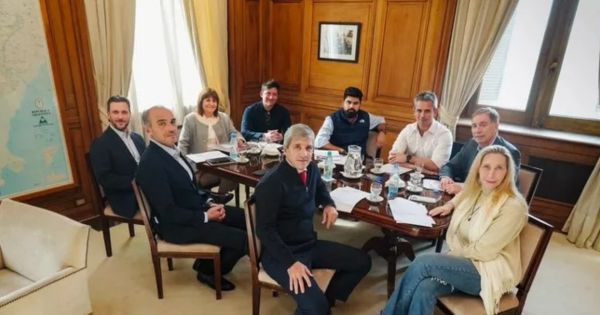
In parallel to the election, the Minister of Economy, Luis Caputo, visited the Palermo Rural Exhibition 2026, where he was received by Pino and other SRA directors. During the tour, Caputo highlighted the Government’s measures toward the countryside, such as the reduction of export duties and the elimination of tariffs for capital goods. He also stated that the official goal is to end export duties before 2031, a goal that coincides with the entity’s historical demand.
Pino, for his part, maintained a fluid relationship with Javier Milei’s administration and publicly stated that the SRA’s final objective should be to achieve «zero export duties.» In that sense, he considered that macroeconomic stabilization generated better conditions to discuss the productive future, although he insisted that the tax burden on agriculture must continue to decrease.
Management proposals and upcoming challenges
The officialist list included in its platform the relocation of the institutional headquarters, the cleanup of finances, a greater presence of the Board of Directors in the interior, and the modernization of genealogical records. It also ratified demands for improvements in infrastructure, financing for producers, and technological updating.
Carlos Odriozola, an agronomist and producer, will accompany Pino in the vice presidency. Odriozola had been serving as director of the entity and coordinator of the Meat Commission.
Comparison of data between sources
The two sources consulted present complementary information. La Derecha Diario, a digital media outlet, provides detailed electoral results and the context of the internal dispute. The Ministry of Economy, in its official statement, confirms Pino’s presence as president of the SRA and reports on the meeting with Caputo, but does not mention the election or its results. This difference is expected, since the ministry limits itself to reporting on official activity.
Regarding the figures, La Derecha Diario indicates that the SRA groups about 3,900 members and that 2,229 voted, representing a turnout of 57.1% of the electoral roll. This calculation arises from dividing 2,229 by 3,900, although it must be considered that not all members are eligible to vote, so the actual turnout could be higher. The media outlet itself does not offer that percentage, so it is our own elaboration.
The primary source of the electoral results would be the SRA itself, but it is not directly cited. La Derecha Diario acts as a secondary source by reproducing the data. The Ministry of Economy is an official source, but it does not provide data on the election.
| Data | La Derecha Diario | Ministry of Economy |
|---|---|---|
| Elected president | Nicolás Pino | Nicolás Pino (confirmed as president in office) |
| Pino’s votes | 1,441 (70%) | Not reported |
| Pereda’s votes | 592 (30%) | Not reported |
| Districts won by Pino | 13 of 14 | Not reported |
| Turnout | 2,229 voters | Not reported |
| Vice president | Carlos Odriozola | Carlos Odriozola (mentioned as director) |
Methodological note: The table compares the data available in each source. La Derecha Diario is the only one that reports on the electoral results, while the Ministry of Economy only confirms Pino’s participation in the Rural Exhibition. Cells with «Not reported» indicate that the source does not provide that data.
What to follow
The point to follow is the definition on the future of export duties. Both the Government and the SRA agree on their elimination, but they differ on the timelines: Caputo mentioned «before 2031,» while Pino speaks of «zero export duties» without a precise date. It will be relevant to observe whether Pino’s reelection strengthens his position to negotiate a faster reduction, or if the Executive maintains its schedule. Also, attention should be paid to the reaction of the internal opposition, which could challenge the interpretation of the statute in court.
Fuentes consultadas
- La Derecha Diario
- Argentina.gob.ar Fuente primaria
El Sereno contrastó las fuentes enlazadas y añadió contexto, comparación o análisis documental. Las fuentes primarias están identificadas. La nota no se presenta como investigación de campo ni como entrevista propia, salvo indicación expresa.
Comentarios