
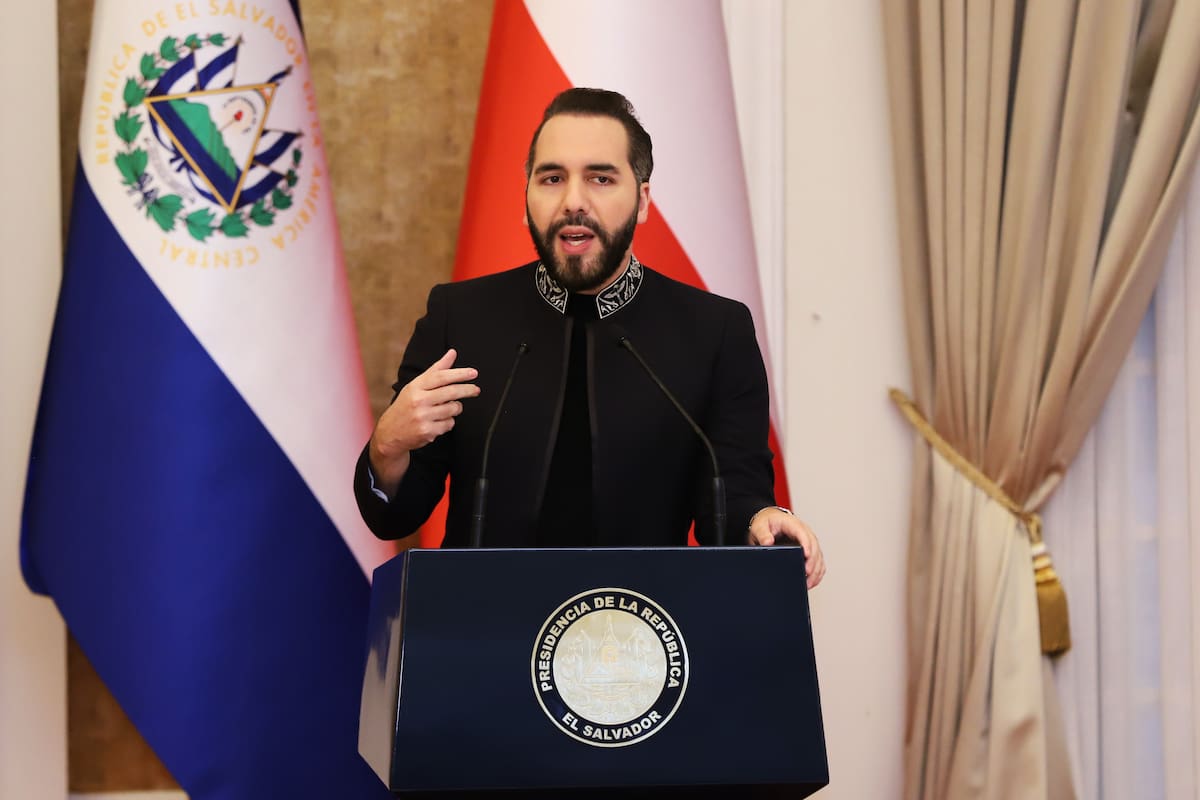
No one needs to teach Óscar Martínez what criminal gangs are in El Salvador: the businesses they run, the deaths they cause, the fear they inspire. As an investigative journalist, he covered them for ten years. That’s why he never let himself be seduced by President Nayib Bukele’s revered security policy, the “cool dictator” so admired in Latin America.
As editor-in-chief of the digital platform El Faro, Martínez went from covering gang crimes to investigating the missteps of Bukele’s government, which placed the fight against violence at the center of its discourse while, almost as an aside, building a tailor-made, one-person power structure with recurrent practices of authoritarianism and corruption.
Is the trampling of institutions and citizens’ rights the price to pay for safe streets? Is anything acceptable as long as they keep voting for him? Martínez never believed so, and in fact, he denounced it, with testimonies, videos, documents, and compelling evidence. These painstaking and risky investigations earned him exile and a forced life as a political refugee in Mexico.
“Bukele never had an ideological or national plan,” says Martínez during a visit to Buenos Aires to present his book Bukele, the Naked King, where he describes the controversial Salvadoran leader inside and out.
–Leaders with messianic speeches, like Fidel Castro in Cuba or Hugo Chávez in Venezuela, are leaders who come to fill voids. What void did Nayib Bukele come to fill?
–Bukele understood that the vast majority in El Salvador no longer cared about the left-right debate, that it no longer put food on the table. He understood a nation’s disenchantment with the symbols of ideological definition and falsely sold himself as an outsider. Because he is not an outsider; he came from the left, dressed in red, and congratulated Che on every anniversary of his death on social media. Bukele is someone who already had that power plan, and the left seemed like a viable vehicle to him. And when it no longer seemed so, he became a far-right man.
–Was the change perhaps due to the rise of the far right worldwide, because it was something in the air?
–I think Bukele never had an ideological or national plan. Bukele is a man of whims. If not, look at his economic policy: what policy? Bukele starts by saying that bitcoin will be the salvation of a country where 60% of the population has informal jobs. But when that failed, he decreed the death of the bitcoin law and accepted a $1.4 billion loan from the IMF. Same with security policy. He was a partner of the gangs for eight years, and when the gangs committed a huge massacre, the third massacre during his government, he decided to switch to a state of emergency. He keeps having whims, but he executes them with determination.
–You mentioned an initial agreement between Bukele and the gangs. What was that understanding like?
–When he entered politics in 2012 in El Salvador, the first pact with the gangs occurred, that of the FMLN government [the historic left-wing party], of which he was a part as mayor. Bukele began to understand when he entered politics very young that to defeat the gangs you had to make pacts with them. At that time, the FMLN created a logic of prison benefits in exchange for a reduction in homicides. Later, the party requested support to install the president who came before Bukele and to install Bukele as mayor of the capital. He won by only 6,000 votes. I have covered gangs for over ten years. I guarantee you that in the capital they could give you 6,000 votes and more. Much more.
–When the 2019 presidential election came, Bukele was the only one with the political capital of the gangs. So he won in a landslide election, yes. If in a gang neighborhood you arrive at the polling station, even though the vote is secret, if you see the gang leader’s cousin or the gang leader’s wife sitting at the table… do you think you’ll believe your vote is secret? People marked what they were told to mark.
–But how did he become this kind of champion of the fight against gangs, as he is now known abroad?
–At the end of March 2022, there was a weekend that ended with 87 corpses on the streets. And then Bukele decided to break the pact and establish a state of emergency, which basically means that police and soldiers have superpowers to arrest you. That due process no longer exists. And then a dynamite hunt began. For some reason, the gang members escalated violence, perhaps some agreement went wrong, and Bukele said: “Well, now that I have the power, let’s change policy.”
–You have been very critical of Bukele’s security policy, because anyone can be caught, because of the torture in prison…
–The state of emergency implies that citizens cannot know what they are accused of. But at El Faro we obtained 690 files of the initial requirements, the documents with which you are arrested at the first appearance before a judge, with which a judge approves whether you remain in prison. In dozens of documents, it only said: “Showed nervousness.” In dozens of other documents, only the ID number was written. Those who arrested them did not even make an effort to support the accusation, but Bukele already had all the judges under control and the Attorney General’s Office completely controlled. There was a lot of innocent population. The police understood that they had to fulfill Bukele’s political discourse, who said he would capture them all. And they went out to fill the prisons.
–On the other hand, you have written that the streets are calmer. Doesn’t that give a point in favor to those who defend his policy?
–To the people who want that model, I would say, OK, I understand the reasons, I covered gangs, I know what they did to society. It was terrible. So, if someone wants that model, what I would tell them is: I hope you get the good side. If you happen to be a man or woman who wants that model and there are no more gangs in your neighborhood, all good. If you happen to be on the side of being such a man or woman and they took away your innocent son, don’t complain. Because that comes in the package. If you got the bad bullet, sorry, there’s no way to free your son, due process is over. There is no Supreme Court of Justice, no Constitutional Chamber, no Attorney General’s Office to help anyone. Many have fallen like that: you got the bad side of the dictatorship. In the package comes a coin toss, to see which side it lands on.
–Look, when someone tells me that the only way to solve crime is to give all power to one man to do whatever he wants, no, I don’t buy it. That is: “Oh, there have to be a lot of innocent prisoners for there to be justice. It’s the only way.” No, that’s a lie. And we don’t have to nullify human rights. There are many countries with strong democratic institutions where crime has not been able to thrive. Bukele could have used his enormous power and enormous popularity to try to build a real democracy in the country. But he decided not to. That’s where we need to build institutions to stop the gang members.
Para mí Bukele es un facho disfrazado de moderno, un dictador ‘cool’ que persigue pobres y mata inocentes mientras los gorilas lo aplauden. El régimen de excepción es una cacería, no un plan. ¡Fuera Bukele, solidaridad con el pueblo salvadoreño! – El Che Palavecino
Para mí este periodista vendido habla pavadas, Bukele limpió El Salvador de pandilleros mientras los zurdos lloran. Ocurrente el que salvó vidas, no este exiliado que se fue a llorar a México. Viva Bukele carajo!