
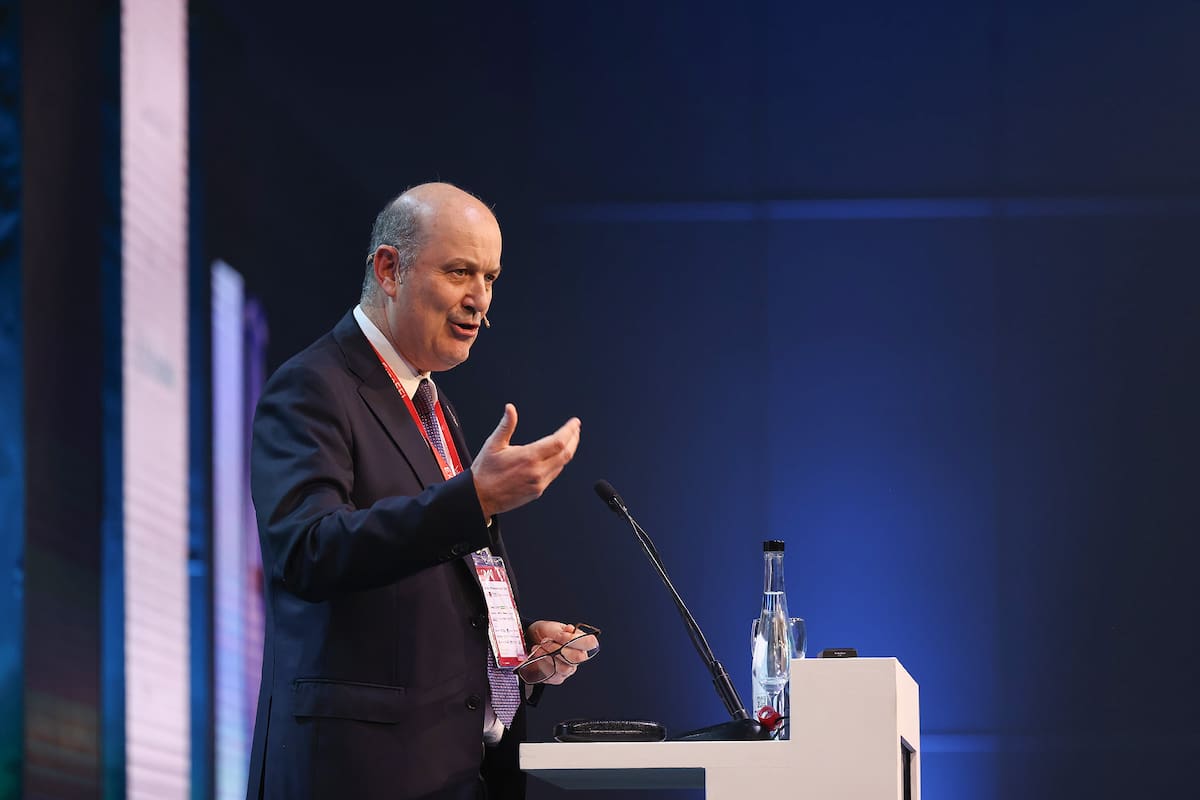
Minister Federico Sturzenegger has once again shaken the political landscape with a proposal that promises to change work in Argentina forever. It is a bill that creates so-called ‘automated societies,’ companies managed entirely by artificial intelligence, without a single employee in a dependent relationship. The initiative has already entered the Senate and, if approved, would make the country the first in the world to have such legislation.
According to the Ministry of Deregulation and State Transformation, the idea is to prepare the ground for an economy where, in ten years, a considerable portion of GDP is produced by AI agents. ‘In ten years, GDP will be made up of AI agents. If we create the legal framework for these agents to be incorporated in Argentina, we could be 50 million Argentines and 50 million AI agents producing for the whole world, but paying taxes here,’ Sturzenegger stated during ExpoEFI 2026.
The project creates two unprecedented legal figures in Argentine law: the Automated Society, a company that fulfills its purpose with algorithmic systems or AI agents without workers, and the Operational Decentralized Autonomous Society (DAO), governed by code on blockchain. The proposal has already sparked intense debate among specialists and tech world figures.
Joan Cwaik, author and expert in emerging technologies, noted that ‘when Sturzenegger says that 90% of the world’s product will be generated by AI agents, we are in a different register. That does not appear in any economic report I know of.’ Nevertheless, he acknowledged that the project places Argentina at the center of a global discussion.
From the ministry, they assured that the model they have in mind is that of Ireland, which managed to attract foreign investment with an attractive legal and tax framework. ‘We want to be the beachhead for investments in automated companies,’ they indicated. They cited the case of Apple, which moved the company that owns the iPhone software to Ireland, causing Irish GDP to grow by 26% in 2015.
One of the most controversial points of the project is the liability regime. Currently, the Civil Code establishes that in the event of damage, the owner or guardian of the thing is liable. In contrast, the new law provides that the automated society responds with its assets, which can be seized or, in extreme cases, the society dissolved. But Cwaik warns: ‘The problem is that it does not clarify how to reach a person. If the algorithm fails and only the algorithm’s assets respond, there is a link that is broken. Here the risk is ending up facing a closed box with legal personality, where the damage occurred but no one in particular is held accountable.’
Additionally, the project allows these societies to resolve their internal conflicts under foreign law or international arbitration. ‘That means part of the litigation might never go through an Argentine court. It is an architectural decision worth examining closely, because it defines who ultimately has the last word,’ Cwaik noted.
Regarding the companies that could arrive, the ministry mentioned humanoid robots for elderly care, surgical assistance, or autonomous systems that manage financial portfolios. ‘It is not far-fetched to imagine companies that provide humanoid robots to care for older adults or surgical assistance in medicine,’ they stated. They emphasized that the bet is for Argentina to provide the most favorable environment for such companies, even when they operate in other countries.
The project still needs to be discussed in committees and there is no date for its ruling. Meanwhile, the debate promises to be intense. For Sergio Pernice, physicist and director of the Artificial Intelligence Engineering program at UCEMA, ‘the proposal that Milei-Sturzenegger defended in the Financial Times placed Argentina at the center of a global discussion. Instead of arriving late to a conversation written by others, this time we opened it. That Yuval Noah Harari responded that it would be a mistake confirms the magnitude of what has been unleashed.’



Comentarios