One shoulder higher than the other, an asymmetrical waist, or a slight tilt of the trunk may seem like unimportant details. However, in some cases they are the first signs of scoliosis, an abnormal curvature of the spine that affects approximately 4% of children and adolescents. Although it usually appears during growth, it often goes unnoticed because in its early stages it does not cause pain.
During scoliosis awareness month, specialists agree that early detection is one of the main tools to prevent the curvature from progressing and requiring more complex treatments. However, numerous doubts and misconceptions about this condition still persist.
One of the most widespread ideas is that scoliosis appears due to poor posture, excessive cell phone use, or carrying a backpack on one side. But specialists assure that this is not the case. «Those habits can cause pain or poor posture, but they do not structurally deform the spine,» explains Miguel Puigdevall, head of the Scoliosis and Pediatric Orthopedics Section at the Hospital Italiano de Buenos Aires.
According to the specialist, the most common form is idiopathic scoliosis, whose exact origin is still unknown, although it is believed that multiple factors are involved, such as genetic predisposition, bone growth alterations, biomechanical factors, and neuromuscular and hormonal mechanisms.
For Andrés Ferrero, a traumatologist specializing in spinal pathology at the Hospital de Clínicas of the University of Buenos Aires, understanding this point is key because many families waste time looking for wrong causes while the deformity continues to progress.
Scoliosis usually gives few warning signs. That is why daily observation by parents, teachers, and coaches can make a big difference. Puigdevall points out that the main clues appear in the form of body asymmetries: «One shoulder higher than the other, a more prominent shoulder blade, a higher hip, or a rib that sticks out more on one side.» Ferrero adds that a misaligned pelvis, asymmetrical folds in the back, or alterations in the overall balance of the spine can also be observed.
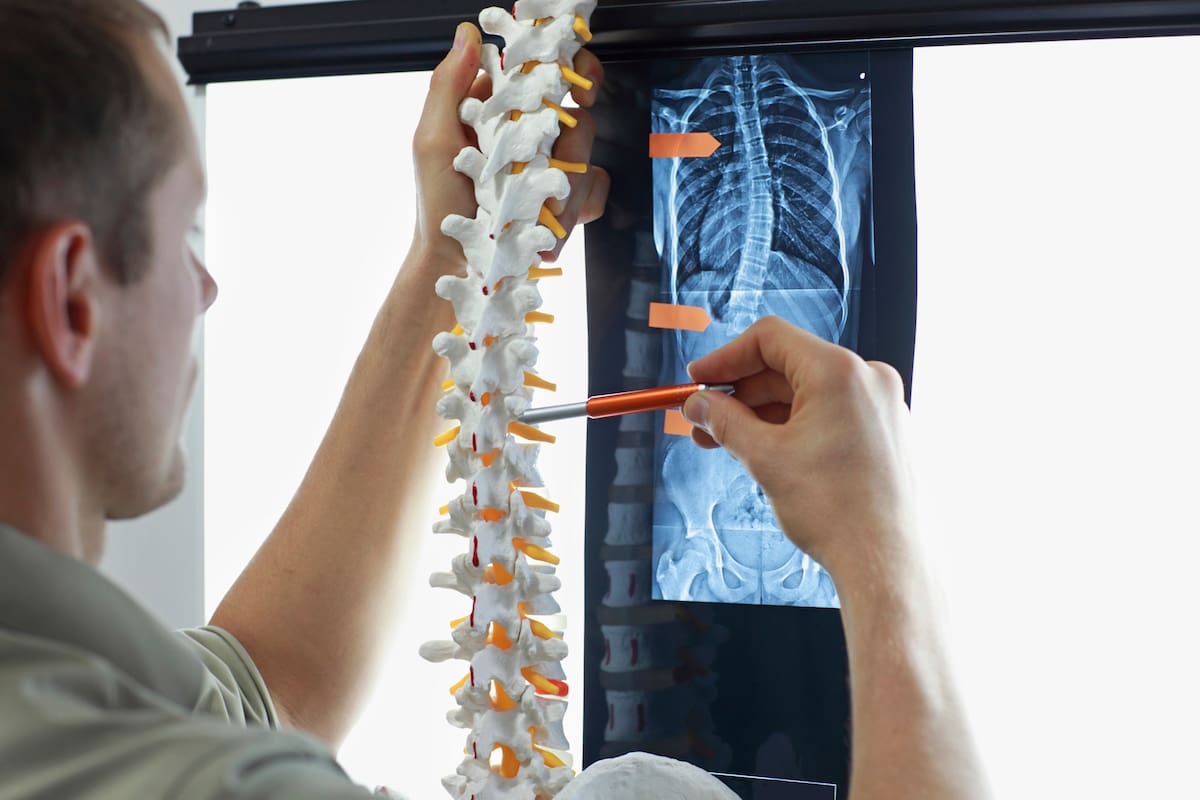
Since pain is usually not present in the early stages, specialists recommend consulting for any of these differences. The diagnosis is confirmed through a medical evaluation and imaging studies, such as a spinogram, an X-ray that allows analysis of the entire spine.
Adolescence represents a particularly important stage for scoliosis monitoring. Nicolás Massun, a traumatologist on the Spine team at the Hospital de Clínicas, explains that the disease usually manifests between ages 10 and 18, coinciding with periods of rapid growth. «In girls, the most critical period usually occurs between ages 10 and 14, while in boys it occurs between ages 12 and 16,» he details.
The reason is that curves can progress while the spine continues to grow. «A small curve can remain stable for years and during the pubertal growth spurt increase several degrees in a few months,» he notes. Therefore, when scoliosis is detected, doctors not only evaluate the degree of the curve but also how much growth the adolescent has left.
Another common myth is thinking that diagnosis inevitably leads to invasive treatments. According to Ferrero, when the curvature is mild, periodic monitoring during the growth stage is usually indicated. If the curve progresses and reaches a moderate degree, a brace may be necessary to try to stop its progression. Surgery, on the other hand, is reserved for the most severe cases.
Puigdevall agrees that treatment depends on multiple factors, such as age, remaining growth, and the magnitude of the curvature. «Many children with mild curves only require periodic check-ups to monitor their progression,» he explains. He also highlights that when diagnosis is made in early stages, the brace has a much better chance of being effective. Late diagnoses, on the other hand, usually find larger and stiffer curves, where the likelihood of needing corrective surgery increases.
Most mild scoliosis does not cause major long-term problems. However, some curves can progress and affect quality of life in adulthood. Massun describes that more advanced cases can be associated with chronic lower back or mid-back pain, muscle fatigue, trunk imbalances, and early wear of discs and joints. In severe situations, respiratory alterations may also appear due to deformation of the rib cage.
«It is important to convey that having scoliosis does not necessarily mean suffering serious problems in the future,» he clarifies. «But proper monitoring during childhood and adolescence allows us to identify which patients are at risk of progression and which are not.»
Scoliosis not only affects the spine. It can also influence self-esteem and body image perception, especially during adolescence. Massun says that many patients experience shame, insecurity, or anxiety about medical check-ups and treatments. When a brace is indicated, these emotions can intensify. «I always tell parents that the goal is not only to correct a curve, but to care for a person who is going through a very sensitive stage of their physical and emotional development,» he states.
In parallel, specialists emphasize the importance of maintaining an active life. Ferrero stresses that physical activity promotes healthy development, improves muscle strength and flexibility, and helps prevent postural problems and overweight. «Sport is a fundamental tool for the healthy growth and development of children and adolescents,» he maintains. And although exercise alone does not correct the structural curvature of the spine, Puigdevall clarifies that most children with scoliosis can practice sports normally and benefit both physically and emotionally from staying active.


che pero si los pibes se sentaran derechitos como dios manda no habria escoliosis los zurdos kirchos nos quieren enfermar con esa mentira del 4% es puro verso enderecen el pais no las columnas firmado @VamosArgentina
para mi esto es lo q pasa cuando ajustician la salud publica los pibes con escoliosis sin diagnosticar x culpa del sistema mientras los ricos se operan en el swiss los del conurbano se quedan torcidos de por vida una verguenza firma el loco de la esquina