
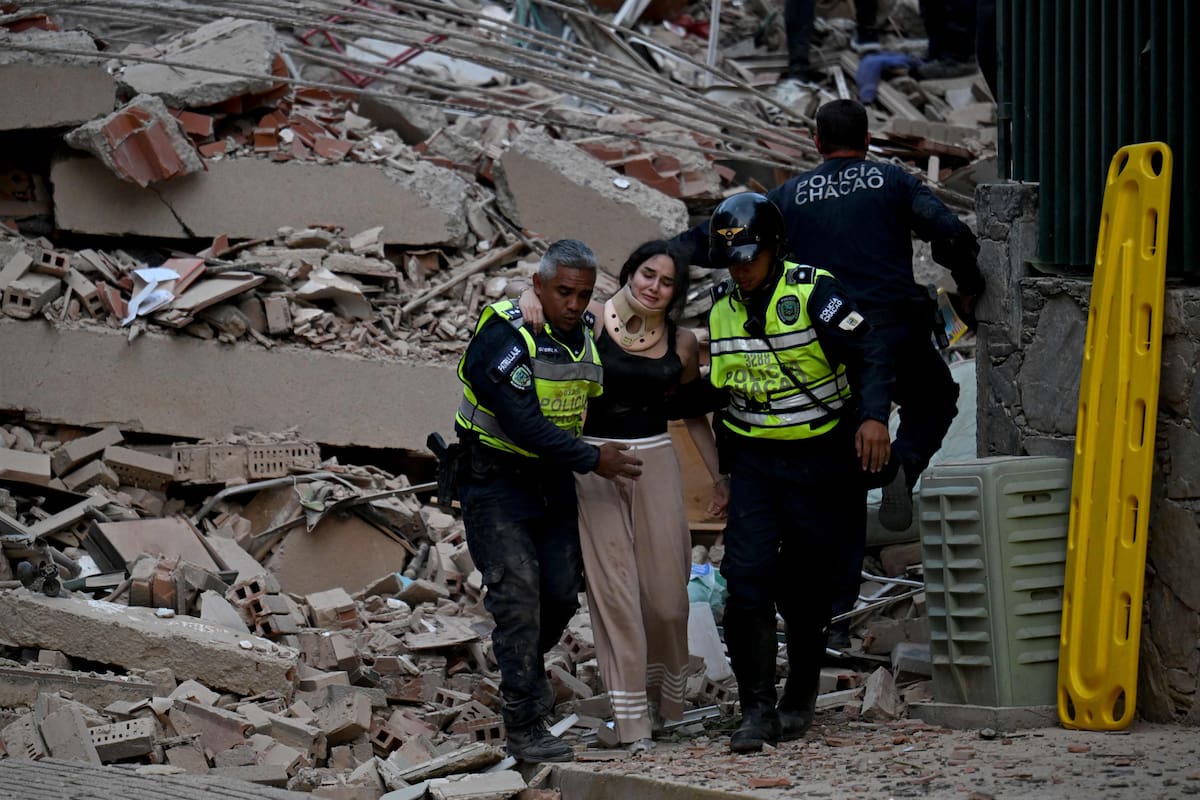
The two earthquakes that shook Venezuela within seconds left the world in shock. A first quake of magnitude 7.2 was followed, barely a minute later, by an even more powerful one of 7.5. For geologist and professor at the University of Buenos Aires (UBA), Andrés Folguera, it was a phenomenon known to science, although with especially devastating consequences.
In an interview, the specialist explained that both seismic movements occurred on the Oca fault, located in northern Venezuela, and argued that the second earthquake finished destroying structures that had already been compromised by the first. «Between a 7.2 and a 7.5 earthquake there is approximately ten times the energy difference. The 7.2 damaged infrastructure and the 7.5 finished bringing it down. It is a terrible academic and scientific coincidence,» he stated.
Folguera recalled that the magnitude scale is exponential, not linear: «One degree more represents about 33 times more energy.» According to the geologist, both earthquakes originated on the Oca fault, an active geological structure that crosses northern Venezuela parallel to the Caribbean Sea. «Every hundred years it produces an earthquake of this magnitude. It happened in 1812, again in 1900, and now it happened again in 2026,» he explained.
The specialist detailed that for decades tectonic plates remain locked while accumulating tension. «For a hundred years they are stuck, and one day that deformation is suddenly released. That is what happened. Last night it unlocked,» he summarized. Unlike what happens in Chile, where one tectonic plate sinks beneath another, in Venezuela the mechanism is different: the plates move laterally, rubbing against each other until the accumulated energy exceeds the rock’s resistance and is released abruptly.
Folguera clarified that although research exists to try to predict earthquakes, science still does not have a reliable method to anticipate exactly when one will occur. «The location where it may occur is known with great precision because they are very well-known and studied fault segments, but the exact moment cannot yet be predicted,» he noted. However, he stated that the historical precedent of the fault allowed knowing that Venezuela was already within a high-probability window for another large-magnitude earthquake.
Another factor that aggravated the tragedy was the shallow depth of the seismic movement. Folguera explained that the earthquake occurred at barely 10 kilometers depth, a characteristic that notably increases surface damage. «This fault produces very shallow earthquakes. That makes them particularly destructive,» he indicated. He also noted that cities built on soft or sedimentary soils suffer much more intense vibrations than those on solid rock.
For the specialist, the emergency is far from over. He explained that every large-magnitude earthquake generates a sequence of aftershocks that can last for hours or even several days. «There will be earthquakes of magnitude 6, 5, or 4. Even if they are smaller, they affect infrastructure that is already damaged and can cause new building collapses,» he warned. He also alerted that the greatest immediate risk no longer depends solely on the earthquake, but on the subsequent humanitarian situation. He compared the Venezuelan scenario to recent tragedies such as those in Haiti and Turkey, where precarious infrastructure and difficulties in responding to the emergency multiplied the number of fatalities. «The great humanitarian crisis is happening now,» the geologist concluded.



para mi los terremotos son castigo de dios x el chavismo pero estos geologos de la uba siempre quieren hacer politica la falla de oca es culpa de maduro y su mugre socialista los zurdos llorando replicas q se vayan todos al carajo firmado @VenezuelaLibre2024
uh loco para mi la culpable de los terremotos en vzla es la derecha lacaya que privatizo los estudios sismicos el geologo de la uba la tiene clarisima pero seguro macri recorto plata pa la ciencia falla de oca? sigan temblando che esto huele a cipayos