
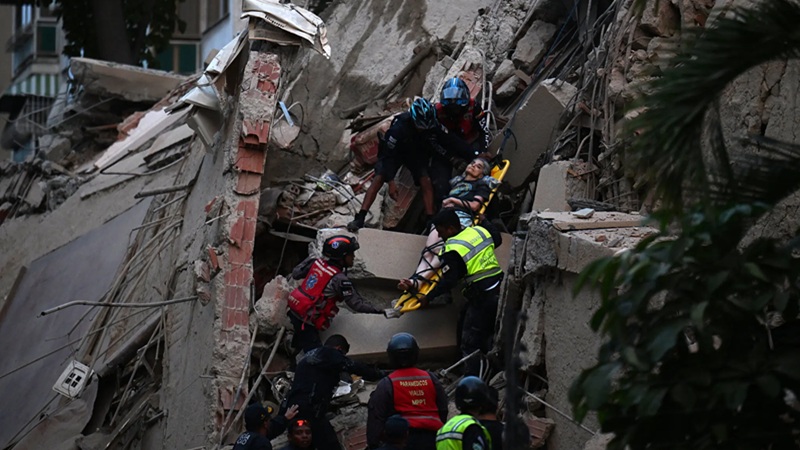
Two powerful earthquakes of magnitude 7.2 and 7.5 shook Venezuela on the afternoon of Wednesday, June 24, causing severe damage in Caracas and La Guaira, as well as affecting, collapsing, and interrupting services in Miranda, Aragua, Carabobo, and Falcón, with additional reports in Yaracuy and Trujillo. While rescue efforts continue, the magnitude of the emergency is still being assessed.
Vice President Delcy Rodríguez called for national unity and declared a state of emergency, but the tragedy highlights a structural reality: the impacts of the disaster are concentrated in the popular sectors, where urban decay, the crisis of services, and the precariousness of living conditions have been accumulating for years. The problem is not just the magnitude of the earthquake, but the conditions under which it strikes.
Preliminary reports indicate dozens of fatalities, hundreds of injured, and multiple collapsed buildings. In this scenario, the question is not only the immediate response, but who will pay for reconstruction and under what conditions. For working families, who already faced insufficient wages, collapsed services, and difficulties accessing safe housing, the catastrophe deepens a pre-existing precariousness.
The state of emergency enables the extraordinary mobilization of public resources and the intervention of civil and military agencies in rescue, evacuation, and aid distribution tasks. But this centralization of the response opens a deeper political dispute: who controls the resources, who defines the priorities, and what interests order the reconstruction.
The growing participation of the armed forces in managing the social crisis also reflects a process of militarization of civilian functions that has been occurring for years in Venezuela, where tasks such as aid distribution or territorial organization of the emergency are increasingly consolidated under military control. Far from being a technical matter, it is a form of crisis management that displaces social, community, and organized workers’ organizations.
Images from Caracas show collapsed buildings, severe structural damage, interruptions of basic services, and thousands of people forced to leave their homes due to the risk of new aftershocks. Meanwhile, in areas such as San Bernardino, Los Palos Grandes, Altamira, and other sectors of the capital, significant damage is reported, while neighbors and rescue teams participate in evacuation, relief, and containment tasks due to insufficient immediate responses.
First and foremost, we express full solidarity with the affected working families, with those searching for their loved ones, and with those participating in rescue efforts. In times like these, mutual aid, community organization, and solidarity from below are essential so that no one faces the consequences of the tragedy alone.
Although earthquakes are natural phenomena, social catastrophes are not. The earthquake strikes a country where, according to ENCOVI 2025, 68.5% of households live in poverty and nearly one-third in extreme poverty. More than half of the population faces multidimensional poverty associated not only with income but also with deficiencies in housing, employment, health, education, and basic services.
In Venezuela, millions of working families survive on insufficient incomes, deteriorated public services, and enormous difficulties in accessing safe housing. ENCOVI itself notes that a minority of households have a continuous water supply and that serious infrastructure failures persist. Under these conditions, a natural emergency does not affect the entire population equally: those already living in precariousness face greater risks, less capacity for evacuation, and more obstacles to rebuilding their lives.
The greatest damage is concentrated where urban decay, lack of maintenance, insufficient public services, and lack of investment in safe infrastructure have accumulated over the years.
The tragedy once again raises a fundamental question: how can thousands of families protect themselves when they survive on incomes insufficient to cover basic needs? How to face an emergency when homes are unsafe and public services have been eroded for years?
For millions of workers and popular sectors, a natural disaster quickly turns into a social crisis. Vulnerability does not arise with the earthquake; the earthquake simply makes it visible.
The Venezuelan government has announced the activation of emergency measures, the mobilization of civil protection agencies, and the receipt of international aid. Various governments and organizations have expressed their willingness to collaborate in rescue and humanitarian assistance efforts, while medical teams and emergency brigades begin to move to the most affected areas.
The magnitude of the tragedy makes it essential to coordinate all available state resources for rescue, medical care, temporary shelter, and assistance to the affected population, under control and with the active participation of workers, communities, and popular organizations. However, as important as mobilizing aid is ensuring that it reaches effectively and as a priority to affected working families, collapsed hospitals, and popular communities that concentrate the highest levels of damage.
In a country marked by years of economic crisis and the impact of the blockade and sanctions imposed by the United States, the capacity to respond to emergencies of this magnitude is severely constrained. Therefore, the discussion about rescue and subsequent reconstruction cannot be separated from existing material restrictions, nor from the need for resources allocated to the emergency to be directed to the urgent social needs of the working population.
However, the magnitude of the situation demands immediate and transparent responses. All information about victims, missing persons, structural damage, and resources allocated to the emergency must be public and accessible. It is also essential to guarantee housing, food, medical care, and economic support for affected families.
The emergency cannot become an opportunity for speculation or to shift the costs of reconstruction onto those already bearing the crisis. Nor can it be ignored that humanitarian aid, within the framework of the US blockade and sanctions, is part of broader political disputes where assistance can operate as an instrument of pressure and conditionality, rather than as a neutral mechanism of solidarity.



pa mi este terremoto es un aviso dios los castiga x robar tanto maduro y su bandita de comunistas no sirven ni pa limpiarse el culo los pobres siempre pagan los platos rotos mientras ellos se llenan los bolsillos q asco de pais y de gobierno
para mi la burguesia festeja mientras el pueblo se desangra terremoto? no, capitalismo en su maxima expresion el gobierno de mierda solo se preocupa por la deuda externa y los pueblos originarios en la calle viva la lucha de clases carajo firme el che del conurbano