
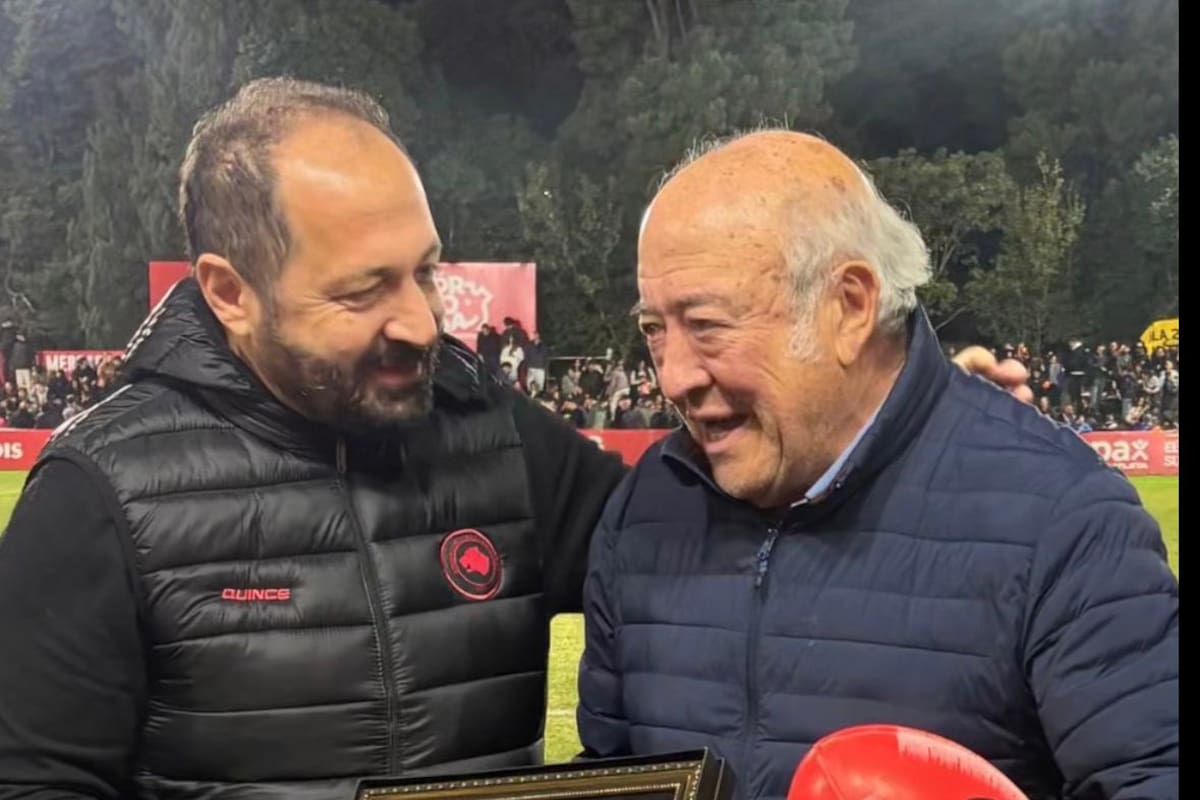
CÓRDOBA. – 61 years after being a key participant in the foundational milestone of Argentine rugby, 6,500 kilometers away, from his residence in Miami, Raúl Loyola pauses before answering. «If we are talking so long after a rugby match, it must have been important what we did.» It is not hard to notice that, on the other end of the phone, an emotion emerges that time and geographical distance only amplify.
Loyola was one of the Pumas who took part in the 1965 tour of South Africa, which, thanks to the victory over the Junior Springboks, became the seed of a tree that bore much fruit. He is aware of some of them, such as the baptism of the national team as «Pumas» or the genesis of the famed claw. But he does not fully grasp another equally significant one: the unification of all Argentine rugby. Until then reserved almost exclusively for players from Buenos Aires clubs, Loyola became the first Cordoban to represent the Argentine national team in this sport. Along with Rosario natives José Luis Imhoff, Juan Coco Benzi, and Eduardo Gringo España, they were the only representatives from the interior among the 26 heroes of that epic.
«It seems unbelievable. 60 years ago we went to South Africa and people are still talking about it,» he reflects from his apartment in Key Biscayne. «At that time it was all joy. Our goal was to give our all on the field in every match, every training session, and to uphold the reputation of Argentine rugby. I never imagined it would be so transcendent.»
Invited by friends, he started playing at age 14 at Universitario de Córdoba and scored a try in his first match. «Rugby is very sticky: you get into it and you’re stuck forever,» he says. «The clubs in Argentina are extraordinary, everyone puts their heart into it; there’s nothing like it anywhere else in the world.»
He played as a flanker (or wing-forward, as it was called then). «He was strong, reliable, and unbreakable,» Horacio Pichot described him in his book Los Titulares. He debuted for the provincial team at 18 and reached the final of the Argentine Championship in 1963, where they lost 9-3 to Buenos Aires at the Córdoba Athletic field. There he caught the attention of national selectors and debuted for the Pumas (though they were not yet called that) in the 1964 South American Championship.
«I wasn’t aware of the sacrifice, but to train with the national team I traveled every weekend by bus, or sometimes by train all night,» he recalls lucidly, at his young 84 years. «When you’re that age you don’t realize it. I trained in Buenos Aires, spent the night at the Belgrano Athletic dorms, and the next day returned to Córdoba. I was very disciplined; I trained on my own in Córdoba. Today rugby is no longer so lax; they are professionals. From our era, the only things similar to today are the field, the posts, and the ball. And the spirit, of course.»
–That is fundamental. It is the famous claw of the Pumas, and that remains intact. Fortunately, we have been able to transmit those kinds of things. It was all forged during the 1965 tour of South Africa. That fighting spirit, concentration, and friendship that is still seen in the team comes from there.
–That particular group, moreover, is characterized by having remained united over time, right? –Yes, we just had a meeting recently in Argentina. I travel especially every year. Those gatherings have never stopped. Unfortunately, although the spirit is the same, many have already passed away. But they are still present in some way. We meet at the house of Gato [Ricardo] Handley in Talar de Pacheco. I try to go every year. From that tour, I kept the friendship of 27 guys who gave everything and at the same time had a spectacular time for two months playing rugby, discovering a different world, and aware that we had to give our all to win. Today it’s the same as before: every time we get together, the same thing happens. We have constant contact via chat; friendship and affection exceed any limits.
–It wasn’t common to call players from the interior. Was there a big difference with Buenos Aires rugby? —In Córdoba at that time there were several high-quality players. I remember Jorge Ricciardello, who later played for Pueyrredón, the Quetglas brothers at the «Uni.» I was lucky that they looked at me and selected me, but there could have been more. 90% played for Buenos Aires. Rugby from the interior has a very special place. Even in our time, Tucumán was very important; they had great self-esteem and it was a headache to play against them. They were already poised to compete on equal footing with Buenos Aires. Córdoba and Rosario were also growing a lot.
–Everyone remembers Pascual’s try in that match against Junior Springboks, but you also scored one. How was it? —There was a scrum for South Africa near their own in-goal. The scrum-half passes it out, I break away from the formation, charge him, then he passes it to the fly-half. I follow the run and he drops the oval ball, I tackle him, pick up the ball, run 20 meters to touch it down under the posts.
–(He thinks.) If we are talking so long after a rugby match, it must have been important what we did. Rugby gained a lot of momentum, although we didn’t realize it at the time. We played against Wales, Scotland, Ireland. The matches against the Europeans were very tough, very different from what we were used to in clubs. They weren’t professionals, but they had different dispensations. The one I remember most is the match against Wales [in 1968]; they were a fantastic team, top-level in Europe, and we played them on equal terms: we won one and drew the other.
– In ’66 I moved to Buenos Aires. I returned and played for Belgrano Athletic because I had become very good friends with several players from the squad, some from being Pumas teammates and others from meeting them when I stayed over on weekends. I have very fond memories of that time, all great guys. I played until ’71. I had an extraordinary time. I got married in ’72 and in ’77 we came here.
–I’ve lived in Miami for many years. I arrived in ’77. An Argentine company hired me to develop a business in plastic laminates. After the Martínez de Hoz era, things went badly for them; they wanted to cancel everything and I looked for another field. I got into aluminum, supplying raw materials to large construction companies. It went well, I can’t complain. When we arrived we rented an apartment, then we bought it and I’ve been here for 37 years. My two daughters were born in Argentina and were little when we came here; they gave me two grandchildren who were born here; I have my whole family settled. But I always miss Argentina. Before it was more complicated due to communications, but today I follow everything closely thanks to newspapers and television. It’s almost as if I live there.


Para mí este Loyola es un capo, 61 años y sigue firme. Los pibes de hoy no tienen esa garra, se la pasan con ideología de género y boludeces. El rugby argentino se va al carajo si no vuelven a los valores de antes. ¡Vamos los Pumas, carajo!
che q grande el viejo raul pero para mi estos pibes de ahora son unos blanditos ni a palos tienen la mugre del 61 la uar es una manga de vendidos q se arrodillan ante los europeos esto huele a traicion no como esta leyenda vamos los pumas carajo