
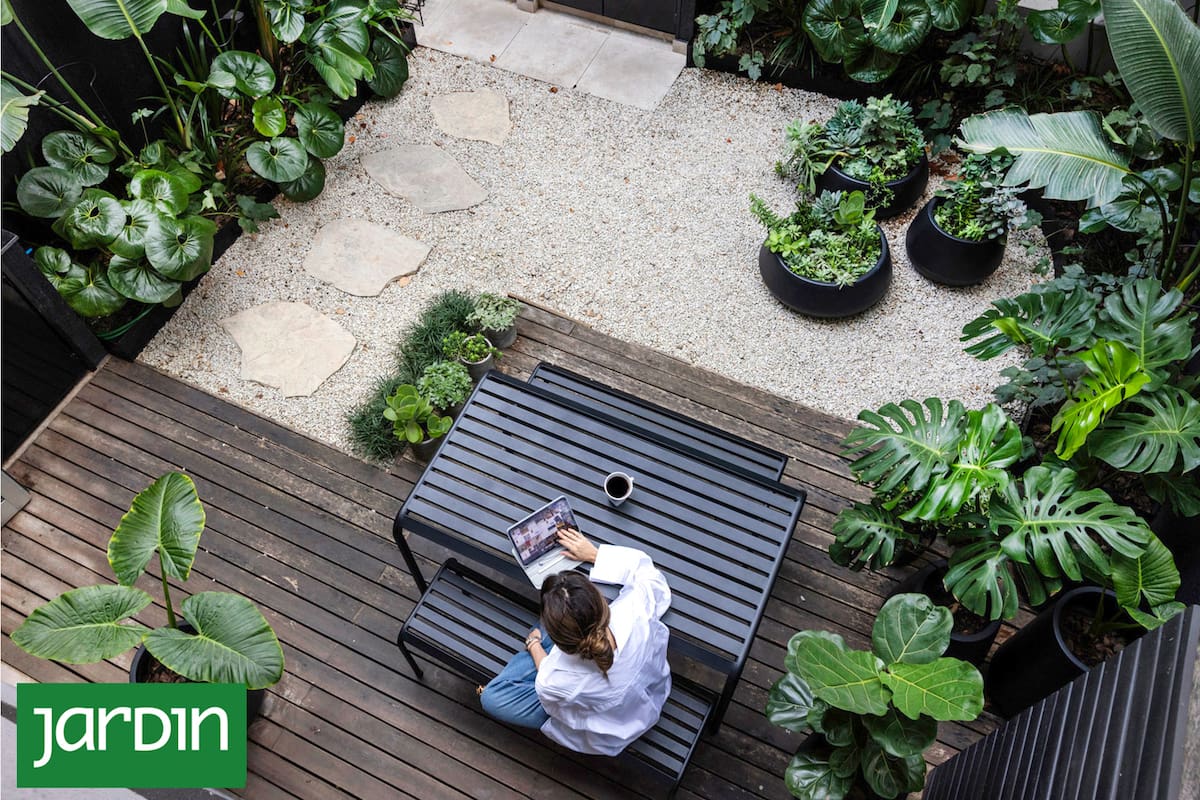
“I want lots of green, I want a jungle.” That was the request from Guadalupe Manero when she decided to transform the patio of her apartment. At first, there was nothing more than a dark space with aqua green walls; a flat and lackluster place. No more than 40 m², the patio had grass deteriorated by lack of light, some stones, and little visual depth. What followed was a collaborative design process that turned it into a functional, attractive, and meaningful space.
With a need to combine the contact with nature that had marked her childhood with a routine dictated by work and travel, Guadalupe began contributing to the project of landscape designer Agustina Busto from her passion for decoration. With that premise as simple as ambitious, both -landscape designer and client- collaborated very closely to transform the space. In Agustina’s words: “I think a nice synergy was created.”
However, achieving that result involved overcoming several challenges. The main constraint in the renovation was the ground level: the patio was built on the building’s garage slabs. To raise it, planters were implemented. But, since rains are not scarce in Buenos Aires, water drainage became a new problem to consider. With this in mind, Agustina made a trench from the planters to the drain with large-grain gravel. To prevent them from sinking into the ground, she used a geotextile fabric and, on top, about 3 cm of smaller stones, called bínder Mar del Plata. With black edges that give it a modern and timeless look, the planter became a structure capable of housing different species, heights, and textures. To simplify maintenance, she decided to keep some of the existing stones and incorporate a drip irrigation system. In this way, the space expanded its appeal without sacrificing practicality.
Considering the dark conditions of the place, the landscape designer worked with a “deliberately restrained palette,” based mainly on greens and whites. The large leaves of the Strelitzia nicolai provide a coarse texture to contrast with the medium height and rounded leaves of the boina de vasco. Its yellow flowers bring a luminous counterpoint that, as Agustina says: “bring the joy of the missing sun.” Among the filler plants, Japanese anemones appear, especially striking during their flowering, and neomaricas cándidas, also called walking iris, a native plant that contributes to the diversity of forms.
The designer emphasizes the importance of the space having “visual and seasonal interest throughout the year,” especially in small gardens, where every centimeter counts. In her words, “the different heights and textures were like different layers of vegetation where I could achieve contrasts and variations in scale.”
In addition to the plants, another resource the garden designer used to create depth was a path of light flagstones. Although it is only four steps, she considers it was fundamental to organize the space and direct the gaze toward the back. “A path demands a journey, it adds and separates the space into environments.” In this way, the patio ceases to be perceived as a single space and acquires new layers and routes.
Throughout the patio, from the leaves of the strelitzias to the flagstones on the floor, Agustina challenges the idea that in small spaces everything must be of reduced scale. Far from resorting to tiny elements, she opted for pieces with a strong presence destined for the collection of succulents from Salta that Guadalupe inherited from her family. “Many small objects in a small space make it much noisier; large pots give more order and harmony.”
Thus, knowing the emotional and practical needs of the client, Agustina Busto transformed a small and underutilized space into a visual that is enjoyed as a journey and, at the same time, from inside the house. The patio restored for Guadalupe a connection with nature that she associated with her childhood and showed how a small space can change if the needs of those who inhabit it are taken into account.



Para mí esto es un asco, un patio oscuro es un cagadero, no una jungla urbana. Me parece que romantizan la miseria, parece una villa con yuyos. Yo creo que llamen a un paisajista de verdad, no a un hippie que no sabe lo que hace. ¡Basta de joder con plantas y más orden, carajo!
para mí es una cachetada que festejen este patio de cheto cuando en la villa no tenemos ni un pedacito de tierra. esto huele a clasismo, se creen dueños de la naturaleza mientras los pibes se crían entre el asfalto. viva la lucha de clases, firmado el zurdo de la villa.