
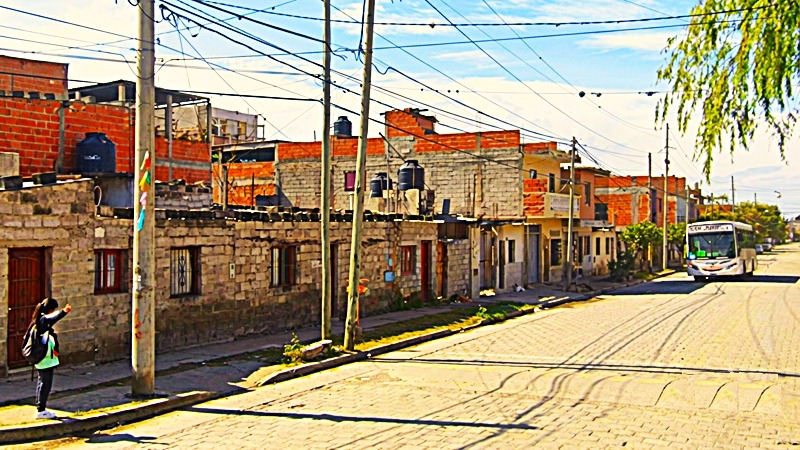
The adjustment policy and punitiveness of Milei seek to discipline a youth to whom the system only offers exclusion. Against fragmentation and discard, the urgency of building a political way out from below. Chronicle of a young worker from the Punta Diamante neighborhood.
Punta Diamante and El Chingo are two working-class neighborhoods separated from downtown San Salvador de Jujuy by the defenses of the Río Grande. There, the promises of the patronal politicians have always been smoke. If you go downtown wearing sportswear, a cap and hoodie, being black and from the neighborhood, you are exposed to discrimination. They can call you black shit or slum dweller shit, people who consider themselves decent. On the pedestrian street, waiters are pressured by their bosses to kick you out, lest customers feel uncomfortable.
That discrimination is not natural: it has a purpose. It seeks to justify inequality and exclusion, and divide us from above. They want those with more stable jobs to see us as competition, with fear or prejudice; that the black person accepts hard jobs, almost without rights and for little money; that they cannot access formal employment. That benefits the bosses: if you don’t accept the conditions imposed on you, there will always be twenty others willing to take that job, even for less. That’s what discrimination is for: to make inequalities accepted and for the political response to be prison or repression.
In El Chingo and Punta Diamante, life is hard. It’s not new; I remember that in 2005 there were no parks, gardens or schools capable of containing us. What was always present was the police. We called them cana, button, eggplant, carrot, or abuser chick, because they abused their power. According to official figures, in Jujuy poverty exceeded 52%. Many of us went downtown to see what was left over in restaurants, sell on the street or work as car watchers and collect some cash. Hunger was pressing, while at home our parents were unemployed or worked all day for pennies.
The cops’ response was harassment and abuse: they took you to the station, mistreated you, beat you until they got tired and forced you to undress to humiliate you. Women were also violated. There were rapes inside police stations, but everything always remained locked in there. Twenty years passed, governors and mayors, and the promises were always the same: urbanize the neighborhood, defeat poverty. Lies. Gerardo Morales and Natalia Sarapura even promised that Punta Diamante would grow, but reality did not change. The patronal politicians filled their mouths during the campaign, lied to the neighbors and then disappeared. Meanwhile, many presidents of neighborhood councils, instead of organizing the neighborhood to fight against this situation, ended up as point men for those same politicians: putting out the anger with a bread for today and resignation for tomorrow, while seeking their own accommodation.
The traditional parties, like the UCR and the PJ, never wanted to change anything fundamental. It suits them that we remain as discard of this system, because that misery benefits those at the top: the big bosses they answer to and from which they also benefit. Now Milei’s far-right government sells you as the great solution against crime the lowering of the age of criminal responsibility. But those of us who live in the neighborhood know that this is more of the same. They want to lock up a 13-year-old kid who was born in a house where there is no food because they don’t guarantee the right to work, education, health, and now they even take away the glass of milk and soup kitchens.
It’s easy to say it’s the parents’ fault. But what does a father do who has to work 14 hours off the books to buy the basics? Or a mother who has no daycare to leave her kids? Children grow up on the street because the system closes the school door on them. The story of El Chingo and Punta Diamante is not only one of blows, it is also one of resistance and struggle. In 2017, the company EJESA wanted to bring in machines to charge us rate hikes we couldn’t pay; the neighbors organized in assembly and stood at the entrance of Punta Diamante and they had to leave. The same happened in 2020, during the pandemic, they wanted to install a crematorium next to the Xibi Xibi river, in the middle of our neighborhood, as if it were a dump. Again, we closed the entrance and fought for a whole month, faced the police and repression. They had to back down and leave. Those fights are an example that when the neighborhood rises up and fights, it can win.
Today, in this 2026, the street speaks. The fairs of Alto Comedero, Medalla Milagrosa or Copacabana are bursting. It’s not entrepreneurship, it’s pure survival. There are more and more kids selling chocolates or making music on buses because genuine work continues to recede, and more than ever under Milei’s adjustment plan and the governors. The lowering of the age of criminal responsibility voted in Congress will not change anything in terms of security. What it will do is turn prisons into warehouses for minors, while the big drug traffickers and the police who free up the areas continue drinking coffee downtown. Milei tells you: if you steal to eat, you go to prison; if you are a banker and steal a generation’s future, you are a market hero.
The challenge of finding a way out: organizing the new working class. The comparison is clear: in 2005 they beat you for stealing a sandwich; in 2026 they want to imprison you for being young, poor and unemployed. Don’t fall for the story. The solution will not come from above, from the same ones who have been screwing us since 2001. The only thing left for us is unity and organization of workers, from below, of those teachers, nurses and professionals, who day by day put their bodies on the line to sustain public education and health, despite defunding and poverty wages; those who run transportation, services and industries, unite with those precarious and off-the-books workers, those who live off odd jobs and daily hustles, and who live in those neighborhoods that are the discard of the government and the system. We are a new working class, which the capitalist regime constantly seeks to divide, fragment, make us fight among ourselves, so that if someone has a little more, they look down on those who are worse off. The way out comes from uniting what they want to divide. That is the unity that hurts them: that the neighborhood stops being the backyard and becomes part of a single force that fights for genuine work, for the distribution of working hours and for a public works plan that truly urbanizes our neighborhoods.



che dejen de llorar milei tiene razon los pibes chorros tienen que saber q si la hacen la pagan el punitivismo no es trampa es justicia dejen de defender delincuentes y trabajen vagos de mierda firmado el gaucho de la 9
para mi milei es un facho de mierda quiere bajar la imputabilidad pa encerrar pibes pobres mientras los ricos chorean en punta diamante sabemos q la unica salida es organizarse no el garrote basta de hambre y exclusion la culpa la tiene el capitalismo abajo el gobierno genocida firmado el chino de la villa