
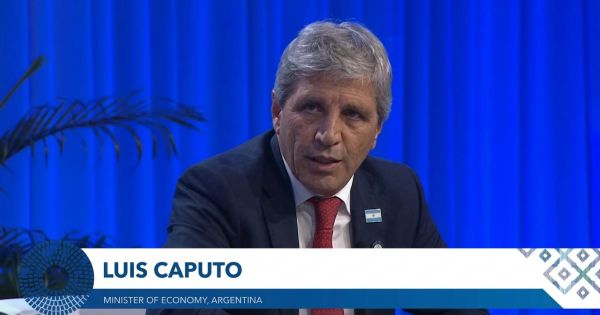
Economy Minister Luis Caputo spoke on the panel «Debate on the global economy: Forging resilient and dynamic economies for the future,» held in Thailand during the Annual Meetings of the International Monetary Fund (IMF) and the World Bank. According to Crónica, Caputo stated that «people will never vote to return to a past of near hyperinflation and multiple exchange rates.» He also argued that «Argentina will be one of the best-performing economies in the coming years» and that «the biggest risk is not investing» in the country.
Caputo’s statements on management and investments
During his presentation, the head of the Treasury reviewed indicators of his management. He said that since Javier Milei took office, «5 points of fiscal deficit were eliminated in the first month of the mandate, without raising taxes and cutting public spending by 30%.» Regarding the RIGI, he mentioned: «we are talking about $200 billion to be deployed in the coming years.» He also recalled that Argentina «suffered 22 crises in its history, defaulted 9 times and removed 13 zeros from its currency.»
The minister linked these figures to the need to generate predictability and confidence. He argued that the Government «fixed the inherited disaster without breaking contracts» and that companies «are rewarding us with a vote of confidence by investing large sums of money in the real economy.» On fiscal matters, he stated that the «myth that fiscal balance was politically unpopular» was challenged and that inflation was lowered and poverty reduced «with a trade surplus and current account surplus.»
Argentina’s projected payments to the IMF
Independently, the IMF publishes an official TSV download with Argentina’s projected payments to the organization, updated as of June 30, 2026. That document, a primary source, details maturities in Special Drawing Rights (SDRs) for the years 2026, 2027, 2028, 2029 and 2030. The annual totals listed are: 2,082,529,842 SDRs for 2026; 5,650,460,371 SDRs for 2027; 7,004,829,747 SDRs for 2028; 7,792,755,072 SDRs for 2029. For 2030, the list continues with items that do not close with an explicit annual total in the portion provided.
The detail includes concepts such as GRA Basic Charges, GRA Level Based Surcharge, GRA Time Based Surcharge, Net SDR Charges and GRA Repurchase (EFF). The largest amounts correspond to Extended Fund Facility (EFF) repurchases, with maturities that in several cases reach 583,333,333 SDRs. The information is expressed in SDRs, the IMF’s unit of account, and does not include conversion to dollars or pesos.
Contrast between sources: scope and limits
The two sources provided address different dimensions of the same topic. Crónica, a secondary source, reports Caputo’s statements on an IMF panel. The IMF, a primary source, publishes a table of Argentina’s projected payments to the organization. There is no direct contradiction between the two, but neither is there cross-confirmation: the minister’s statements on investments, deficit, spending or inflation are not verified with the IMF document, which only contains projected financial obligations.
The thematic coincidence is the Argentina-IMF link in the same period. The central difference is one of nature: one source records political discourse; the other, payment commitments. The main limitation is that the TSV offers no context on payment capacity, reserves or effective compliance. Nor does it allow assessing whether the investment projections mentioned by Caputo materialized.
Data to monitor
The data to follow is the effective execution of the maturities listed in the IMF TSV, especially the annual totals for 2027, 2028 and 2029, which exceed 5,600, 7,000 and 7,700 million SDRs respectively. It is also worth following the evolution of the RIGI, given that the figure of $200 billion mentioned by Caputo corresponds to an official projection without public disaggregation in the material provided. The next update of the TSV and the IMF reports on Argentina will allow contrasting whether the schedule remains or is modified.
Value module: comparison of magnitudes
| Concept | Source | Unit | Value |
|---|---|---|---|
| Total projected payments 2026 | IMF, TSV as of 06/30/2026 | SDR | 2,082,529,842 |
| Total projected payments 2027 | IMF, TSV as of 06/30/2026 | SDR | 5,650,460,371 |
| Total projected payments 2028 | IMF, TSV as of 06/30/2026 | SDR | 7,004,829,747 |
| Total projected payments 2029 | IMF, TSV as of 06/30/2026 | SDR | 7,792,755,072 |
| RIGI investments mentioned | Crónica, Caputo’s statement | USD | 200 billion |
| Fiscal deficit eliminated | Crónica, Caputo’s statement | percentage points of GDP | 5 |
| Reduction in public spending | Crónica, Caputo’s statement | percentage | 30% |
Methodological note: The annual totals in SDRs come from the official IMF TSV updated as of June 30, 2026. They are not converted to dollars or pesos because the material does not include an exchange rate or conversion factor with an exact date. The RIGI, deficit and spending figures correspond to statements by Caputo reported by Crónica and do not have independent verification in the sources provided. No additional differences or percentages are calculated to avoid unsupported inferences.
Fuentes consultadas
- Crónica
- Fondo Monetario Internacional Fuente primaria
El Sereno contrastó las fuentes enlazadas y añadió contexto, comparación o análisis documental. Las fuentes primarias están identificadas. La nota no se presenta como investigación de campo ni como entrevista propia, salvo indicación expresa.
Comentarios