Argentina’s Supreme Court dealt a new blow to Javier Milei’s government by upholding the injunction that forces the Executive Branch to comply with two key articles of the University Funding Law. The decision came Thursday as it rejected the extraordinary appeal filed by the ruling party against the ruling of the Federal Administrative Litigation Chamber, which had validated the payment as a precautionary measure.
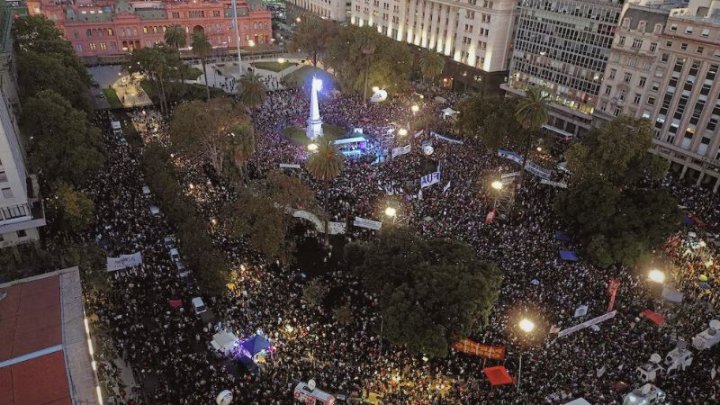
The ruling comes just two weeks after rectors and most university federations signed an agreement with the government for a much smaller increase than stipulated by law. The Supreme Court’s decision ratifies the injunction, and now the court must rule on the constitutionality of the decree that withholds funds from universities. Meanwhile, the struggle of university workers and students continues, with new measures and a possible non-start of the second semester.
Thus, Thursday’s ruling forces the government to comply with Articles 5 and 6 of the funding law, which mandate paying salary adjustments from 2023 to date, equivalent to a 55% recomposition for losses against inflation over the same period, and increasing Progresar Scholarships. The salary agreement signed just 15 days ago by the national government, university authorities, and teaching and non-teaching federations (except Conadu Histórica, which rejected it by a vote of its members) granted a smaller salary recomposition of 21% and another 3% in October, and only increases in Manuel Belgrano Scholarships, not Progresar.
This agreement sparked enormous outrage among the rank and file and rejection by broad sectors, who believe it was a concession to the government to try to close the conflict, jeopardizing the demand for effective implementation of the law, won through struggle and on the streets. The Supreme Court’s ruling vindicates thousands of teachers, non-teaching staff, and students who opposed the infamous agreement by university authorities and union leadership, which is far below what the law stipulates.
With today’s resolution, the «merits of the case» in the judicial dispute remains to be resolved—that is, whether the decree suspending the execution of the university funding law is constitutional or not. But this will not be decided by the Supreme Court, as what reached that instance was only the reconsideration appeal filed by the Government and rejected. The substantive issue is being discussed in a first-instance court by Martín Cormick, which, according to major media outlets, is close to a decision.
The Supreme Court’s argument for rejecting the extraordinary appeal against the injunction is that it is not directed against a final or equivalent ruling. Therefore, the rejection of the Government’s appeal leaves the previous ruling in force, meaning the injunction must be complied with and the new law’s mandates paid. The technical aspects of judicial proceedings keep the entire university community in suspense, which for two and a half years has been battling with its own methods to get the Executive, Legislative, and Judicial branches to defend the right to public and free education, and to send sufficient funds to guarantee it. This is the lowest funding level in the last 20 years, expelling dozens of workers and students every day.
The strategy of union leadership and university authorities to first channel this struggle to Congress and then to the courts has proven limited in providing a response commensurate with the attack. Even these leaders signed the agreement with the government «in the name of the Law» precisely to deactivate the grassroots fight to ensure compliance. It is symptomatic that between May 15, three days after a massive university march, when the Supreme Court received the file on University Funding, and June 25, when it finally rejected the Government’s appeal, two things happened: on June 4, the Senate voted on the appointment of Rosatti’s son as a judge, in a scandalous session where Peronism voted for 72 of the 74 judges requested by Milei; and just six days later, on June 10, radical and Peronist rectors, along with mostly aligned union leadership, signed the surrender agreement with the government.
That is why grassroots sectors, students, teachers, and anti-bureaucratic non-teaching staff reject the agreement and continue organizing to demand adequate salaries, funding for education, research, science, scholarships, infrastructure, and to bring down Milei and the IMF’s austerity measures, aimed at ensuring debt payments and handing over resources to imperialist capital.


Para mí la Corte siempre metiendo la cola donde no la llaman. Milei tiene razón, no podemos regalarle la guita a esos vagos universitarios que ni laburan. Esto huele a curro de los zurdos. ¡Aguante el ajuste, lacras! Viva la libertad carajo.
Para mí esto es un golpe al gorila de Milei, la Corte le dijo ‘ni en pedo’ y le frenó el veto. Me parece que los libertarios lloran porque no pueden cagar a los pibes. Viva la lucha universitaria, carajo, la educación es de los pibes, no de los empresarios.