
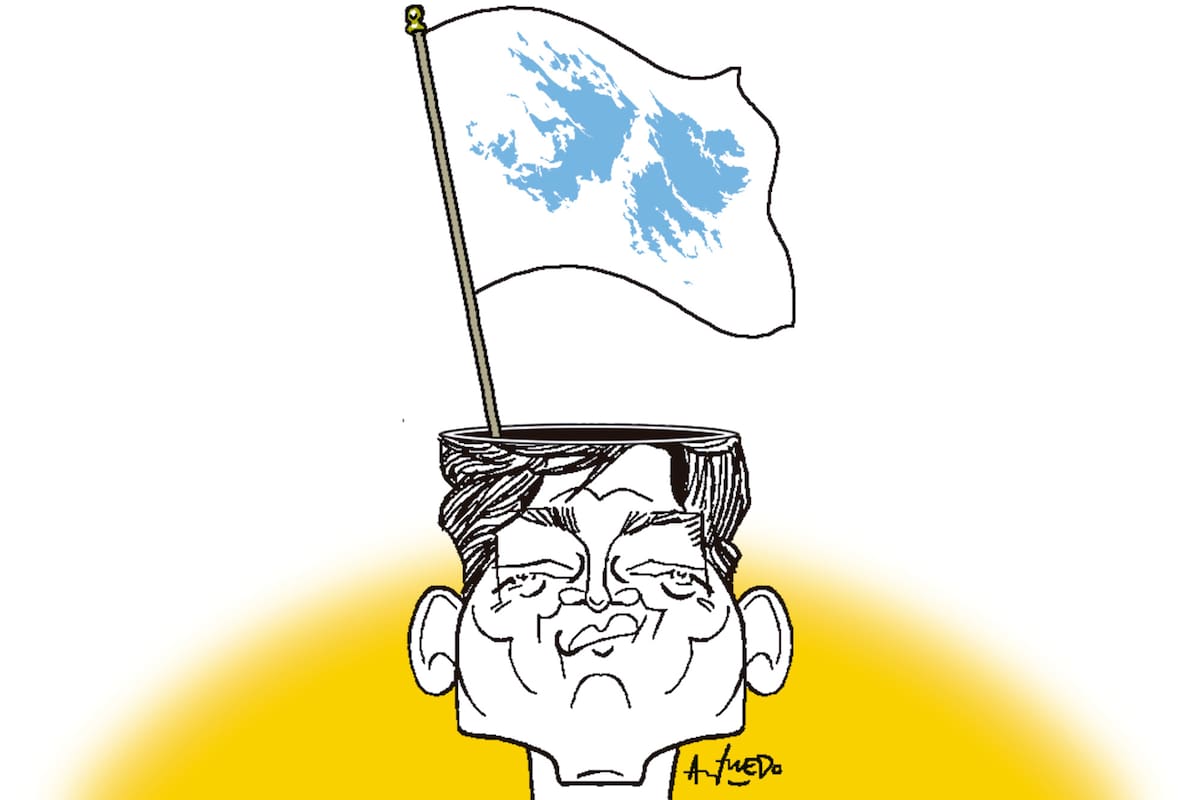
The Malvinas question appears in two documents of a different nature that do not validate each other. The Foreign Ministry issued a statement about a formal protest to the United Kingdom over the actions of a military vessel. La Nación published an analysis article that attributes to Santiago Caputo the initiative to champion the cause and describes political and economic ramifications. The official statement does not mention Caputo, Donald Trump or a «Malvinas Law»; the newspaper article does not mention the July 13 protest or HMS Medway. There is no factual overlap between the two.
The formal protest: what the Foreign Ministry statement says
On the instructions of Foreign Minister Quirno, according to the statement, a formal note of protest was submitted to the Embassy of the United Kingdom on July 13. The text rejects the movements of the vessel HMS Medway, described as «illegally deployed in the Malvinas Islands,» and maintains that they were not notified in accordance with the bilateral agreements and declarations in force. The Foreign Ministry states that those movements involved transit through the Argentine Territorial Sea.
The document invokes the Joint Declaration of September 25, 1991, which replaces Annexes I, II, III and IV of the Madrid Joint Declaration of February 15, 1990, in its section I.2 on confidence-building measures, point «b,» according to the wording of the Buenos Aires and London Joint Declaration of July 12, 1993. It also cites United Nations General Assembly Resolution 31/49, which urges both parties to refrain from adopting decisions that introduce unilateral modifications in the situation of the islands while the sovereignty dispute remains pending.
The Foreign Ministry describes the British action as a «military incursion» into spaces under Argentine jurisdiction and frames it within a «sustained policy of unilateral acts.» It reaffirms the «legitimate and imprescriptible rights of sovereignty» over the Malvinas, South Georgia and South Sandwich Islands and the surrounding maritime spaces. The statement does not detail the British response or the exact content of the note delivered.
The La Nación article: attributions and hypothetical language
The piece entitled «The unexpected entanglements of the Malvinas cause» maintains that Donald Trump put the claim of Argentine sovereignty over the islands back on the agenda. It attributes to Santiago Caputo, adviser to Javier Milei, having seen an opportunity to turn the ruling party into the dominant actor in the national debate, challenge Peronism in its «historical nationalist propensity» and obtain advantages in internal disputes over power and budget. It mentions the creation of a National Security Council and new resources for areas under his control, such as Defense and Intelligence.
According to the article, the «grand production» presents drawbacks: economic uncertainty, tension with the administration of José Antonio Kast in Chile, internal rivalry with the sector led by Karina Milei, concern over «authoritarian impulses» and «seeds of conflict» with countries to which the economic team turns in search of financing. These are assertions of the article, presented as analysis and not as facts confirmed by the official source.
La Nación relates that the passage of the «Malvinas Law» required treatment of maximum urgency due to «sudden dangers» that the Government was unaware of before August 31, the date on which Trump would have hinted that he could review his country’s neutrality to support Argentina. It adds that the libertarians in the Chamber of Deputies decided to postpone consideration and suggests that the postponement could be due to a message from the United States to review the first part of the bill. That text contemplated administrative and criminal sanctions for those who extracted oil from the sea surrounding the islands. It mentions the Sea Lion venture, with the companies Navitas (Israeli) and Rockhopper (British), and warns that the sanctions would reach suppliers, marketers, insurers and banks.
The article cites an experience at the Foreign Ministry with the Dutch supplier Bluewater Energy Services, builder of buoys for a pipeline from Vaca Muerta, and a version about a short circuit between Caputo and Barry Bennet over unpaid fees. It mentions a check for 20 billion dollars attributed to Scott Bessent to «save» Luis Caputo’s plan in 2025 and suggests that some Democratic legislator could raise questions about alleged profits from Argentine bonds. All of these are assertions of the article, formulated with speculative language («would have,» «apparently,» «version circulating»), without confirmation in the official source.
Contrast: coincidences, differences and limits
The two sources agree that the Malvinas question is on the public agenda, but they differ in focus and in the status of the information. The Foreign Ministry limits itself to a specific diplomatic protest over a specific event: the unnotified movements of HMS Medway. It does not mention Santiago Caputo, nor Trump, nor the «Malvinas Law,» nor Sea Lion, nor the political tensions described by La Nación. The newspaper article, in turn, does not mention the July 13 protest or HMS Medway.
The official source is primary and verifiable as to the existence of the note and its regulatory foundations. The La Nación piece is a secondary source of political analysis, whose assertions about intentions, internal disputes and supposed messages from the United States are not supported by the Foreign Ministry statement. The article uses hypothetical language and attributions to versions, which prevents treating them as confirmed facts.
The main limit is that no source allows confirming the causal relationship between the diplomatic protest and the political «entanglements» described. Nor can the existence or content of the «Malvinas Law» or its postponement be verified, nor the figures mentioned (20 billion dollars), nor the companies involved in Sea Lion, except for what the article states. No exchange rate, source or date is available for a currency conversion, so the figure remains in dollars.
What each document establishes and what questions remain open
| Document | What it establishes | What it does not establish | Open questions |
|---|---|---|---|
| Foreign Ministry statement (July 13) | Formal protest to the United Kingdom over unnotified movements of HMS Medway; invokes the 1991 Joint Declaration and UN Resolution 31/49; reaffirms sovereignty rights. | Does not mention Caputo, Trump, the «Malvinas Law,» Sea Lion or internal political tensions. Does not detail the British response. | What was the United Kingdom’s response? What was the scope of the note? Were there other diplomatic actions? |
| La Nación article | Describes a Caputo strategy to reposition the Malvinas cause; mentions tensions with Chile, the United States and the Karina Milei sector; relates the postponement of the «Malvinas Law» and the planned sanctions; alludes to Sea Lion and a supposed dispute over fees. | Does not provide official documents or confirmation of the versions it cites. Does not mention the July 13 protest or HMS Medway. | Does a bill called the «Malvinas Law» exist? What is its exact text? Was the postponement confirmed? What did the companies mentioned say? Were there official messages from the United States? |
The detail to follow: the British response and the fate of the bill
The Foreign Ministry statement leaves open the expectation regarding the United Kingdom’s reaction to the formal protest. That is a verifiable detail worth following: whether there will be an official response, whether consultations will be convened or whether the notification mechanisms provided for in the 1991 Joint Declaration will be modified. In parallel, the La Nación article raises questions about the legislative treatment of the so-called «Malvinas Law» and about the consequences of the sanctions planned for foreign companies. None of those points is confirmed by the official source. The political decision to postpone or modify the bill, as well as the scope of the conversations with the United States, are matters that require additional documentation to be verified.
Fuentes consultadas
- LA NACION
- Cancillería Argentina Fuente primaria
El Sereno contrastó las fuentes enlazadas y añadió contexto, comparación o análisis documental. Las fuentes primarias están identificadas. La nota no se presenta como investigación de campo ni como entrevista propia, salvo indicación expresa.

Comentarios