
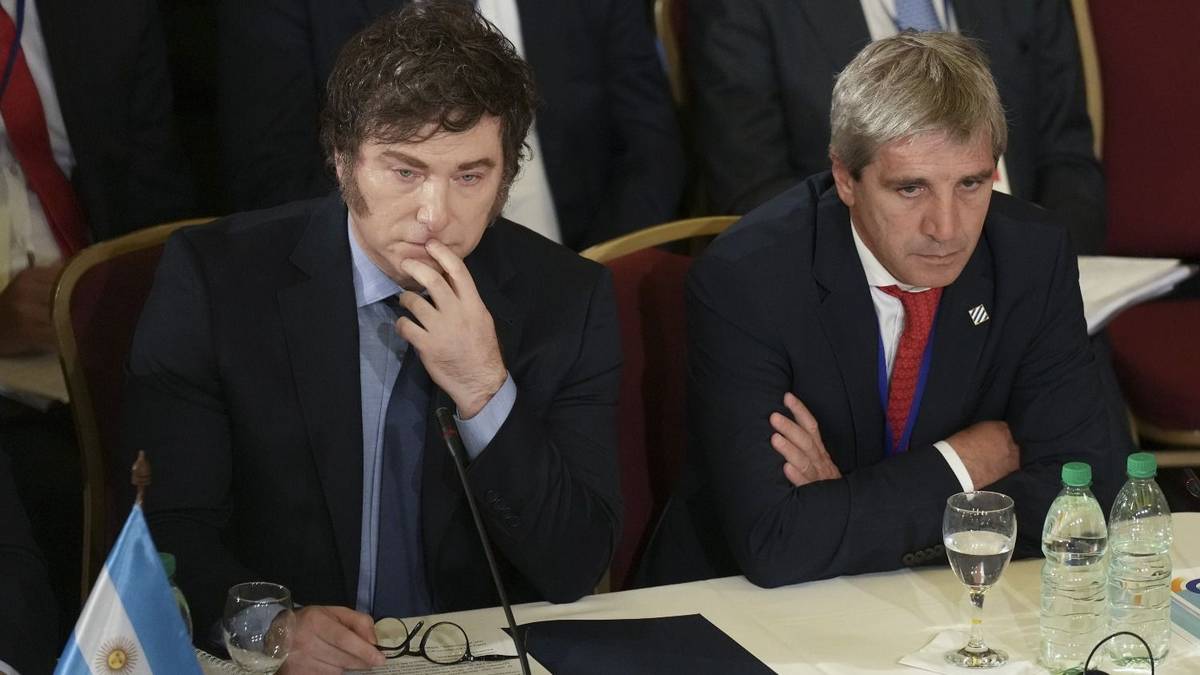
The national Government confirmed that it is working on a reform project for the Charter of the Central Bank of the Argentine Republic (BCRA). The initiative, which has not yet been sent to Congress, seeks to prohibit in a categorical manner the financing of the Treasury and to classify as a crime the issuance to cover the fiscal deficit. However, the text raises questions about its possible retroactive application and about the operations carried out by the Javier Milei administration itself.
What the reform proposes and at what stage it is
According to the Presidency of the Nation, President Milei led a Cabinet meeting at Casa Rosada after the events for Independence Day, where he provided details about the reform project of the BCRA Charter. The official statement indicates that the draft is being prepared and that the formal announcement will be made in the coming weeks. Once completed, it will be sent to Congress for consideration.
The official source does not specify the specific content of the project, but the note from El Destape details that the reform incorporates a chapter into the Penal Code called «Crimes affecting fiscal and monetary stability,» which punishes with prison the use of tricks or issuance to finance the Treasury. In addition, it restricts the distribution of accounting results to the Treasury and eliminates mechanisms of indirect assistance.
Operations of the current management that could be covered
The El Destape article maintains that, had the new regulation been applied retroactively, the transfers of BCRA profits to the Treasury made between 2024 and 2026 could fit into the crimes that the reform seeks to punish. According to that source, the accumulated amount would reach US$ 24.2 billion, equivalent to $36.4 trillion pesos.
The outlet details that in 2025 alone, the BCRA transferred $11.7 trillion for the previous fiscal year, which represented 40% of the monetary base at that time. Those funds were used to sustain the exchange rate scheme and cancel financial commitments.
El Destape cites studies from the Center for Argentine Political Economy (CEPA) indicating that the transfers did not arise from real profits, but from an accounting revaluation of the Non-transferable Letters. The mechanism would have had four stages: the modification of the valuation of the Letters in May 2024, the indebtedness with the IMF in April 2025, the repurchase of Letters with a 40% discount in May 2026, and a projection of new differentials for 2027.
Who is affected and since when
The reform, if approved, will impact the functioning of the BCRA and the relations between the Executive and the monetary authority. The immediate effects would be felt in the prohibition of future profit transfers to the Treasury, which would limit the Government’s financing tools. However, its retroactive application is uncertain, since the project does not establish that character.
The initiative also affects officials who could be penalized for issuing money to cover the deficit. In that sense, President Milei himself and the Minister of Economy, Luis Caputo, came under scrutiny for their previous decisions, according to El Destape.
The outlet recalls that on October 5, 2025, Milei admitted in a television interview that he had instructed the economic team to dismantle the Fiscal Liquidity Letters (LEFI) scheme. «I summoned the entire economic team to Olivos (…) We have to clean the Central Bank’s liabilities,» he declared, which shows interference in the decisions of the board.
Concrete consequences of the reform
- Immediate: If approved, the BCRA will not be able to transfer profits to the Treasury, which will force the Government to seek other sources of financing.
- Conditioned: The classification of crimes could reach officials who have participated in issuance operations, but only if the law has retroactive effect, something that is not confirmed.
- Uncertain: The impact on the relationship with the IMF and on exchange rate stability will depend on how the norm is implemented and the reaction of the markets.
Value module: comparison of transferred amounts
To measure the weight of profit transfers, the amounts reported by El Destape are compared with the monetary base of 2025.
- Document: El Destape article of July 26, 2026.
- Organization and date: BCRA, fiscal year 2025.
- Unit: Argentine pesos.
- Values used: Transfer of $11.7 trillion; estimated monetary base of $29.25 trillion (indirect data: 40% of the base).
- Operation: $11.7 trillion / 0.40 = $29.25 trillion (implicit monetary base).
This relationship shows that the transfers represented a significant portion of the system’s liquidity, which explains the concern about their fiscal impact.
What to keep an eye on
The key data to monitor is the final text of the draft that the Executive will send to Congress. There it will be known whether the prohibition of Treasury financing includes transitional clauses or if some exception mechanism is established. It is also relevant to observe whether the project contemplates the situation of operations already carried out, since that will define the criminal scope for current officials.
Fuentes consultadas
- El Destape
- Argentina.gob.ar Fuente primaria
El Sereno contrastó las fuentes enlazadas y añadió contexto, comparación o análisis documental. Las fuentes primarias están identificadas. La nota no se presenta como investigación de campo ni como entrevista propia, salvo indicación expresa.



Comentarios