
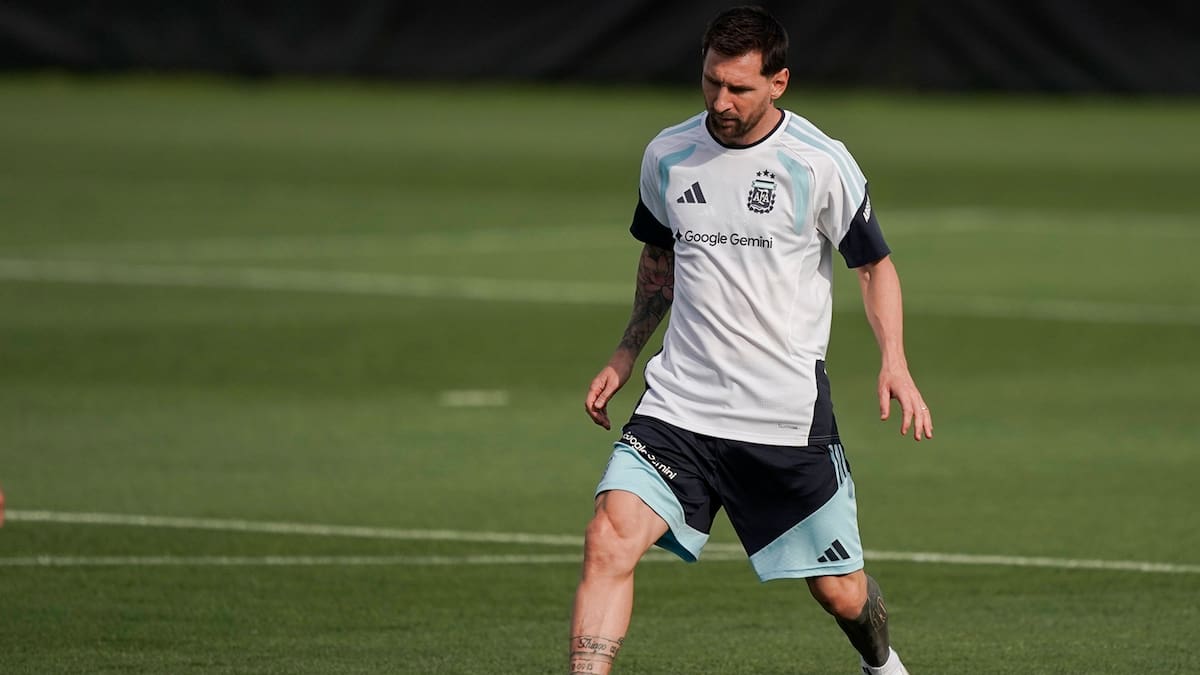
The story, from our side, has its variations but is more or less known. Upon learning that in the quarterfinals Argentina would have to wear the alternate jersey again against England, Carlos Salvador Bilardo decided that, under no circumstances, would they put on the blue ones they had already worn against Uruguay in the round of 16 days earlier—they were a few grams heavier than the light blue and white version. That’s when Rubén Moschella, an AFA employee and the great hero in that mess, appeared. After touring countless stores in the Mexican capital, he brought some models to the training camp for Bilardo to make the final decision. “What a beautiful jersey; with this one we are going to beat England,” said Diego Maradona upon seeing the iconic uniform with which he became world champion at the Azteca Stadium. And there was no more discussion. The rest is history.
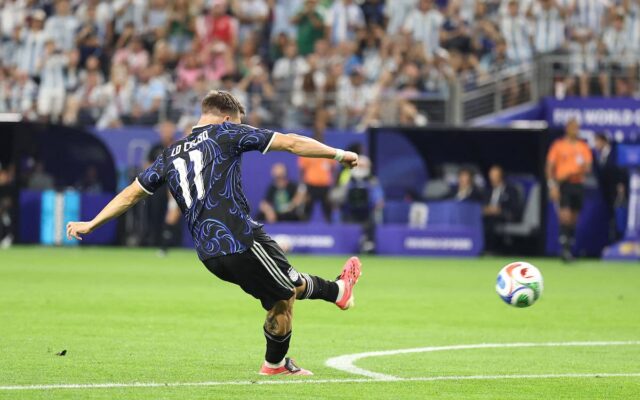
The scene repeats every time Rodrigo De Paul appears on the main field of the Compass Minerals complex, the national team’s bunker in Kansas City. Inseparable sidekick of Lionel Messi, and even more so amid the delicate family moment the captain is going through, the midfielder usually moves close to him. So when he steps away from the group for a few minutes and walks alone toward the press area, he inevitably draws attention. Eyes follow him, cameras focus on him. He has something hard to explain. A presence that imposes itself even when he is still. A special aura, as the younger ones would say. And that also translates to the pitch.
The Versailles appeals court confirmed this Friday that footballer Achraf Hakimi will be tried by a criminal court following a rape complaint filed in 2023. French justice determined that there are sufficient charges to proceed with the oral process, in which Kylian Mbappé could testify. The judicial ruling upheld the decision made in February by an investigating judge. The defender for Paris Saint-Germain (PSG) and the Morocco national team appealed that measure, but the court dismissed the appeal hours before the player played the second World Cup match against Scotland.
FIFA officially appointed Egyptian referee Amin Mohamed to officiate the match between Argentina and Austria, corresponding to Group J of the 2026 World Cup. The match will be played on June 22 at Dallas Stadium, and the main referee will be accompanied by Mahmoud Abouelregal and Ahmed Hossam Taha as assistants, while Spaniard Alejandro Hernández will serve as the fourth official.
For years, Lionel Scaloni built a national team with top-level footballers in almost every sector of the pitch. Lionel Messi, Rodrigo De Paul, Enzo Fernández, Alexis Mac Allister, Julián Alvarez, or Lautaro Martínez are some examples. The full-backs, on the other hand, were never world stars or the most admired in the squad. And yet, they ended up being fundamental pieces of a team that won everything. While other national teams sought wing-backs capable of deciding matches on their own, Scaloni bet on a different profile. Balanced footballers, defensively reliable and with a vocation to support attacks, but whose primary mission was to provide support to a midfield that brings together several players with good footwork and few specialists in recovery: against Algeria, for instance, the central midfielder was Alexis Mac Allister. In that context, Nahuel Molina, Gonzalo Montiel, and Nicolás Tagliafico became key pieces of the coach’s idea. That is why it is not surprising that, ahead of Monday’s match against Austria, one of the main concerns of the coaching staff appears precisely on the flanks.
The first week of the World Cup has passed, and the marathon of matches left goals, records, current stars, and some surprises. With almost 30 matches played out of a total of 104, there was a constant in the vast majority of stadiums in the United States, Mexico, and Canada: full venues and others, even in matches of national teams with no history and few fans, nearly packed. Switzerland-Bosnia and Herzegovina was played this Thursday in one of the most imposing stadiums of the tournament. The SoFi Stadium in Los Angeles, where the United States debuted and hung the full house sign, has a capacity for 70,492 spectators in this tournament. What was presented as one of the least attractive matches between two small European nations showed on the giant screen the sign of 70,026 tickets sold. Earlier, South Africa and the Czech Republic played in another of the largest venues of this World Cup. The Atlanta stadium, with a capacity for 68,239 seats, had an attendance of 67,442 people.
We begin! 1/32 ✅ Mexico is the first to qualify for the round of 16 of the #FIFAWorldCup. 🇲🇽⚽ MEXICO OPENED THE SCORING! At 50′, Romo, with the help of the goalkeeper, scored 1-0 against South Korea.
In the lead-up to the second match of the Argentine National Team, the players surprised by appearing in their training sessions wearing cooling vests and boots. Sports doctor Jorge Franchela, in a conversation with LN+, explained the functioning of these vests that use freezable gels: “In this case, there are gels that we know daily, which have a container with a gel inside that freezes. When placed on our skin, the heat from our body goes toward the gel,” the specialist detailed about the thermoregulation mechanism applied to the players. “When the player puts on this vest with small gels, the heat from his body passes to the environment that is colder,” added the specialist. The professional highlighted that these vests act as “a small cooler around the body” to accelerate the dissipation of metabolic heat, a critical function, given that the human body to stay healthy must constantly regulate its internal temperature around 36 or 37 degrees, regardless of external climatic conditions, which can be extreme. The use of these elements helps the body perform this self-regulation effort more efficiently, allowing faster recovery ahead of the upcoming matches on the World Cup calendar.
Italy plays in blue without a single blue stripe on its flag. The Netherlands turned orange into a national symbol, although it does not appear on theirs either. Germany still uses white and black due to a Prussian heritage predating even the country’s modern flag. And Japan chose blue even though its national emblem barely combines red and white. In football, jerseys do not always represent national flags. Often they tell something deeper: monarchies, wars, national flowers, superstitions, or sporting traditions that ended up imposing themselves over patriotic symbols.
Watch the 2026 World Cup in the best quality
These are the most sought-after TVs to watch the National Team. All with 12 interest-free installments:
- Smart TV Kanji 32″ LED HD – From $120,000 in 12 interest-free installments (VAFTS9-89J3)
- Smart TV LG 43″ 4K UHD WebOS – From $450,000 in 12 interest-free installments (VAFTS9-WXW9)
- Smart TV Samsung 50″ 4K UHD – From $600,000 in 12 interest-free installments (VAFTS9-VVE0)
Approximate prices. 12 interest-free installments subject to each seller. Look for the codes on Mercado Libre.

Comentarios