
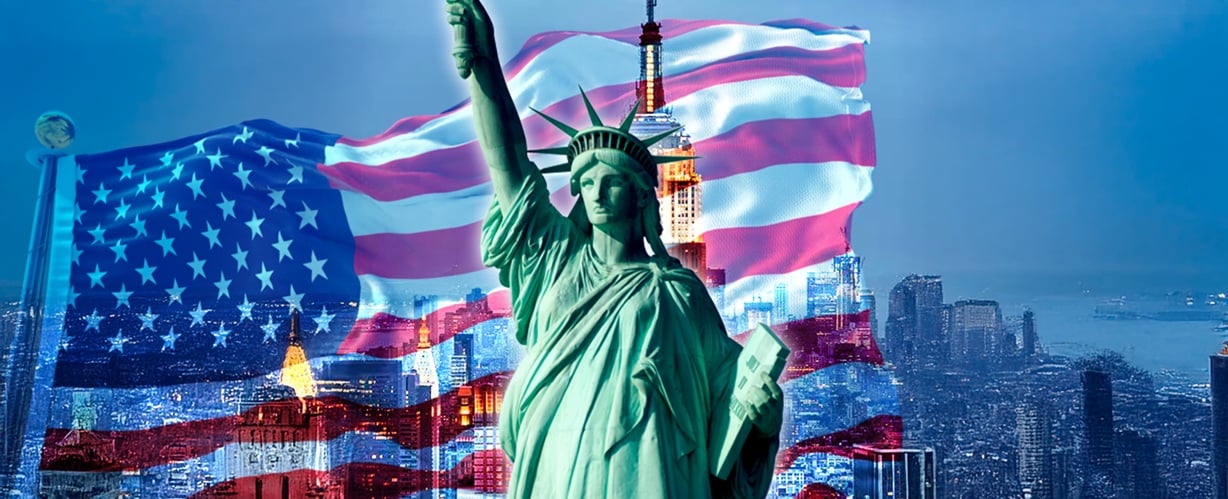
Two and a half centuries ago, an idea was born. Not an ethnicity. Not a nation built around a language, a religion, or an age-old tradition. An idea was born. Two hundred fifty years later, that birthmark still distinguishes the United States from the rest of the world.
Few countries exhibit comparable heterogeneity. Within its vast territory, dozens of cultures, religions, languages, customs, and traditions coexist. The Alaskan American, the Iowa farmer, the New York businessman, the Latino immigrant in Florida, the Asian descendant in California, or the Texas rancher may seem like inhabitants of different countries. Yet they remain united. Why? Because the cement that holds that society together was never a cultural identity. It was, from day one, an idea.
The answer is written in the second paragraph of the Declaration of Independence, probably one of the most influential political texts in history: “We hold these truths to be self-evident: that all men are created equal, that they are endowed by their Creator with certain unalienable Rights, that among these are Life, Liberty and the pursuit of Happiness.” Therein lies the true American social contract. One need not have been born in Boston, Chicago, or Dallas to belong to that community. Nor share a specific ethnic origin. It is enough to adhere to that set of principles.
Whoever accepts that liberty precedes the state, that rights belong to the individual, and that the pursuit of happiness constitutes a legitimate aspiration can integrate into the American social current regardless of where in the world they come from. President Reagan expressed it with extraordinary clarity. One can live many years in Germany but will hardly become German. One can spend decades in Japan but will never be Japanese. Even today, Europe witnesses how a foreign tide invades it without integrating. In contrast, anyone who adopts the American social contract can feel American, because behind that belonging there is no common blood or uniform culture: there is a shared idea.
That intellectual elasticity has been one of the great strengths of the United States. It allowed it to weather wars, devastating economic crises, racial conflicts, political clashes, and even a civil war that would have disintegrated almost any other country. European history offers numerous examples of the opposite. Entire states disappeared from the map because their cultural, religious, or national differences proved irreconcilable. Others continue to exist formally, though beneath an institutional surface that barely conceals societies deeply fractured by incompatible conceptions of life.
The United States took a different path. Its true originality consisted in demonstrating that a nation can present itself as a solid political unit while being, at the same time, a vast cultural archipelago. The Supreme Court itself synthesized that paradox by defining American federalism as an “indissoluble union of independent states.” An apparently contradictory phrase that, nevertheless, explains as few others can the balance between the autonomy of each state and the existence of a single Republic.
Something similar occurs with individuals. The United States is the result of millions of individual wills coordinated by a legal system that allows cooperation and competition simultaneously. That combination multiplies wealth, incentivizes innovation, and makes it possible for millions of personal projects to find an environment in which to develop. It does not guarantee success; it guarantees the freedom to try. And that difference is decisive.
250 years ago, a country was born based on an abstraction. An abstraction as intangible as it is powerful. As invisible as the millions of individual dreams that people from all corners of the planet continue to believe they can turn into reality on American soil. While many governments promise to guarantee well-being from cradle to grave, they end up building societies where personal initiative withers and opportunities become scarce. The result is often repeated: citizens pack their bags and cross oceans seeking precisely what their own countries stopped offering them.
The shores of the United States continue to receive men and women who arrive with different languages, diverse creeds, and varied customs, but with a common hope: the possibility of building their own destiny. That remains the true American strength. And also the explanation for the permanent miscalculation of those who, for decades, have announced a decline that never materializes. Because the United States does not rest on a race. It does not rest on a religion. It does not rest on a language. It does not even rest on a territory. It rests on a moral conviction: that every person is born free, that their rights are not a concession of power but an attribute of their human condition, and that the state exists to protect that freedom, not to administer it.
As long as that idea remains alive, men and women willing to start over will keep coming. Entrepreneurs, scientists, artists, workers, and immigrants convinced that there it is still possible to write a different story will keep appearing. And as long as that happens, the prophets of decline will keep being wrong. 250 years ago, a Republic was born. But above all, an idea was born. And ideas, when truly universal, do not age. They do not need a passport. They know no borders. They cannot be defeated by propaganda or replaced by welfare. Because there will always be someone, somewhere in the world, willing to abandon the security of a promise to embrace the risk of freedom.
Perhaps that, two and a half centuries later, is the greatest contribution of the United States to the history of civilization: having demonstrated that the most powerful wealth of a nation is not its natural resources, nor its military power, nor the size of its economy. It is an idea capable of inspiring millions of people who were never born there and who, nevertheless, continue to believe that that old American dream also belongs to them. Happy birthday United States of America!!! And may the torch lit in Philadelphia 250 years ago continue to illuminate the path of those who believe that the future is in each one’s hands…



para mi los zurdos de mierda nunca van a entender q USA es el faro del mundo no como aca q nos hundimos en populismo berreta 250 años de libertad y los progres queman banderas viva USA carajo firme ElGauchoPiola
Para mí 250 años de hipocresía yanki nomás che. La «idea más poderosa» fue esclavitud y genocidio no su independencia berreta. Yo creo que se creen únicos pero son los mismos imperialistas de siempre. Basura yanqui viva la lucha antiimperialista carajo.