
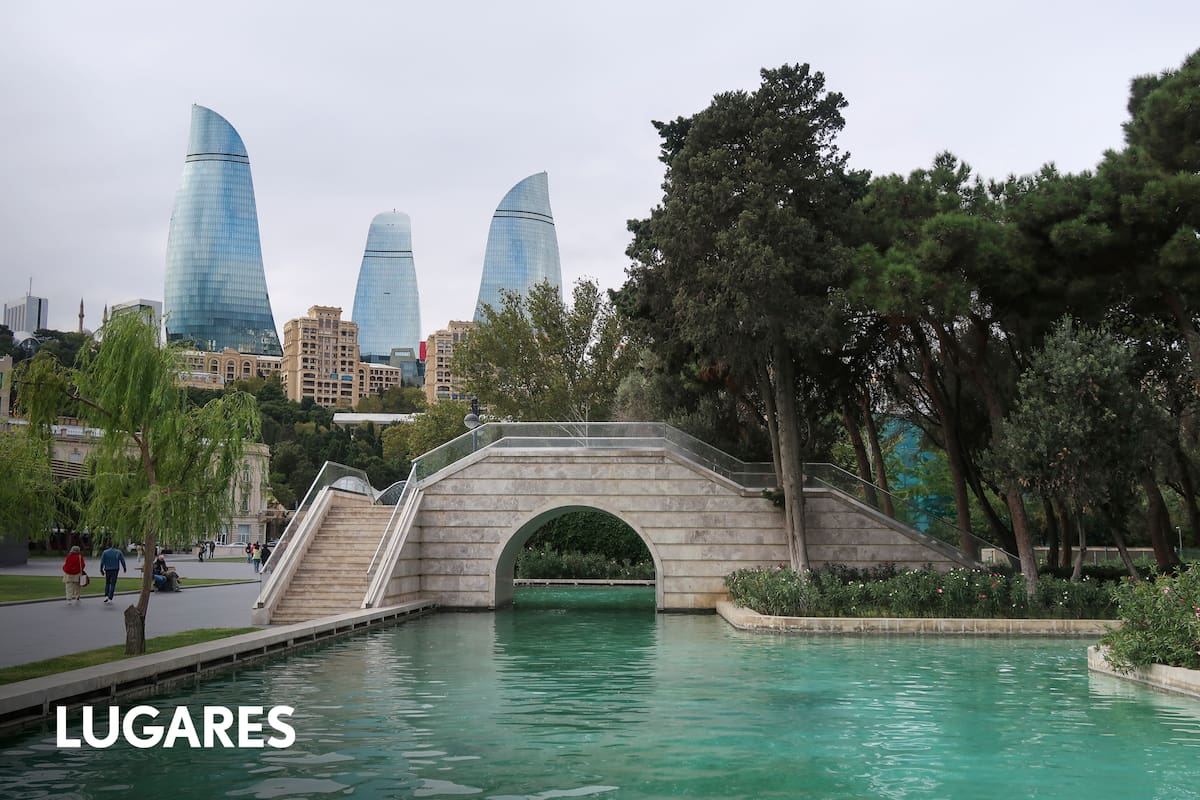
Clean, orderly, without graffiti, with scarce presence of Islamic veils on the streets, traditional architecture and spectacular design buildings in Dubai style. That is Baku, the capital of Azerbaijan, a Muslim country in the Caucasus, with a privileged coast on the Caspian Sea and sitting on a very rich oil basin.
Like Chicago, it is the city of winds. Its Persian neighbors gave it that nickname many centuries ago, and it is something you notice on a quick walk along the waterfront.
The peninsula where it sits, Absheron, is known as the land of fire, due to the flames that for centuries spontaneously burst from the ground. The phenomenon – now in decline – is caused by giant underground gas deposits and was recorded by Marco Polo himself when he crossed the territory in 1271 on his way to China.
All that hydrocarbon wealth has been industrially exploited for 200 years, since the time when the territory belonged to the Russian Empire and later was one of the republics of the Soviet Union. However, in the last two decades, extraction has been boosted, giving a great impulse to the Azerbaijani economy. This is mainly noticeable in Baku, which took advantage of the oil boom to transform its urban industrial profile, renew itself, and incorporate attractive design architecture that breaks in among neoclassical and Soviet styles.
The airport already welcomes you with a building full of curves and wide spaces, inaugurated in 2014, and the avenue leading to the center is a catalog of striking constructions, all by different firms. The cable-stayed bridge is followed by a huge covered stadium and, further on, one after another, the Baku Tower office building, the Ministry of Finance – rising in a succession of misaligned cubes – another twisted state office building, or the Azersu tower in the shape of a water drop.
However, since 2012, the postcard of Baku has been the Flame Towers, known as the «Torres de la Llama,» a complex of three bluish buildings, 33 stories high, with reflective exteriors, visible from a distance. Each tower has a different purpose but is aimed at the same audience: luxury residences, corporate offices, and high-end hotels.
The Flame Towers, with their emblematic Fairmont Baku hotel, emerge behind the old city and undeniably define the urban profile. Today they are the identity and trademark of the capital. They appear in brochures and in the thousand shots of each Formula 1 Grand Prix held in September. At night they come alive illuminated with red, orange, and yellow lights that dance and resemble a flame in the middle of the city. In front of them, separated by a busy avenue, a mosque reflects its minaret in the mirrored facade, blending spirituality and modernity.
But even more dazzling than these magnificent towers, although not part of the skyscraper profile, is the celebrated Heydar Aliyev Center, designed by British-Iraqi architect Zaha Hadid.
What catches the eye is not its 100,000 square meters distributed over eight floors, but its spaces, which know no straight lines, without visible columns, wide, bright, white to the point of causing vertigo. It is an architecture as fluid as the waves of the sea, as Hadid defined it, who sought to break with the geometry of the Soviet construction of neighboring buildings and poured all her creativity to achieve this architectural gem. It was inaugurated in 2012 and cost 250 million dollars; undoubtedly the time will come when tourists come to Baku just to see it, as happens with the Guggenheim in Bilbao.
A few meters from the Flame Towers, recent history, painful and very present for Azerbaijanis, has a sober and perpetually mourning space on Martyrs’ Street. The corridor is a tribute to those who lost their lives in the 1918 offensive of the Russian Bolsheviks, to those who fell in January 1990 during the turbulent months before the collapse of the Soviet Union, and to the soldiers killed in the war with Armenia over the disputed Nagorno-Karabakh region. A hundred black granite graves line up, uniform, with images of the dead (many of them civilians) carved into the headstones, in the style of Muslim cemeteries in Central Asia. They are not all, but they represent all. The path, bordered by cypresses and pines, leads to a wide dry plaza at a height, facing the sea. There, a small temple with a votive flame shows, through its columns, in the distance, a mast over 20 meters high, with a gigantic flag waving almost over the Caspian.
The place is one of recollection, silence prevails, and it is moving because of the proximity in time to the last war. After clashes with Armenia in 2020 and 2022, Azerbaijan militarily defeated its neighbor in 2023 and peace was signed in 2025. The agreement, sponsored by the United States, laid the groundwork to boost the development of the hydrocarbon industry in the region in the coming years, with the construction of an oil pipeline that will cross both countries, reach Turkey, and from there connect to Europe.
Retracing our steps, in front of the Flame, another design building, with curved steel-colored roofs, has as its only indication a discreet «f» at its entrance. It is the funicular station, a glass train that covers the 455-meter elevation difference in just over three minutes, down to the sea. The view is not as spectacular as one might imagine due to the structure of the cars and the trees on one side, but for half a dollar… the experience is well worth it. The funicular descends to an avenue parallel to the waterfront, which can also be reached on foot by a staircase that borders the walls of the old town.
Near the sea, a low, colorful building with the curious shape of a rolled-up carpet is visible. It is, precisely, a museum dedicated to them, which will turn 60 in 2027. The permanent exhibition displays much more than carpets woven with different techniques and from various regions: it exhibits textiles that were always used in the countryside, in harnesses, and in daily life. It also shows an attractive collection of jewelry, including pectorals, earrings, bracelets, daggers, and exquisite pieces in gold filigree with semiprecious stone inlays.
In front of this museum, Little Venice has no gondolas, but it does have boats for a short ride through its canals, in the middle of a garden with slopes carefully prepared for selfies. We are steps away from the waterfront, a promenade that follows the Caspian profile for several kilometers and is the great magnet for Baku’s inhabitants.
The sidewalk is wide, impeccably clean like the whole city, and with neat stalls offering coffee, ice cream, popcorn, or proposing a moment of leisure shooting at a target.
On the other shore, which is not visible, lies the forbidden land… Turkmenistan, an oil-rich country, also Muslim, former member of the USSR like Azerbaijan, but which finds it difficult to grant visas to journalists.

Para mí Bakú es pura fachada de lujo mientras los armenios los tienen vigilados. Esto huele a traición de la izquierda cobarde que no entiende que hay que defender lo nuestro a sangre y fuego. ¡Patria o muerte! Firmado: ElGauchoNacionalista
para mi baku es una fachada de lujo capitalista q esconde sangre armenia y explotacion azeri los rascacielos no tapan la guerra ni las alfombras robadas muestra de marmol alma de miseria firme pantera roja