
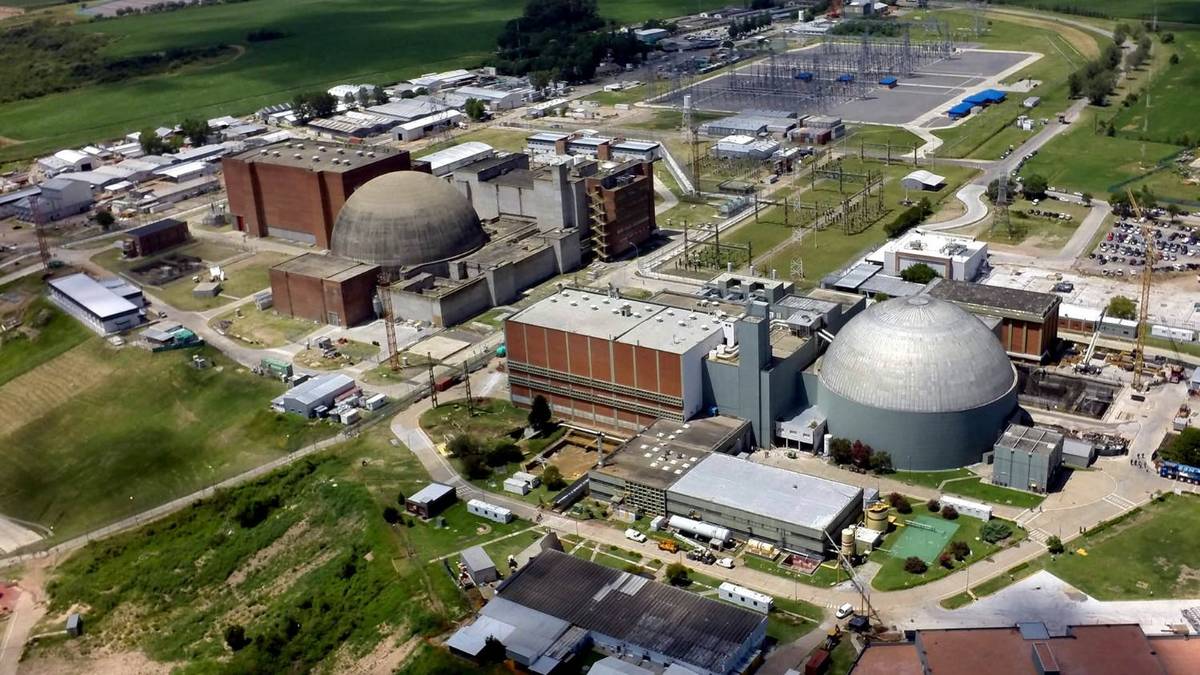
The government of Javier Milei is dismantling one of the few scientific-technological complexes in Latin America: the Argentine nuclear system. While a RIGI is promoted to attract foreign capital to exploit natural resources, the nuclear sector accumulates budget cuts, halted projects, and the departure of hundreds of specialized workers. The contrast is brutal: on one hand, the extraction of raw materials is incentivized; on the other, a knowledge-intensive value chain that took more than 70 years to build is being abandoned.
Over seven decades, Argentina built a unique network in the region, with the National Atomic Energy Commission (CNEA), the company INVAP, and a network of industrial suppliers spanning from basic research to engineering, nuclear medicine, and research reactors. We were the first country in Latin America to put a power nuclear plant into operation, Atucha I, in 1974. We designed and exported reactors, produced radioisotopes for medical use, and trained highly qualified human resources. That is what is being lost.
According to a report by the Center for Studies for the Development of Nuclear Activity (CEDAF), the sector’s budget suffered a real cut of 53% in infrastructure and equipment, and the wage bill lost 42% of its value. Strategic projects such as the CAREM modular reactor and the RA-10 multipurpose reactor are facing delays and uncertainty. Since December 2023, the nuclear system has lost nearly a thousand workers: 571 layoffs at CNEA, 306 at Nucleoeléctrica Argentina, 37 at the Nuclear Regulatory Authority, and 31 at Dioxitek.
Currently, Argentina has three operational nuclear power plants (Atucha I, Atucha II, and Embalse) that contribute between 5 and 8% of national electricity, with state management and positive economic results for more than 7 years. However, last September, the Government announced the partial privatization of Nucleoeléctrica Argentina. For CEDAF specialists, the risk is dismantling capabilities that took decades to build. Rebuilding research teams and complex technological projects requires much longer times than any private investment can guarantee.
In parallel, the Government announced an investment in Atucha for a modular reactor under the Super RIGI, with the company Meiter Energy, of US capital from the Ansari Group, which participated in the foundations of SpaceX. «Argentine capabilities, foreign profits,» summarized CEDAF. The decision goes against the global trend: the United States promotes multi-million dollar programs for small modular reactors with public funding, China accelerates the construction of new plants, France maintains its nuclear matrix, and South Korea expands reactor exports.
«Each stalled project means delaying developments that can hardly be recovered in the short term. Each generation that stops being trained reduces the possibilities of sustaining an autonomous scientific policy,» specialists warned. The underlying discussion is whether Argentina will continue to consider knowledge as a strategic resource or whether it will resign capabilities that took more than 70 years of institutional construction.
While the RIGI seeks to attract investments to exploit natural resources for export, the setback of the nuclear system implies giving up one of the few industrial complexes capable of generating proprietary technology, integrating local suppliers, and exporting high value-added knowledge. It is not just a matter of two economic sectors, but of two models of country: one that bets on technology and knowledge, and another that settles for being a mere exporter of raw materials.



Para mí este pelotudo de Milei tira 70 años de tecnología nuclear a la basura para regalársela a las mineras extranjeras. Me parece un vendepatria que no le importa un carajo la soberanía nacional. Viva la libertad carajo!
Para mí esto es un choreo a mano armada. 70 años de desarrollo nuclear tirados a la mierda pa que los yankis se lleven todo. Milei nos entrega a las mineras y nos deja un desierto radioactivo. ¡Vendepatrias! #NoAlDesguaceNuclear