
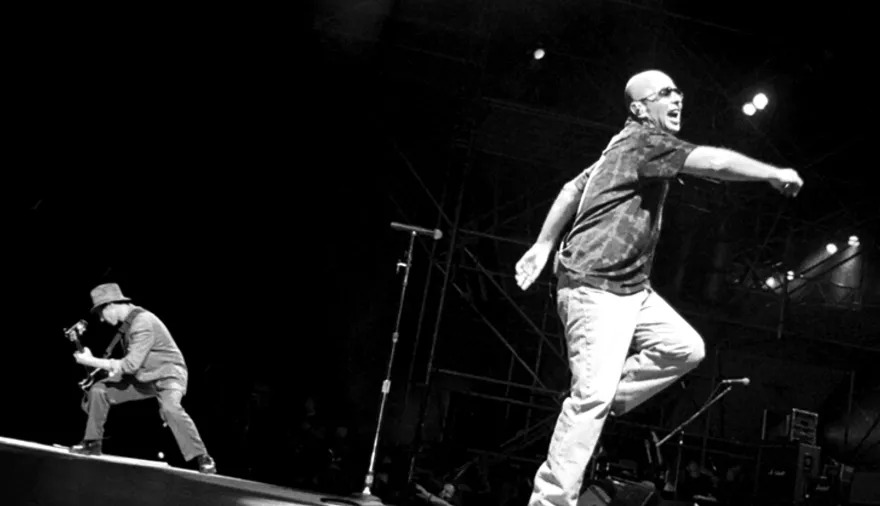
Indio died. Carlos Alberto Solari, mythical figure of Argentine rock, left this world, and with him went the mystery, the voice, and the lyrics that marked entire generations. For three days they held a wake, they mourned him, they listened to him. On a rainy Sunday, 75 blocks of people said goodbye to him, arriving from every corner of the country. There were spontaneous gatherings on every corner: getting together to listen to his music, to dance, to sing, to cry, to reunite with childhood friends who shared Los Redondos’ albums.
They mourned him, the veteran ricoteros who went to the concerts, but also a generation born after the band’s breakup. Teenagers who never attended an Indio show, but who found in his music that dystopian world that seems a faithful description of the reality we live in today. There is a lot of social sadness, a society that can no longer bear one more absence in its empty hearts. That loss is amplified when it comes to an idol who truly reached the deepest layers of society.
Indio Solari is the voice of an entire counterculture, of an entire myth that no one fully knew how to explain. Because there are many explanations for what Patricio Rey y sus Redonditos de Ricota means. There is an entire generation that did not experience those self-managed concerts, the basements, that rock, those performances in theaters that Indio recounted in his interviews. Many began to experience the massive masses like Olavarría or Salta, mud up to their knees, the biggest mosh pit in the world. Others were left with the legacy of the albums they listened to from their parents, older siblings, a friend, or who experienced Indio already affected by Parkinson’s.
Indio was always cautious about his image: what to say, not to unveil his lyrics, not to explain what he meant, to operate in ambiguity. For an artist, that is perhaps the culmination of a work: that the artist does not matter, but what he produced. His lyrics and what they generated in others. Because it is true that often the artist does not matter, but how the people appropriate that and give it their own meaning.
The lyrics of Los Redondos, the mythical cover of Oktubre drawn by Rocambole, are symbols of Argentine society. They are on the flags of teams in football stadiums, on the walls of neighborhoods. Many are used as symbols of resistance. Indio was an artist who thought that one had to change man to change society. He had combat bands, not entertainment bands. He thought it was wrong to entertain people while they were being robbed from their pockets. With his lyricism, with his poetry, he showed that culture, music, and art are not secondary disciplines, but ways of understanding life, of transmitting a message.
Those lyrics, those melodies belong to everyone. They speak of love, of heartbreak, of those who govern us, of those who crush us, and also of the neighborhood band, those who raise the red and black flags. There, the figure of the artist ceases to be in the spotlight and begins to be his message. Indio, in his permanent attempt to show himself in ambiguity, gave few interviews, just enough to clarify misunderstandings.
But there are also shadows. Carlos Alberto Solari, as an individual, can be reproached for many things: from his role and subsequent indifference in the case of Walter Bulacio, a watershed for an entire generation of followers who expected more from the band, to the deaths that occurred at one of his last concerts in Olavarría, due to the precariousness of the mega-events organized by him. What to do then with those artists who gave us so much but also disappointed us? One cannot have an idyllic vision of anyone, not even geniuses. They are geniuses precisely because their works ceased to be theirs and began to belong to those flags, those murals, those phrases we dedicate to friends and loves. The artist’s flaws do not reach those appropriations, but they do not disappear either. They remain there, as an uncomfortable truth, as the price of evaluating what we love in all its dimension.
That is why, when you see an interview with Indio, you may agree more or less with what he says, with his ideas and the governments he supported. But the things that Patricio Rey y sus Redonditos de Ricota sang generated almost 100% agreement, beyond not fully understanding his lyrics or many of us not being able to decipher some metaphors. That is why both those over 50 and 15-year-olds mourn him so much. Because the lyricism of Los Redondos knew how to give voice and lyrics to an entire society that began to find itself hopeless about the future, about that future that never comes, about that dog that is always there.


para mi se fueron todos detras del indio como si fuera un santo pero nadie habla de las sombras este tipo hizo apologia de la droga y el descontrol y nosotros los aplaudimos somos una generacion de debiles dejen de llorar y asuman que nos vendieron un verso viva la libertad pero con orden y patria carajo
para mi dejen de llorar por el indio como si fuera un santo se la pasaban bancando el capitalismo y ahora se hacen los revolucionarios hipocritas su legado es de luchas a medias tintas mientras la izquierda de verdad peleaba en las calles basta de mitos paguen la deuda de no haber sido consecuentes viva la lucha obrera no el rock de ricos