
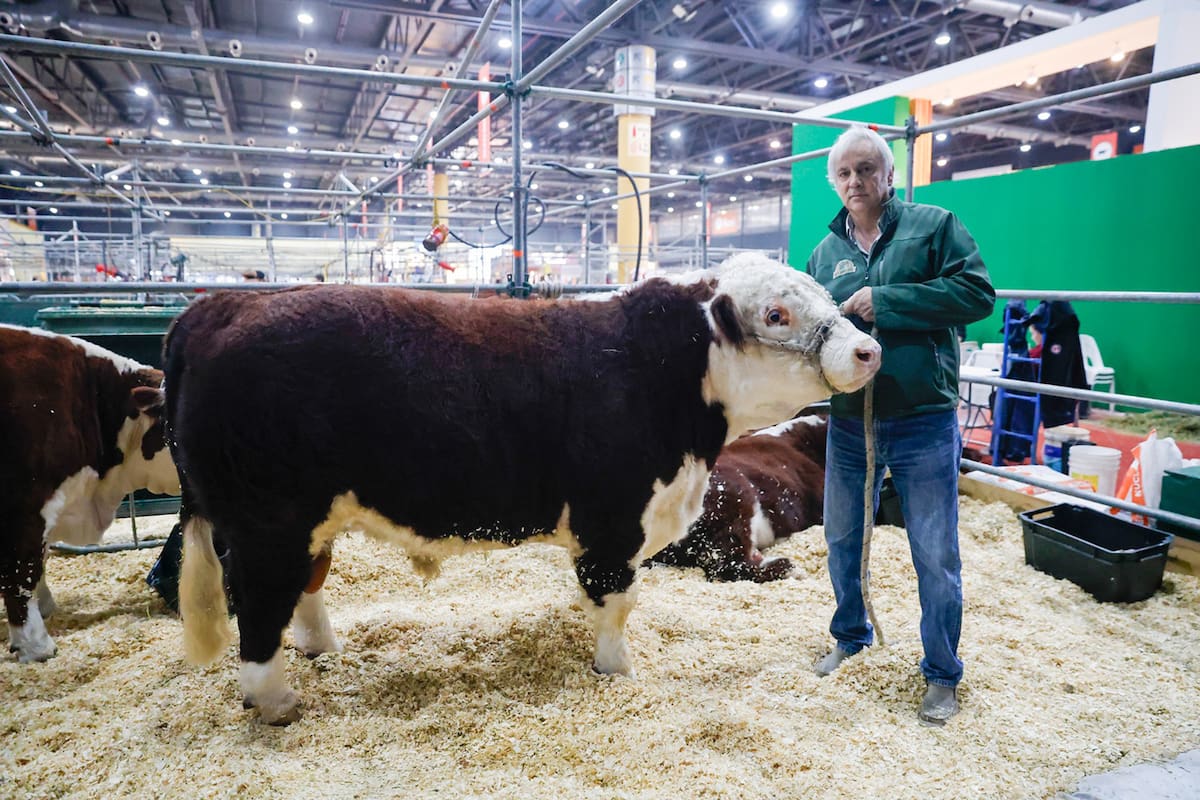
The main ring of the Palermo Rural Expo is already the stage for the World Cup of the country’s best breeders. With the bovine pavilions full of animals from different parts of Argentina, behind each bull and each female there are years of genetic selection. This year, the context has also boosted investments in breeding farms. With better prices for livestock, greater predictability, and favorable expectations for the business, breeders are accelerating projects to incorporate technology, add data, and enhance genetic improvement.
Breeding farms have historically been one of the most innovative segments of livestock farming. Several producers consulted agreed that the current scenario allows them to advance projects that require long-term planning and that until recently many preferred to postpone. Investments range from infrastructure and field improvements to tools for measuring more and more information about animals, incorporating biotechnology, and producing more efficient breeders.
“Today you can buy practically everything with many fewer kilos of steer or calf than a while ago. So we are improving infrastructure because the only way to lower costs is by investing in technology and making processes more efficient,” said Francisco Matta y Trejo, owner of the Santa Lucía breeding farm in Villaguay, Entre Ríos, where they produce Angus and Brangus.
According to him, the change in relative prices modified the equation of many investments. The company expanded the area dedicated to winter forage and pastures to produce more meat per hectare, incorporated solar pumps to replace windmills and gasoline engines that required moving personnel to pump water, began using drones for various tasks on the farm, and is analyzing using feedlot waste to produce biogas. Additionally, it is advancing with the systematization of fields to control erosion caused by slopes and prevent the formation of gullies.
The improvement in profitability has also begun to change land use. Fields that in recent years were mainly used for agriculture are returning to livestock. Marcelo Huber, agricultural producer and manager of Agropecuaria La Olguita, a Braford breeding farm in Bell Ville, Córdoba, said that mixed farming systems are making a comeback. Matta y Trejo, meanwhile, expanded the area dedicated to pastures and forage.
Meanwhile, Fernando Hernández, head of the San Edmundo breeding farm, which produces Angus and Hereford, advanced with alfalfa-based pastures and new watering points to intensify grazing, in addition to importing embryos from Scotland to incorporate new genetic lines. “Before, since it was a rented field, we were afraid to make investments that needed many years to pay off. Now we are more encouraged because we believe this scenario can be sustained,” Hernández explained.
For producers, the change is not only about better current prices but also about the possibility of projecting investments whose results will only be seen several years later. “Today livestock farming is giving a margin it didn’t have before. Plus, there is predictability, and that’s no small thing. That predictability gives you the flexibility to invest again,” Huber summarized.
But a good part of these investments is not only reflected in new facilities or the purchase of breeders. One of the main bets of breeding farms today is generating more and more information about animals to make better decisions. “When we started, the goal was to have the same data in livestock as in agriculture. We wanted to do precision livestock farming,” Huber said.
At La Olguita, they are increasingly performing ultrasounds to gather information about breeders. With them, they measure characteristics such as ribeye area—which reflects muscle development—and marbling or intramuscular fat, two data points that they then incorporate into animal selection. Additionally, the entire herd is already identified with electronic ear tags, even before that system became mandatory.
The next step, according to Huber, will be to incorporate electronic feeders to measure residual feed intake, an evaluation that allows identifying which animals produce more kilos of meat while consuming less feed. The breeding farm has also incorporated handling facilities aimed at improving animal welfare and streamlining livestock management.
At Santa Lucía, they also advanced in that direction. The company incorporated handling facilities with electronic readers to automatically record ear tags, weights, and daily gains of each animal. It also works with genomic evaluations and participates in studies promoted by the Argentine Brangus Association to analyze the relationship between hair length and tick resistance.
In this context, Matta y Trejo explained that another evaluation that is becoming increasingly important is residual feed intake. Through electronic feeders, they record how much feed each animal consumes and how much weight it gains. That information then allows identifying the most efficient lines. “The ideal is to enhance the animal that eats less and converts more kilos of meat,” he emphasized.
The incorporation of data is not the only strategy that breeding farms follow to accelerate the improvement of their herds. Some also go looking for new genetic lines abroad. That is the case of Alfredo Bellocq, veterinarian and owner of the Santa Rosa breeding farm in Indio Rico, southeastern Buenos Aires province. For three years, together with Santiago Debernardi of the firm Select Debernardi, he has been touring establishments in the United States to identify breeders that can best adapt to Argentine production systems. “In 15 days we review between 3,000 and 4,000 bulls. We travel more than 5,000 kilometers looking for what can adapt to our system. We try to bring new blood to Argentina, both for the commercial producer and for breeding farms,” he explained.
According to him, the goal is to find animals that can respond to a predominantly pastoral system like Argentina’s. Bellocq started the breeding farm in 2004 with just three cows and today works with about 300 pedigree mothers. He markets around 180 bulls per year and has another 25 in various insemination centers in the country. That growth, he explained, also forced the incorporation of more tools to reduce the margin of error in selection. “When you multiply a donor, you multiply it exponentially. If you make a mistake in genetics, you don’t see it immediately, but you do several years later,” he warned.
In addition to daily monitoring of animals and the use of electronic ear tags, the breeding farm incorporated genomic evaluations through DNA to improve the accuracy of EPDs (Expected Progeny Differences), a tool that allows more accurately estimating what characteristics a breeder will transmit to its offspring. “New generations are increasingly demanding it,” he stated.



para mi estos de la rural son unos hdp mientras el pueblo pasa hambre ellos con sus toros de lujo y sus dt de primera se rien de nosotros firme el che de la esquina tiene razon explotadores de mierda
para mi estos zurdos hdrmp no entienden nada la rural explota con toros de lujo y ellos quieren cerrar el campo viva la carne viva el campo los kukas llorando como siempre 🐂🇦🇷