
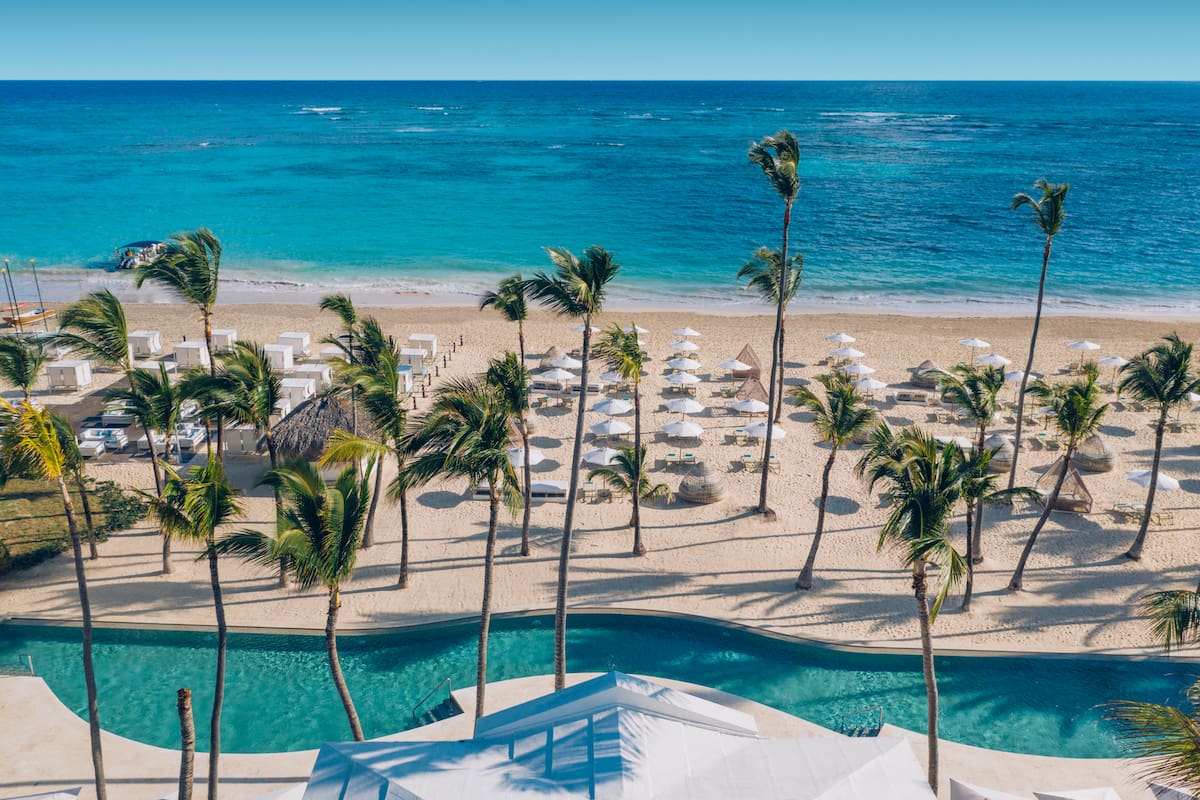
As soon as you step off the plane, Punta Cana offers a first glimpse of what the Dominican Republic is all about. Before the turquoise sea, the white sand, and the first shot of mamajuana – that local drink that makes you feel part of the place and to which many attribute almost miraculous powers – appear the faceless dolls: hand-painted clay figures that greet tourists at the airport and serve as a brand of identity. They have no defined features because they represent the Dominican cultural mix, its diversity and history.
Then comes the familiar postcard, the one that more and more Argentines are choosing. The humid Caribbean heat that hits your face without asking permission, the palm trees, and the transfer to its beaches immediately instill the idea that Punta Cana is, above all, a promise of rest to forget about routine for a while. Eat. Sleep. Go into the sea. Repeat.
The famous all-inclusive model has made this Dominican corner one of the most recognized destinations in the Caribbean. But stopping there is only seeing part of the picture. With over 50 kilometers of white sand beaches and crystal-clear waters, it concentrates nearly 170 hotels and many of the main international chains, especially along Playa Bávaro, the most famous beach in the destination. The Dominican Republic has that certain something that sparked the interest of Argentine tourism and consolidated it as one of the most chosen Caribbean options in the last year.
According to data from the Dominican Ministry of Tourism, in 2025, 442,088 passengers arrived from Argentina, 62.3% more than the previous year and the highest level in the last six. The country thus became the leading Latin American source market for the Dominican Republic and third in the continent, behind the United States and Canada.
And that growth is noticeable inside the hotels. «In the last three years, Argentines have gone from representing about 15% to nearly 40% of our guests,» says Jeovanny Reyes, marketing & brand experience director of Iberostar in Punta Cana, one of the groups with a strong presence on Playa Bávaro that operates five-star hotels: Selection Coral Bávaro, JOIA, Coral, Waves Dominicana, and Waves Punta Cana, within a 133,000-square-meter complex on the beachfront. For example, one night in one of the hotels costs from US$160 per person based on double occupancy, depending on the category and season.
Although the all-inclusive remains the dominant format, tourists, and especially Argentines, choose to do activities outside that format. For example, 72% of Argentines who entered the country in 2025 took the excursion to Isla Saona, one of the most sought-after outings in the destination and one of the most Instagrammable, where no filters are needed. Despite being the most in demand, it is not the only one.
Punta Cana does not end with the photo posted on social media. Behind that image appears the other side of the destination: nature reserves, protected species, recovering reefs, and an increasingly urgent environmental discussion for a region that lives, precisely, off the beauty of its coasts.
One of the clearest examples is the Ojos Indígenas Ecological Reserve, a 1,500-hectare natural park where trails go into a tropical forest and lead to 12 freshwater lagoons; in several of them you can swim surrounded by vegetation. Walking along those paths, with the sounds of nature, but without forgetting the guide’s jokes and riddles, allows you to discover a different Punta Cana. A little greener and far from the classic postcards of loungers by the sea.
The reserve also helps understand a question that has been hanging over the destination for some time: how to sustain tourism growth without damaging nature? On the island of Hispaniola, shared by the Dominican Republic and Haiti, live threatened endemic species, such as the rhinoceros iguana and the Hispaniolan hawk. Habitat loss, illegal hunting, and the advance of invasive species have put them in critical condition, and various conservation programs work on monitoring, protecting, and recovering their populations.
That concern has begun to shift to hotels, which are precisely the recipients of tourism. Some complexes seek to add a proposal that goes beyond: wellness, nutrition, waste reduction, coastal protection, and restoration of marine ecosystems. It is not about denying the impact of the tourism industry, but about assuming that the future of the business increasingly depends on caring for the resource that sustains it.
In the case of Iberostar, for example, that agenda appears through its global movement Wave of Change, an initiative that began with the elimination of single-use plastics and expanded toward more ambitious goals: waste reduction, responsible fishing, carbon neutrality, and restoration of coastal ecosystems. And, in Punta Cana, one of its most visible lines of work is linked to corals.
The search also extends to the guest experience. «We train our guests to travel with a more sustainable ecological footprint, while ensuring their comfort and well-being,» said Alice Scavarda, room division manager of the hotel.
In a format that for years was synonymous with endless buffets and leaving any healthy habit aside, the brand began to incorporate proposals linked to wellness and more conscious eating. «The trend is changing. The idea is to put nutrition topics on the table at a resort, a place where many times you think you can’t take care of yourself,» explained Daniel Sánchez, Head of PR at Iberostar.
In that model, sustainability appears as an internal axis and not just a phrase for the guest. «Sustainability is part of the induction,» summarizes Natalia Pairo, general manager of Iberostar Selection Bávaro and Coral Selection Bávaro. The idea, according to the company, is that environmental care permeates daily operations: from waste management and coastal protection to projects linked to corals and work with local communities.
«With more than 60 years of history, we are committed to quality, sustainability, and innovation. We promote a model of responsible tourism that puts the care of people and oceans at the center,» assured Sánchez.
The great challenge today is in the sea. Sargassum, that macroalgae that in recent years has affected much of the Caribbean, has become a daily problem in destinations. When it arrives in large quantities, it changes the landscape, generates odor, and forces large-scale cleaning operations throughout the day.
«Is there sargassum on the beach?» is one of the questions that resonates most among tourists when choosing their next destination. For countries that live off tourism, it is no small detail. But some of the techniques used to remove it can also damage the sand and coastal ecosystem if done with heavy machinery.



Para mí esto huele a capitalismo de mierda: los yanquis y europeos rompen todo, y ahora los argentinos van y rematan los corales. ¿All inclusive? Exclusión total de los locales, mientras los peces se mueren. Yo creo que el progreso así es una basura, solo beneficia a los empresarios. ¡Viva la lucha ambiental!
Para mí esto huele a cuento ecológico de zurdos que quieren cagarle las vacaciones al laburante. 442 mil argentinos vamos porque podemos y punto. Si tanto les importan los corales que pongan plata de los impuestos no jodiendo al que quiere su all inclusive. Viva la libertad carajo.