
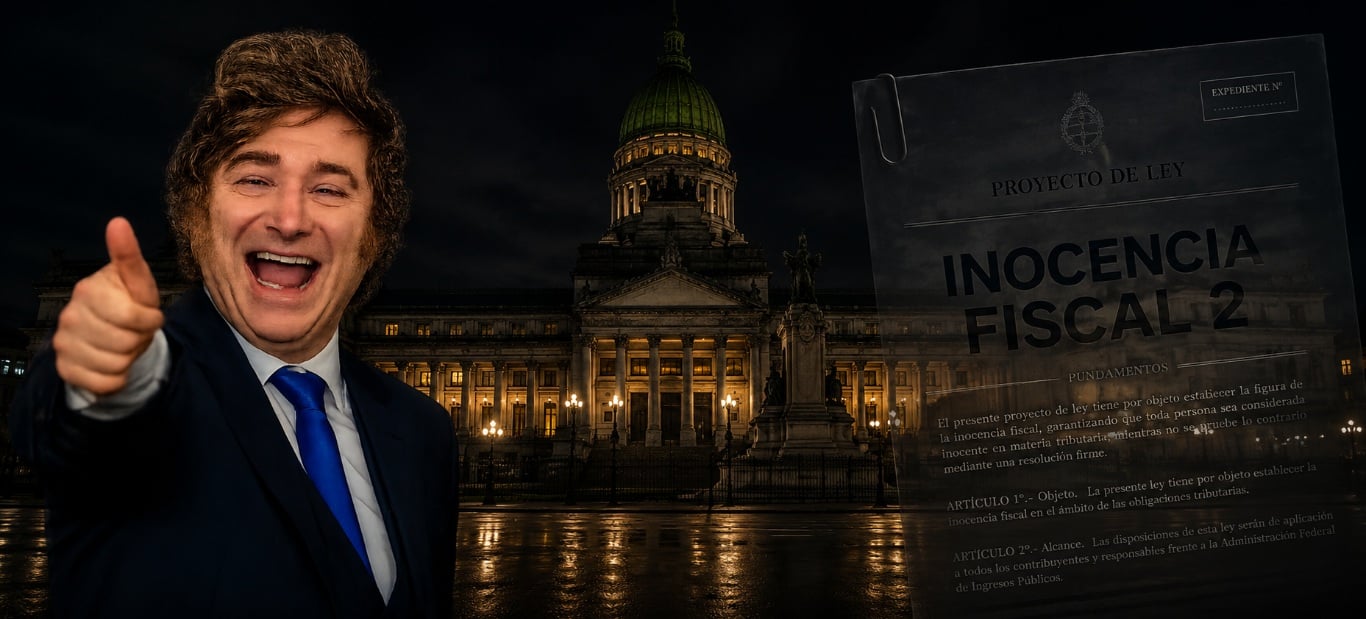
The government of President Javier Milei made a decision that crosses all ethical lines: it sent the Fiscal Innocence Law II bill to Congress. Under the excuse of reviving the economy, the initiative hides a mechanism designed to guarantee impunity for the political caste.
Analyzing the norm in detail, it is not a simple plan for the average citizen to declare hidden savings, but a structure that legalizes the justification of funds of dubious origin, tailor-made for officials, former officials, and political leaders.
In journalism, a key rule is to analyze not only what is said but what is left unsaid. And here lies the most scandalous point: the bill lacks any exclusion clause for Politically Exposed Persons (PEPs) and their direct relatives. This allows those who manage or managed state resources to benefit from an unprecedented tax amnesty.
This is not the first time the Milei administration has resorted to this legal loophole. The original law from late 2025 already served as a protector for members of the government itself to formalize suspicious money. With this expansion, the administration seems to want to protect its own ranks and the leadership of La Libertad Avanza, granting them the right to launder undeclared fortunes through the Simplified Sworn Declaration of Income regime, which now has no asset limits.
But there is more: the bill destroys the state’s control tools. The Revenue and Customs Control Agency (ARCA) will not be able to use general presumptions to investigate a high-ranking taxpayer and will have to bear the entire burden of proof if it detects irregularities. In other words, the burden of proof is reversed.
The curious thing is that this lack of protection for public assets does not comply with the international standards of the Financial Action Task Force (FATF), which requires enhanced audits of politicians’ assets to prevent money laundering and corruption. Ironically, federal judge Ariel Lijo and Justice Minister Juan Bautista Mahiques attended a FATF event in Paris to defend Milei’s administration.
Furthermore, the bill does not benefit only the ruling party: the entire political spectrum could launder money from corruption. If approved, it will also be used by future administrations, degrading the anti-corruption fight promoted in Argentina.
With changes to limits, without exempting officials, in contradiction with the FATF, and limiting ARCA, can anyone believe this is not a project to launder corruption? And one last question: will ARCA act as a persecuting entity against opponents who want to join? That window remains, at the very least, open.

Para mí esto es un choreo a mano armada, Milei es el nuevo Menem legalizando el lavado para que los amigos de la city blanqueen fortunas sin pagar un peso mientras el pueblo se congela. La casta chorra festeja, esto huele a corrupción pura, rajá ya forro.
kjjjj para mi estos zurdos de mierda lloran xq no pueden chorear ellos mismos. Milei les tapa la boca a la casta y los forros de siempre se quejan. viva la libertad carajo! la guita de los corruptos ahora es legal asi se joden. Argentiiinaaa!