
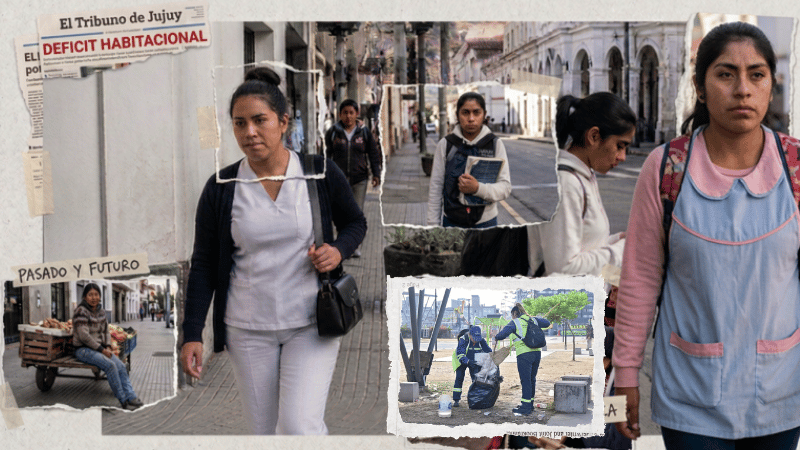
In Jujuy, the North wind not only blew off roofs and knocked down poles: it exposed the crisis that working women have been silently sustaining. While Milei and Sadir deepen the austerity, women and working diversities once again bear the greatest burden of sustaining daily life. It is no coincidence that they also appear time and again on the front lines of the great struggles in Jujuy.
The research promoted by the Youth of PTS, Pan y Rosas, and Independents of Humanities starts from that contradiction to debate how to organize a way out from the working class. The study, titled ‘Those Who Sustain Life Also Sustain the Struggles,’ analyzes how austerity hits hardest those who perform care and social reproduction tasks.
The blackout that affected thousands of families for days was not a weather accident. It was the consequence of EJESA’s lack of investment and the complicity of a government that authorizes rate hikes while protecting the private energy business. The consequences fell in a deeply unequal way on women and working diversities. Not because of a feminine essence of sacrifice, but because capitalism organizes the daily reproduction of life by offloading onto them the tasks that make society continue functioning.
When a company leaves a neighborhood without power, the needs for food, care, study, or preserving medicine do not disappear. Those tasks are transferred to homes and must be resolved with more time, more effort, and resources that many families no longer have. What the state and companies do not guarantee, someone has to sustain.
In recent days, the North wind that battered the province made that reality brutally visible. Thousands of families were without electricity for hours and, in some cases, several days. In working-class neighborhoods, the outages meant losing food and medicine, suffering damage to appliances, and reorganizing daily life to compensate for a service that neither the company nor the state guaranteed.
The blackout was not an isolated episode. In recent weeks, various reports have once again shown a reality that working women in Jujuy have known for years. The province leads the country in housing deficit. Women achieve higher educational levels than men but continue to receive lower incomes. Job insecurity grows, multiple jobs become a necessity for thousands of families, and more and more people find in fairs or informal work a strategy to supplement income.
At the same time, public education and health operate under increasing pressure. Teachers sustain schools marked by poverty and social deterioration. Health workers try to respond with fewer resources to ever-growing demands. Exhaustion, burnout, mental health leave, and consumption of psychotropic drugs appear more and more frequently as individual responses to deeply social problems.
The news arrives fragmented. One article talks about teacher salaries. Another about the housing deficit. Another about gender inequalities. Another about employment. Another about the increase in mental health consultations. They all speak of the same crisis: the growing difficulty of the working class to sustain the daily reproduction of life, that is, to survive and make ends meet.
From socialist feminism, that reality has a name: crisis of social reproduction. It is not just about falling wages or the deterioration of public services. It is a crisis of the material conditions that make it possible to sustain life daily. When the state stops guaranteeing a right, that right does not disappear. Someone rearranges schedules to care for an elderly person. Someone stretches a salary that no longer suffices. Someone accompanies a school trajectory that becomes increasingly difficult. Someone contains suffering that institutions can no longer address.
Crises do not affect all people in the same way because capitalism does not distribute the work necessary to sustain life equally either. There is a deeply structural irony in that organization. While it offloads much of the reproductive work onto women, it also places them where the consequences of each crisis become visible first. They are the ones who see the school deteriorate and then arrive at a home where that same deterioration reappears. Those who hear hunger in the classroom and then stretch a salary that no longer suffices. Those who sustain underfunded hospitals and then care for family members who also find no answers in the health system. Those who sell less at the fair and then return to a table where there is also less food.
That position does not automatically produce political consciousness. But it does produce a unique experience. Women do not see the crisis earlier because they are women. They see it earlier because the system placed them where the crisis becomes impossible to hide.
Teaching occupies a particular place within that fabric. Not only because it is one of the most feminized sectors in the province and the country, but also because the school plays a central role in social reproduction. It does not only teach. It also listens. Records. Anticipates. There, before any statistic, hunger, debt, school dropout, family exhaustion, and the deterioration of living conditions appear. Before a report registers the increase in poverty, a teacher has already noticed that a child arrived without breakfast. Before an index on inequality is published, she has already heard that a family had to leave their rental to move in with relatives or ended up homeless. Before data on mental health appears, she has already accompanied a student who couldn’t take it anymore.
The research by PTS, Pan y Rosas, and Independents of Humanities seeks to debate how to organize a way out from the working class. It is not an abstract analysis: it starts from the concrete experience of working women and diversities in Jujuy, who day by day sustain life while facing the austerity of Milei and Sadir. The question that remains floating is: how long will they continue to bear everything alone?


Para mí este apagón es la joda del capitalismo, Milei y Sadir nos dejan a oscuras mientras nosotras bancamos todo. ¡Me parece una cachetada! La reproducción social la sostienen las mujeres jujeñas, no el Estado. Esto huele a ajuste de mierda. ¡A romper todo, compañeras, solo la lucha nos salva!
otra vez llorando las feminazis no se bancan un cortecito de luz si no les gusta jujuy rajense milei los va a arreglar todo dejen de hinchar son unas vagas que quieren vivir del estado #FuerzaMilei #VamosCarajo