
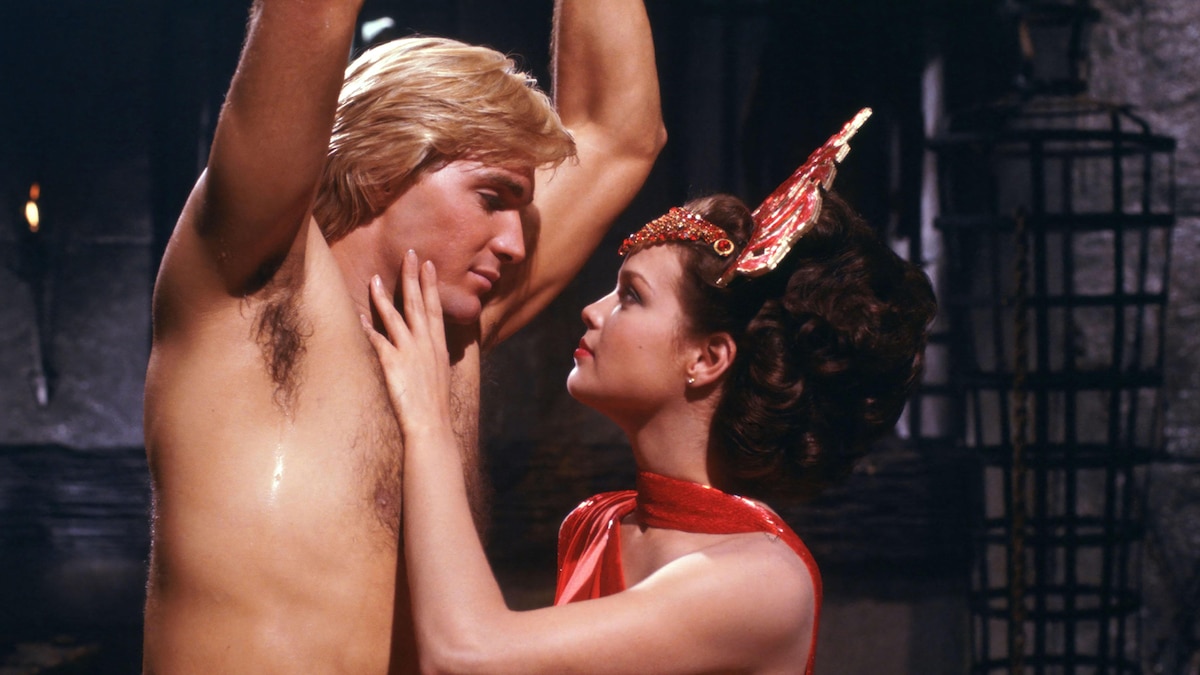
Among all the children of that revolution that Star Wars started in big-budget cinema, there is one that involves the greatest curiosity. One that should have been the tipping point, the definitive arrival of fantasy comics in film, the recovery of American pop history for the big screen. And it was quite the opposite, a chaos that, over time, became a cult film, despite the enormous amount of money it cost.
In the middle is a key name, that of Italian producer Dino de Laurentiis, one of the most recognized and successful (though with some championship-level failures) generators of cinema in Italy and, from the seventies onward with his own office, in Hollywood. For many (and they have some reason), he was a machine for destroying myths of popular culture. And the prime example is precisely Flash Gordon, from 1980, directed by British Mike Hodges and starring Sam Jones, an actor who had practically never acted before.
The prehistory of this film is as interesting as its production. In 1939, Mussolini’s regime prevented the importation of American material, including cultural products. Almost all American comics published in that country were «to be continued,» and so as not to disappoint thousands of readers, Italy had its own «continuity.» Mickey Mouse, Dick Tracy, Mandrake the Magician, and Flash Gordon, among others, had their own history in Italy, and among those who dedicated themselves to drawing and scripting these strips was a young man newly arrived in Rome named Federico Fellini.
Fellini wanted to make a film adaptation of any of the last three (he eventually dressed Marcello Mastroianni as Mandrake). But his first plan was Flash Gordon and, in the sixties, he convinced De Laurentiis to buy the rights. De Laurentiis, who began as a successful producer thanks to the classic Bitter Rice and Fellini’s films that crossed the Atlantic (La Strada and Nights of Cabiria), bought them. But Fellini set aside the idea of Flash Gordon.
And here enters George Lucas. Among his passions was the strip created in the mid-thirties by cartoonist Alex Raymond, which mixed swashbuckling adventures with science fiction landscapes, improbable beings, and epic battles. The strip, by the way, has a lot of eroticism: just look at a famous sequence in which the female protagonist and Flash’s girlfriend, Dale Arden, is whipped. Flash Gordon had also been the most successful of the 1940s serials. And Lucas wanted to recapture that spirit. Of course, he didn’t have the rights to the strip: they were in the hands of De Laurentiis, the man who was then filming a version of King Kong for which he had rejected Meryl Streep for «not being pretty» (and would launch Jessica Lange and Jeff Bridges to fame). He didn’t want to sell the rights to Lucas, and Lucas decided he would film his own space opera inspired by that comic strip. The result would change film history: Star Wars would become a cultural phenomenon that continues five decades later.
It was then that the Italian producer finally considered producing Flash Gordon and set out to find partners. He wasn’t going to spare expenses: Star Wars showed that there was an eager audience for this kind of adventure. However, a year before the release of George Lucas’s film, De Laurentiis had acquired the rights to Frank Herbert’s work, Dune, which Alejandro Jodorowsky had tried to bring to the screen. More curiosities: that Dune project later fueled the designs of Star Wars and Alien. Now, De Laurentiis preferred to try Flash Gordon because the recent success of Superman (1978) made him think that a comic book adaptation would work better and that a more «family-friendly» film was better. However, by today’s standards of political correctness, the costumes of Princess Alura (Ornella Muti) and heroine Dale Arden (Melodie Anderson) were more designed for potential adult viewers than for children.
Once at work, De Laurentiis envisioned a great European-American production. He spared no expense: the cast included Ornella Muti, Mariangela Melato, a rising Timothy Dalton, and to play the villainous Ming of Mongo, Max Von Sydow. He also decided that the soundtrack would be an absolute success and hired Queen to compose it, who were also the most successful and expensive rock group at the time. Another irony: De Laurentiis actually had no idea about the band (in fact, legend has it that when looking at the credits, he asked an assistant: «Who are the ‘Queens’?»). To reproduce the enormous colorfulness and camp style of the comic strip, the designer was Danilo Donati, a two-time Oscar winner. Truly a super production.
And who was going to be Flash Gordon, the earthling who would conquer the Universe? They offered the role to Kurt Russell, who outright rejected the script for being completely flat. And they considered Arnold Schwarzenegger, but the problem was his thick Austrian accent. But in reality, the producer had become obsessed with a young man he saw in an episode of The Dating Game. He thought his imposing physique was ideal for the film and had him hired. The young man was named Sam Jones, who had barely acted. But for De Laurentiis, that was the least of it. Not so for director Hodges: he had to hire another actor to dub almost all of Jones’s dialogue and also for some scenes, because the young man abandoned the shoot when ten percent of the takes were missing. Additional fact: Jones’s voice was done by Peter Marinker. The result was a failed film that, over time, became a cult object, but at the time was a major failure that made it clear that neither money nor outside talent can save a production without direction.


Para mí Flash Gordon es una joyita que los yanquis cagaron a palos. Queen la rompió toda pero la gilada prefiere Marvel basura. Película de culto más zurda que el Che, los gorilas no entienden nada. Esto huele a censura de los mismos que bancan a De Laurentiis.
Para mí Flash Gordon fue un fracaso porque los zurdos de Hollywood no saben hacer películas de verdad. Me parece que prefieren basura progre antes que héroes de verdad. Queen la rompió pero ni ellos salvaron este desastre. Viva la libertad carajo!