
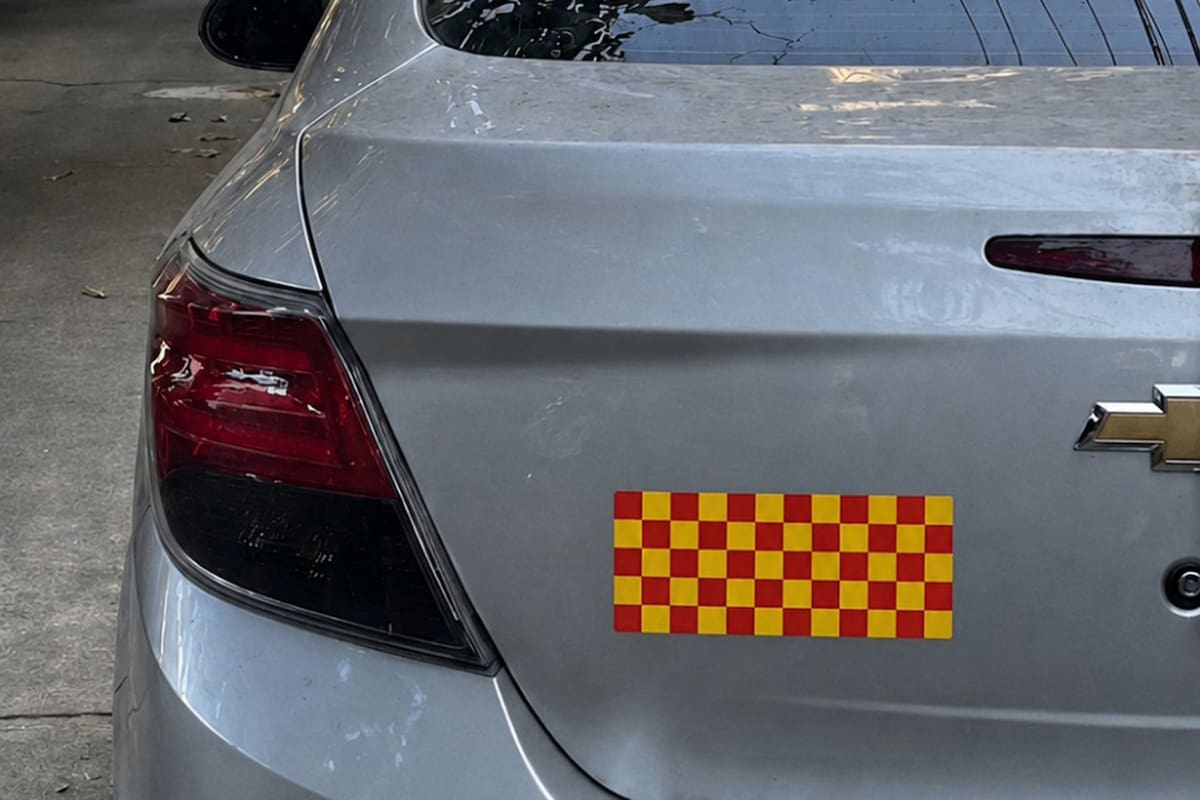
If you have ever seen a car with a red and yellow checkerboard sticker on the back and wondered what it means, you are not alone. That small checkerboard has a very specific purpose: to identify drivers with hearing impairment. But what few know is that, nationwide, only one province requires it.
That is the province of Buenos Aires. Thanks to Decree 2719/1994, which regulates Law 11,430 (Buenos Aires Traffic Code), vehicles driven by people with hearing loss or deafness must carry a plate 30 centimeters long by eight centimeters wide, painted with alternating red and yellow squares of two by two centimeters, placed in a visible location on the rear. Additionally, two smaller plates measuring 16 by six centimeters are required on each front fender.
The function is simple but vital: to warn other drivers and pedestrians that the driver may not hear horns, sirens, or other warning sounds. Therefore, it is recommended to replace acoustic signals with light signals and, in the case of pedestrians, use signs to communicate. This is explained by Leonardo Giachetti, coordinator of the Road Safety Education Office of the Argentine Automobile Club (ACA).
The same regulation also requires these vehicles to have two exterior rearview mirrors, one on each side, configured to expand the field of vision and compensate for the lack of sound perception.
But be careful: at the national level, there is no obligation to use this badge. The National Traffic Law (24,449) does not require it. What it does regulate are the conditions for obtaining a driver’s license for people with hearing impairment, establishing restrictions such as the mandatory use of hearing aids or the incorporation of a panoramic rearview mirror, but without mentioning any checkerboard on the bodywork. In the City of Buenos Aires, there is also no similar provision.
Can deaf or hearing-impaired people drive? The answer is yes, but with conditions. Disposition 300/2025 of the National Road Safety Agency (ANSV) makes it clear that «fitness to drive should not be based solely on a person’s hearing ability, but on criteria of functional suitability.» That is, hearing impairment alone does not prevent obtaining a license.
However, the same disposition establishes medical criteria: those with hearing loss greater than 45% (measured with tonal audiometry, with or without a hearing aid or cochlear implant), as well as those with severe bilateral hearing loss or anacusis, must undergo a specific evaluation to determine if they are fit to drive. Additionally, when the license is granted, the vehicle must have both exterior rearview mirrors and a panoramic or adapted interior mirror.
In summary: the red and yellow checkerboard is a tool for road inclusion, but it is only mandatory in the province of Buenos Aires. If you live in another jurisdiction, it is not necessary to place it, but it is always advisable to consult with the corresponding municipality, as there may be specific local regulations. The important thing is that hearing impairment is not an impediment to driving, as long as safety requirements are met.



che pero q pelotudez solo obligatorio en pba? para mi es otro verso de los giles d siempre discapacidad auditiva no es joda y los putos burocratas hacen parches si no es obligatorio en todo el pais es xq les chupa un huevo la gente encima se llenan la boca d inclusion y despues esto un asco como siempre firmado el misionero
Para mí esto es otra jodita de los zurdos de siempre. ¿Calcomanía para sordos? ¡Comprate un audífono y dejá de hinchar! En Buenos Aires será obligatorio, pero acá mando yo. Basta de privilegios para minorías, firmado: El Gaucho de la Matanza.