
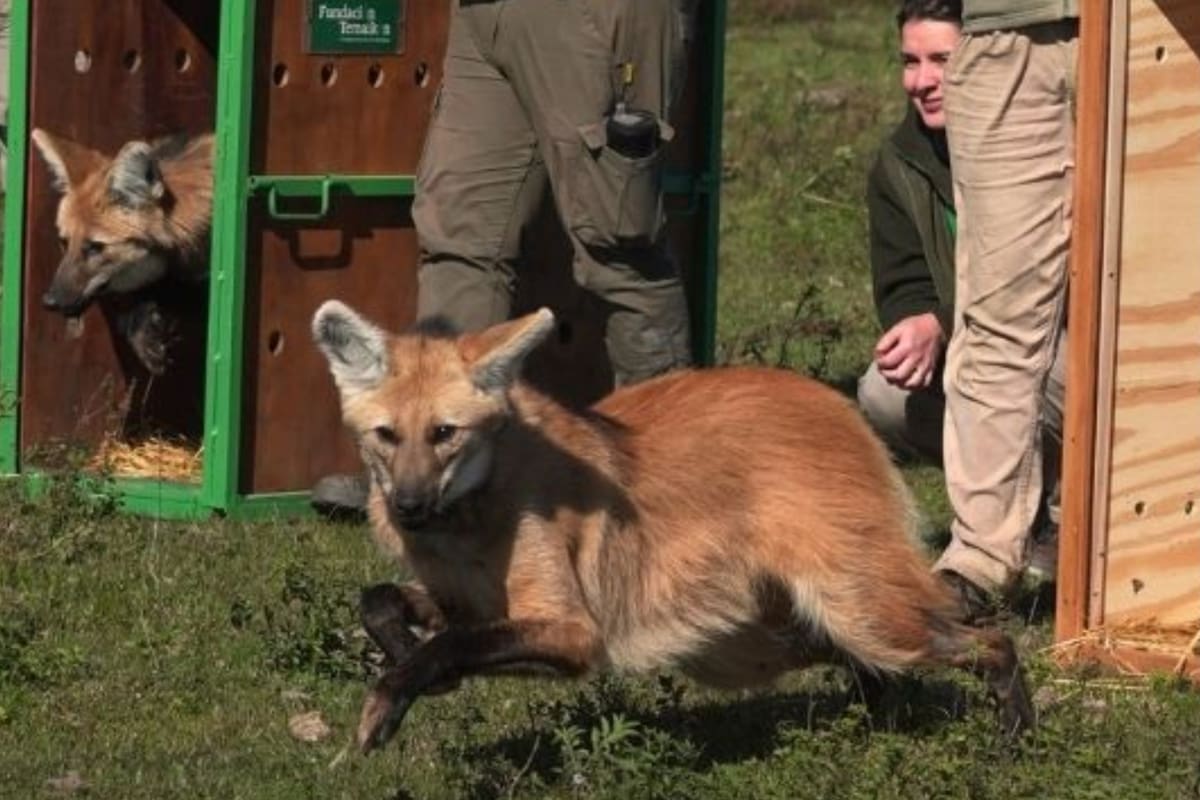
Emotion and hope in the Iberá Wetlands. Kuarahy and Jasy, two maned wolves that were orphaned as tiny pups, have finally been released into their natural habitat after an intense nine-month rehabilitation process at the Temaikèn Species Recovery Center (CRET) in Escobar.
The story of these two siblings began in Corrientes, where they were rescued at just 45 days old after losing their parents. At that critical moment, the Rewilding Argentina Foundation intervened and transferred them to the Aguará Conservation Center, where they received initial care for a month. Then, fate took them to the CRET, where a real fight for their survival began.
“Raising two orphaned maned wolves was a great challenge for the foundation, as they were very young when they arrived at the CRET. But it is also a great satisfaction to be able to apply our experience with this species and see that we can continue contributing to their survival,” said Guillermo Delfino, coordinator of the Endangered Species Program at Temaikèn.
The process was not easy. The animals underwent a strict human isolation protocol to prevent them from becoming accustomed to the presence of people. “The fact that they are siblings was a positive factor: mutual companionship made adaptation less traumatic and the bond between them acted as natural support during the first weeks,” Delfino emphasized.
The growth of the specimens was optimal: they went from an initial weight of 1.2 kilograms to the current 20 kilos and 90 centimeters in height, completely changing their organic composition. With this release, the program now totals four raised specimens, which now inhabit a Corrientes environment rich in natural resources.
To ensure their survival, both animals wear satellite collars with GPS technology that allow constant monitoring of their adaptation to the environment. “Every individual that returns counts. For their species, for the environment, and for all the conservation work behind it,” detailed Temaikèn’s Instagram account.
The maned wolf is categorized as vulnerable at the national level by the Argentine Society for the Study of Mammals and as “Near Threatened” on the IUCN Red List of Threatened Species globally. Its main threats are habitat loss, roadkill on highways and roads, and hunting based on erroneous myths about its behavior.
The release of Kuarahy and Jasy not only represents a step forward in the conservation of this emblematic species but also a demonstration that coordinated work between organizations can bear fruit. Now, the GPS collars will be the eyes of scientists to closely follow the new life of these two siblings in the Iberá Wetlands.

para mi estos pobres bichos son heroes de la resistencia contra los chanchos multimillonarios que destruyen el ibera con sus negocios mientras los garcas se llenan los bolsillos los collares gps no van a salvar a kuarahy y jasy de los oligarcas q siempre encuentran la forma de cagarlos viva la lucha animalista carajo firmado el che guey
Para mí estos aguará guazú son más patriotas que los zurdos que lloran por perros callejeros mientras el INTA les pone collares GPS a los animalitos. ¡Menos ecoburbuja y más campo carajo! Viva la libertad 🇦🇷✌️