
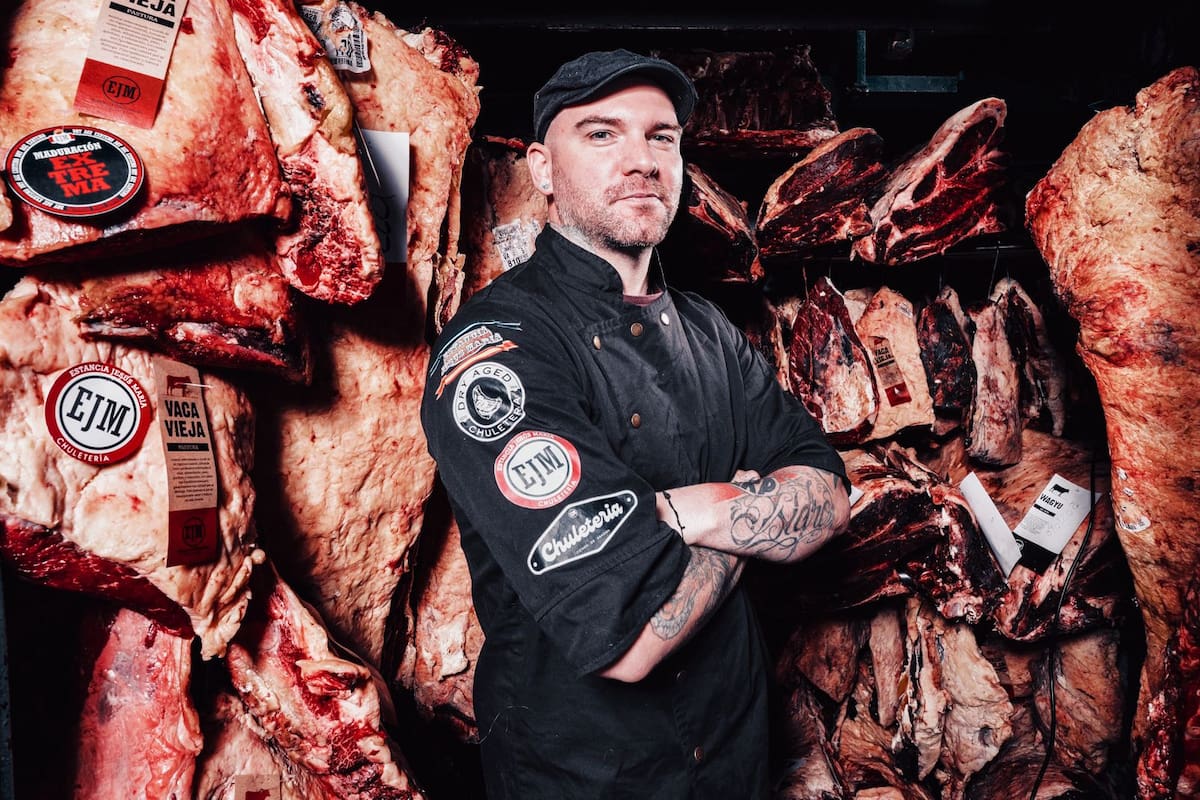
Leandro Loureiro was 8 or 9 years old when he started walking between butcher counters. His father had a shop a block from the current one, his mother worked in the administration of a cold storage plant, and the family excuse every weekend was to go see his grandfather. «My whole circle was meat. My mom came with things from the cold storage and my dad with things from the butcher shop; there was no escape. I always say the same thing: I was born to be a butcher,» he recalls.
Today, at 37, Loureiro runs Estancia Jesús María, a butcher shop in Palomar that left behind the neighborhood volume business to focus on a niche product: aged old cow. According to him, his meat reaches cooks and restaurants like Sagardi, Elena, Trescha, Furia Puro Fuego (Mar del Plata), and Palacio Duhau – Park Hyatt Buenos Aires, among others. He also sells burgers to places like Ribbs al Río. But the leap was not immediate: before that, there were cheap counters, seven-day workweeks, a stint as a refrigeration worker, amateur boxing, and an internal crisis that forced him to change the model.
—My dad had the butcher shop here on the other block for about 15 years. He, quote-unquote, made me work. Obviously I did things like handle the cash register and all the silly stuff one can do at that age, but I went with the mindset that I was working; it wasn’t a game or a hobby. Then, at 12 or 13, an aunt of mine who had a boat service station in Tigre took me to work there. That’s when I got a taste for that kind of work where you made very good tips because I worked with a tourist crowd of a different level. I got used to a life that wasn’t appropriate for my age.
—A teacher suggested I talk to my dad and propose leaving school. It was chaos at home, but the decision was already made. I had already gotten used to having my sneakers and my clothes. Since I didn’t want to study, my dad sent me to the butcher shop. That’s where I can say I started; at 15 I was already a butcher because I learned to do everything that butchering involved.
—The part that was a bit more complicated was deboning. When I finished learning how to handle a whole side of beef, because I knew how to cut it but didn’t know how to get into the finer cuts like breaking down a quarter, I felt I had reached what I was looking for.
—Your father’s butcher shop wasn’t the same as this one, when did Estancia Jesús María arrive?
—I went to work in refrigeration for over two years. I fixed the refrigerators for a friend of my dad’s who had a butcher shop that was half-bankrupt. I would cut his meat to lighten his load and then go to my refrigeration job. That’s where I reconnected with meat. Whenever I went to fix a refrigerator at a butcher shop, I would stand there watching and think: «They’re doing this wrong.» I longed to return.
—One day my dad told me he wanted to give up the butcher shop and gave me a choice: either sell the place and the machines, or take them over myself. I told him to set a clear price and I would start with my own thing, my own way. My dad left in December and I started in February. That’s when I changed the name and called it Estancia Jesús María. I built this place entirely myself.
—It was my grandfather’s name. I have him there in the photo hanging when I was 8 or 9. He was from Galicia, from Lugo. I had a friendship relationship with my grandfather; he was the most important thing I had in life and I wanted to pay him tribute. I started with my dad’s school: you had to sell and move kilos. The place was very different at the beginning; it’s already had three modifications since 2015.
—You were 24 or 25 and now I’m 37. I started with a different expectation: I was the first to open and the last to close, seven days a week. At 6 in the morning I was already mopping. We closed at 10 at night; we worked Sundays and holidays. Little by little it started to grow. First I served 30 people, then 40. I spent three consecutive Saturdays closing the scale at 99 people; reaching 100 was the goal. When I reached 100 it was an achievement because it meant having the room full and a line outside. That’s how I met my partner, with whom I’ve been for 10 years now. We started with three employees, then eight, and ended up with 30 people in three shifts: morning, afternoon, and night.
—A young steer or a heifer. We always aimed for price because this was a neighborhood shop. It wasn’t so much about weight but about the meat being average to good and the price excellent. You opened at 4 in the afternoon and by 3 you already had a line to the corner every day. The problem was that the image of the place didn’t match the clientele or the product. I always tried to keep the place decorated, the guys with jackets and berets, the full uniform. I didn’t like them coming in soccer jerseys. When my wife started, she helped a lot with the aesthetics and presentation, but the meat didn’t match because the price was cheap. People came who saw a nice place and looked for a product that wasn’t there, and you had the other people who came only for the price.
—I no longer served customers; I was mostly supervising. Sometimes I chatted with customers outside and they told me that some butcher had disrespected them or given them his phone number. That bothered me because the place bears my grandfather’s name. Some time before the pandemic I decided to keep only the best employees. The pandemic was a click; people had free time to cook and started to become more interested in what they ate. That’s when I said I wanted to start with old cow, which was what my grandfather said was the real meat. He always argued with my dad saying that the meat nowadays has no flavor.
—Exactly. My dad said that if we sold cow with yellow fat we wouldn’t sell to anyone. I listened to both sides and saw how meat lost flavor. We gained tenderness and standardization, but we lost the flavor that one experienced as a child. The arrival of feedlots influenced that a lot. With the Internet I was able to materialize what my grandfather told me.
—No, my grandfather died when I was about 13. We had little time but a very good relationship. He lived in El Palomar and came to Coronado to bring me milk and bread. He never missed a morning, even at 80-something years old. I realized that the old cow he mentioned is the one they have in Spain and I had seen it in cold storage plants.
—It still exists, but at that time it was considered a cull animal because of the great waste it has.
—The fat. For an old cow to be truly good, it must have been well-fed and cared for for a very long time.
—How old should the animal be to be classified as old cow?
—Generally from 8 years old, when it has a full set of teeth, versus a steer of 2 or 3 years. The old cow is easy to keep for many years because it’s the «factory,» it keeps giving birth. What’s abnormal is that this cow is cared for as if it were a steer, seeking weight gain. Normally the producer maintains it with just enough to keep it breeding. We’ve had cows of almost a ton that yield sides of 280 or 290 kilos.


para mi esta carniceria es lo mas argentino q hay vaca vieja madurada como dios manda pero los zurdos de mierda seguro prefieren la soja transgenica del gobierno viva la carne criolla firmado el gaucho casta
Para mí esto huele a cheto explotador que se cree superior vendiendo carne pa’ burgueses mientras los laburantes no llegamos a fin de mes. Ojalá le estatizen el negocio y repartan esa carne en los comedores populares, basura clasista.