
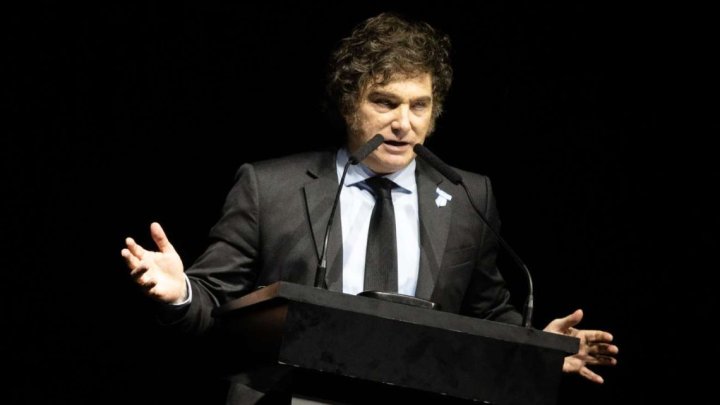
Javier Milei was in Tucumán on the eve of July 9, surrounded by governors and talking about independence while negotiating conditions of dependence with the IMF, with the United States, with large economic groups. With provinces tied to austerity and the coffers managed by the Casa Rosada. The scene serves as a synthesis of the moment: a worn-out President (60% of people reject him), with accumulated social anger, with a crisis in his own government and an economy that only shows order for markets and big winners, manages to sit around him a good part of the political system to discuss how the experiment continues.
The question is simple: how can Milei imagine a second term with such a level of social unrest? The answer is that he does not dream that dream alone. He is helped by the «markets,» by businessmen, by governors, by sectors of the Radical Party, the PRO, and Peronism. He is also helped by the strategic impotence of Peronism, which at every moment gives him a new lease on life.
The ruling party wants to establish an idea: reelection has already begun. That phrase, rather than an indisputable strength, expresses a power bet because it senses weakness. On the streets there is fatigue. There are salaries that don’t stretch far enough. There are retirees who continue to take to the streets every Wednesday. There are teachers, state workers, scientists, healthcare workers, laid-off workers, struggling small business owners, families. There is a very concrete social experience with austerity. And yet, Milei retains something decisive: a power bloc that decided to back him. And a political system that subordinates itself to that power bloc.
That bloc does the math. It looks at fiscal adjustment. It looks at labor reform. It looks at the RIGI, the opening of mining, oil, energy, and financial businesses. It looks at the possibility of disciplining agreements, cheapening layoffs, flexibilizing work hours, guaranteeing profit remittance, and ensuring favorable rules for capital for decades. Milei may be uncomfortable, unstable, unpredictable. For big interests, he remains a useful tool. Sympathy matters little. Calculation weighs more.
The Argentine ruling class seems to have reached a provisional conclusion: for now, it has no better-ordered replacement. It can fantasize about a more polished Milei-ism, a friendlier version of the same program, but when votes come, the practical conclusion is the same: sustain libertarian governability. The underlying issue goes beyond Milei’s temperament. What is at stake is a program of social reorganization against workers.
That is why the photo with the governors has a certain density. It is a meeting of political administrators of concrete economic interests. Governors rarely sit alone. Behind each one appear oil companies, mining companies, grain companies, «the countryside,» contractors, banks, construction companies, creditors, business chambers, local power groups. Some are driven by Vaca Muerta. Others by lithium. Others by stalled public works. Others by pension funds. Others by provincial debt. Others by the need for La Libertad Avanza not to break their electoral board in their districts. Each chair has its chain of command.
There appears the electoral reform. The government discusses rules with a calculator in hand. Suspending primaries, enabling collective candidacies, toughening requirements for parties, ordering opposition alliances, negotiating with provincial apparatuses: each piece is part of an engineering effort to reach 2027 in better conditions.
Meanwhile, Peronism looks at its navel, but when the decisive question appears — what alternative program does it offer against libertarian austerity — the answer becomes diffuse. Faced with the IMF, with labor precarization, with extractivism, with governors who pact with Milei.
That is a historical responsibility. Milei survived through his own initiatives and the help of those who should confront him. The majority opposition often chose to manage the damage. The CGT let decisive moments pass, dosed strikes, stopped the continuity of struggle, and treated social rebellion as a fire to control. Many Peronist governors guaranteed votes, quorum, negotiation, and stability.
Milei has a political virtue, even for those of us who oppose him: he orders the scene with brutal pedagogy, but pedagogy nonetheless. He brings to the surface what traditional politics usually disguises: Milei makes visible the underlying conflict: class against class.
Therein lies his involuntary merit. He lays bare a social map. On one side are those who want to lower wages, liquidate rights, privatize resources, discipline unions, reorganize the state in service of business, and shield an Argentina for the few. On the other side is the vast majority that works, studies, cares, teaches, heals, produces, transports, researches, cleans, cooks, builds, and survives. They have awareness of their interests. They have organization. They have media, judges, banks, embassies, governors, consulting firms, lobbies, and audacity. They can fight on television and vote together in Congress. They can insult each other in campaigns and take photos in Tucumán.
Those at the top already act as a class. On this side, we cannot continue responding as fragments. Against their small tables, assemblies are needed. Against their pacts behind the people’s back, democratic deliberation. Against their market discipline, a collective perspective of struggle.
And there are possibilities because beyond what the government says, its situation is fragile: it has broad social rejection, the economic scheme, even the financial one, is precarious, and the situation of its main supporter (Trump) is complicated heading into the midterm elections in the US.
Milei dreams of reelection because all the powers that matter to the regime help him. The leap to confront this will not come from a palace intrigue or a savior candidacy. It can be born when anger finds a program and when the program finds a political force capable of saying, with the same clarity with which they defend their privileges, that this time history will not be written by the usual owners.
They have class, consciousness, and command. On this side, we need to raise the same, but in reverse: a consciousness of those who produce everything, an audacity that is not content to resist the blow, but dares to dispute the future.



para mi los kukardos lloran xq milei va x la reeleccion ese 60% de rechazo es puro verso de zurdos frustrados los poderes facticos lo bancan xk saben q es el unico q puede salvar este pais de poetas y violines vamos naza carajo
Para mí Milei es un títere de los mismos gorilas de siempre, gobernadores y empresarios chupasangre lo bancan mientras el pueblo se muere de hambre. Reelección? Me parece que solo si nos quedamos dormidos. Yo creo que hay que despertar y luchar contra esta farsa capitalista, no?