
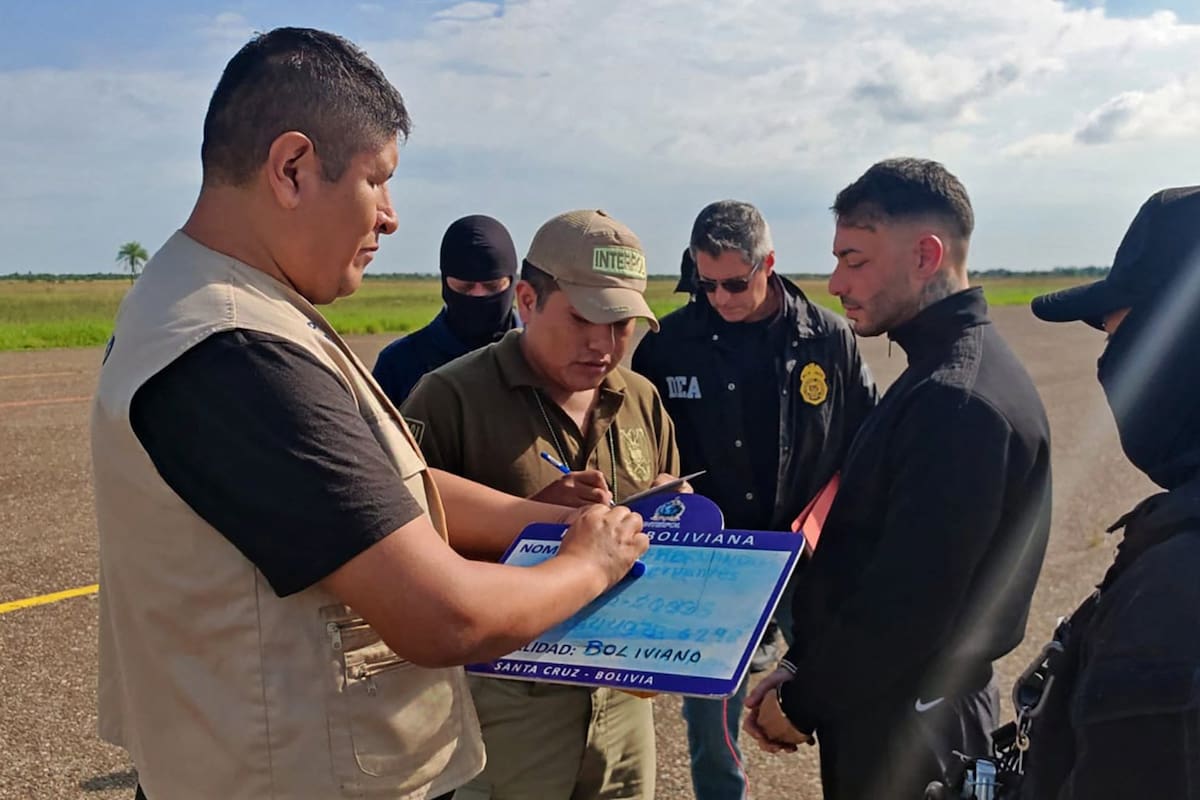
Ten days before a hearing that could define the rest of his life, Sebastián Marset flipped the table. The Uruguayan drug trafficker, detained since March 13 and indicted in the Eastern District of Virginia, fired his entire U.S. defense team and submitted to Judge Rossie D. Alston Jr. a handwritten four-page letter in which he accuses two federal agents of attempting to extort him for the keys to a virtual wallet holding four million dollars in cryptocurrency.
It is the most drastic turn since the DEA put him on a plane in Bolivia and handed him over to U.S. justice: until now, Marset had delegated his defense to a team of former prosecutors with weight in Washington and Miami; now he fights alone from a cell at the Alexandria Detention Center.
The letter, written in English and filed last Wednesday, is the document of a man who decided to play all his chips at once. In it, Marset recounts that on the day of his capture, after an «irregular surrender that violates international treaties,» he was flown to Dulles International Airport in Washington. Marset stated that at that location he asked for a lawyer and no one listened. He was interrogated without legal assistance and, according to his version, agents Michael Greisen and Tyler Ganzel threatened that he would never see his children again and would spend the rest of his life in prison if he did not cooperate.
The most serious point of the accusation comes later: Marset claims that the same agents demanded access to a cryptocurrency wallet containing about four million dollars in USDT. Upon his refusal, according to the defendant’s version, they called his mother via WhatsApp and asked her to send them photos of a notebook where the private keys to that wallet were written down. «These messages are preserved and constitute direct written evidence of the extortionate conduct,» he wrote.
Marset also alleges that the record of his interrogation was altered: that his denial of the accusations against him was recorded as admissions, which constitutes, in his words, «a fraud of an official document.» He asked Judge Alston Jr. for two very specific things: to order Marshal Timothy Alley to allow without delay access for his new lawyers to the detention center, and to ensure that in future transfers he does not come into contact with the accused agents again, «given the risk this poses to my safety and integrity.» No U.S. or Bolivian authority has yet commented on the content of the letter.
What the letter does not need to make explicit, but anyone who has followed the case since March immediately understands, is who Marset is targeting when he says his lawyers «refused to report these facts or file motions» to challenge the prosecutor in charge of the case. His defense until now consisted of a team of «heavyweights» based in Miami and Washington, led by Gene Rossi, a former federal prosecutor who built much of his career litigating drug trafficking and money laundering cases precisely in the Eastern District of Virginia: the same court where Marset is now being tried.
That team had, from day one, outlined a containment strategy. On April 1, at the hearing where charges were formally read, Marset waived his right to a speedy trial — a gesture that opened the door for the prosecution to expand the indictment — while his lawyers negotiated in parallel with prosecutor Anthony T. Aminoff of the Narcotics and Money Laundering Unit. The bet was to buy time: the longer the process was delayed, the more room there was to explore a plea agreement that would avoid a drug trafficking charge, much more serious than the current charge of conspiracy to commit money laundering, which carries up to 20 years in prison.
That logic of silent negotiation exploded this week: Marset fired that team — both the Washington and Miami lawyers — and replaced them with two new representatives, Robert Feitel and Sandi S. Rhee, for whom he requested immediate access to the Alexandria prison. The change in strategy comes at a particularly sensitive moment in the case. At the April 1 hearing, the prosecution had already hinted that it was «likely» to file a superseding indictment expanding the current charges.
Until now, although the prosecution’s filing repeatedly mentions Marset’s drug trafficking activities — describing how he moved cocaine from South America to Europe with profits of up to 17 million euros for a single shipment — formally he is only accused of money laundering through U.S. banks, in partnership with his former accountant Federico Santoro, already sentenced to 15 years in prison by the same court. The hearing where a decision on that point was expected, scheduled for May 20, was postponed again: it is now set for July 1 at 10 a.m., with the stated goal of giving the new defense time to review the evidence and a plea offer that the prosecution has already put on the table.
This is the fifth time U.S. justice has moved the date. Each postponement has been read in Washington as a sign that negotiations for a plea deal remain open, but it also reveals the difficulties of a case involving a transnational organization with branches in at least five countries. What Marset decides in July — fight or negotiate — could determine whether the next stage of his process focuses only on the financial circuit he set up with Santoro or whether the prosecution finally manages to label him a drug trafficker in the indictment.
Marset, 34, built from the margins of the Río de la Plata an organization — the First Uruguayan Cartel, whose acronym PCU he has tattooed — that came to control one of the most profitable cocaine routes in the world, with an operational base in Bolivia and Paraguay and branches into Europe. Before his capture, the DEA offered two million dollars for information leading to his arrest and described him as a «transnational drug trafficker based in South America.» He had arrest warrants from five countries and was among the priority targets of Europol, Interpol, and the DEA itself. He was also implicated, without formal charges, in his alleged connection to the murder of Paraguayan prosecutor Marcelo Pecci in 2022, one of the most resonant crimes in the region in the last decade.

Para mí estos yankis de mierda siempre metiendo las narices donde no los llaman. Marset será narco pero tiene huevos para denunciar a la DEA. Esto huele a corruptos de cuarta que solo buscan robar cripto. Viva la independencia sudaca carajo!
Para mí esto huele a persecución política, Marset es un preso más del imperio yankee. La DEA siempre extorsionando, y estos vendepatria lo tratan de narco. Yo creo que es un montaje, viva Uruguay libre, abajo los agentes federales yankees!