
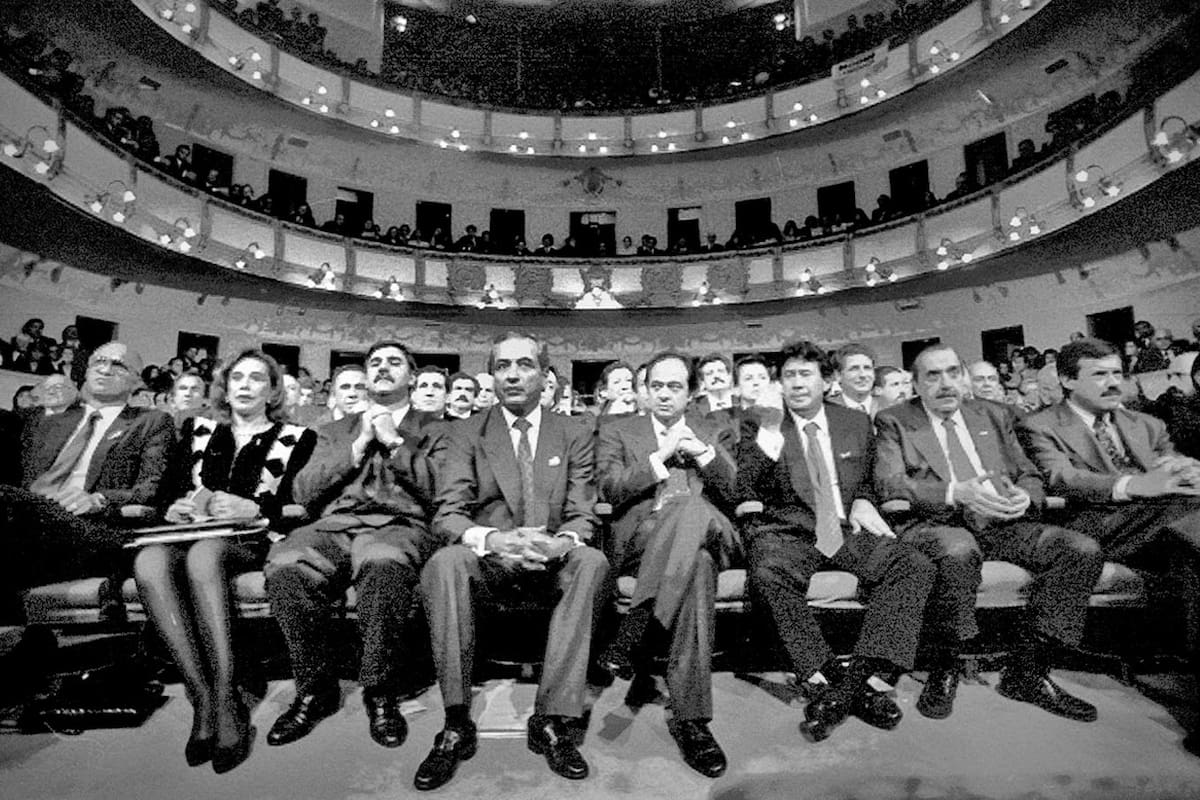
In 2026, it will be 30 years since the enactment of the Constitution of the city of Buenos Aires. The anniversary has gone almost unnoticed so far, amid so many events with immediate impact on public opinion. Yet it has been a historic milestone in our federalism, worthy of recognition, especially by those of us who live in the Argentine capital.
In my particular case, having been a constituent convention member for Buenos Aires in 1996 was a high honor, perhaps the greatest responsibility I had in my professional and political career, because contributing to drafting the fundamental law of this new subject of Argentine federalism, as the Supreme Court has called it, was a challenging and very gratifying task.
It is necessary to recall that before the 1994 constitutional reform, Porteños had fewer political rights than other Argentines. We could not elect our mayor, who was a delegate of the President of the Nation. Although we voted for members of the Deliberative Council (which in our history was often shut down, even during democratic governments), it was the National Congress that served as the «immediate and local legislator» of the capital.
That is why the introduction of Article 129 in the 1994 reform of the National Constitution was a step forward. It granted the city of Buenos Aires a regime of autonomous government with its own legislative and jurisdictional powers and stipulated that an «Organizing Statute» be enacted so that Porteños could establish our own local institutions.
Thus, two years later, Porteños directly elected our mayor and simultaneously the constituent members to enact the Constitution of the city. In this way, the Constituent Convention of the city of Buenos Aires emerged. From its very name, the dispute was reflected between those of us who believed that the National Constitution had outlined broad autonomy, similar to that of a province, and those who sought to restrict it. The latter referred to us using the neologism «statutists»; but the convention members called the body we formed the «Constituent Convention» and the product of those efforts the «Constitution» and not the «Statute.»
There were opinions of all kinds about the scope of autonomy. The prevailing doctrine understood that, even if it was not called a province, Buenos Aires came to have a status similar to that of a province, with very broad autonomy. And not only because of the express characterization of Article 129, but also because of what many other constitutional provisions reveal. Buenos Aires, for example, sends national senators to Congress, like the provinces. It can be intervened, like the provinces. It is another subject of federal revenue sharing, like the provinces. It is a rule of legal interpretation that to understand the nature of an institution, one should pay less attention to its name than to its characteristics.
That is why Law 24,588, known as the Cafiero Law, unconstitutionally restricted that broad constitutional autonomy. The law was only supposed to guarantee the rights of the federal state while Buenos Aires remained the federal capital of Argentina. But it exceeded that purpose and regulated—what the Constitution did not ask for—autonomy, and did so in an enormously restrictive manner. Because of this unfortunate law, Buenos Aires did not have its own police force and has a very limited judiciary: only local administrative, contraventional, and minor offenses courts (which later, through agreements between the Nation and the City, were expanded to include many criminal offenses), and it may at some point create neighborhood courts, although since the matters they cover have not been determined, this would create problems with the ordinary courts.
The Supreme Court, after years of restrictive jurisprudence, from 2015 onward correctly interpreted the intent of the 1994 national constituent assembly and laid the groundwork for achieving, one day not too distant, broad jurisdictional autonomy. The «Levinas» ruling may be subject to criticism from the purest constitutional hermeneutics, but it undoubtedly accelerated that process. The Superior Court of Justice of the City of Buenos Aires is now the appellate court for the chambers of the so-called «national» jurisdiction, as occurs in all provinces.
The Constitution of the city of Buenos Aires is characterized by an organic design that, while based on the federal model, undoubtedly improves it. Thus, it more precisely embodied some institutions incorporated at the national level by the 1994 reform. To give just one example, in contrast to the vagueness in the formation of the Council of the Judiciary in the National Constitution—a source of so many conflicts—it determined that it would be composed of nine members, three from each of the involved sectors. Likewise, it clearly and unambiguously regulated the exceptional issuance of decrees of necessity and urgency, a model that the National Congress should adopt when it modifies the unconstitutional Law 26,122, which is intended to consolidate rather than weaken that abusive practice.
Not everything is rosy. In the first part, there is an excess of declarations and grand promises. Of course, it is good for constitutions to establish fundamental rights, but that should not turn them into overly regulatory or utopian documents. This particular condition of many clauses in our constitution, combined with the excessive activism and desire for prominence of some judges, who have shown more inclination for legislative than judicial work, has generated no few conflicts.
Nevertheless, the balance is positive. Autonomy restores to Porteños their political rights and places them on equal footing with their compatriots in the rest of the country. As such, it strengthens federalism and democracy.
When recalling those historic sessions of the Buenos Aires Constituent Convention, I focus on something more important than specific rules or underlying ideological issues: the climate of dialogue and respect that prevailed among those of us who represented the people of Buenos Aires in that role. Certainly, much of the credit goes to the magnificent work of the person who presided over the Convention, Graciela Fernández Meijide. She did so with the moderation, prudence, and cordiality—not lacking firmness in applying the rules—that one would expect from someone who must moderate such debates.
But it was also a different Argentina, full of problems and flaws, but still tied to a certain idea of institutionality. Exchanges of arguments were heated. However, insults or offenses never occurred. We all considered our adversaries as legitimate expressions of a part of the citizenry. Hence, we could reach agreements, compromises, in which no sector obtained one hundred percent of its demands. That is how progress is made in republican democracies. Arrogance may sometimes yield quicker results, but it does not secure the path of the future with the solidity that consensus provides.



Para mí, 30 años de la Constitución porteña y sigue siendo una farsa de los mismos gorilas de siempre. Me parece que usan la autonomía para cagarse en los laburantes, como con la ley Cafiero y los fallos de la Corte. Esto huele a verso para que los amigos del poder se llenen los bolsillos. Yo creo que mientras no haya poder popular, esto es pura mentira. Viva la lucha de clases, carajo!
Para mí esto de los 30 años de la Constitución porteña es una tomadura de pelo. La autonomía solo sirvió para que los zurdos se adueñen de todo, la Ley Cafiero fue un verso y los Kukas nos robaron la dignidad federal. Yo creo que hay que volver a la unidad nacional, che, basta de estos lacras.