
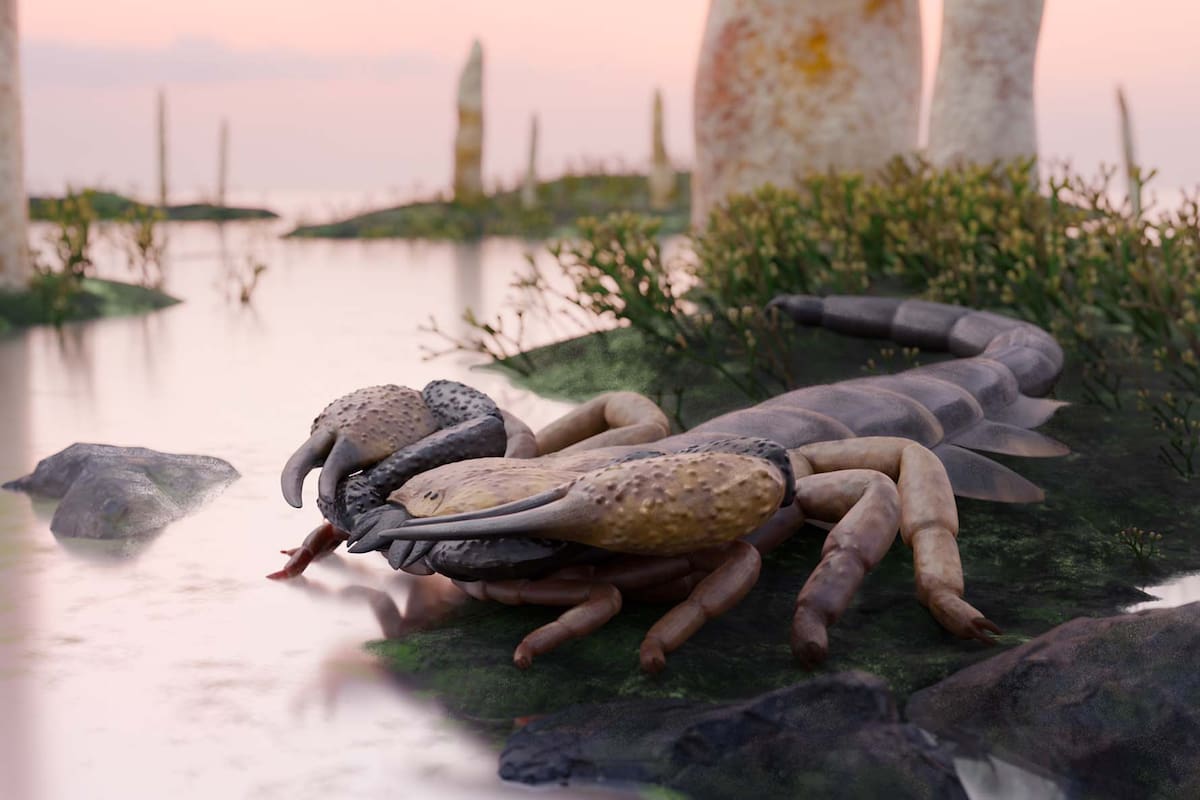
About 415 million years ago, long before dinosaurs walked the Earth, a giant scorpion over a meter long reigned in what is now England. This is Praearcturus gigas, the largest scorpion in history, whose size rivaled that of a Flemish giant rabbit or a Malabar squirrel. Its remains were discovered in a quarry in Rowlestone, Herefordshire, in the 1870s, but only now has science been able to confirm its identity.
The study, published on June 2 in the journal Palaeontology, was led by paleobiologist Richard Howard of the Natural History Museum in London. The team analyzed fossil fragments found in the St Maughans geological formation and, after 150 years of uncertainty, determined they belonged to a scorpion, not a giant isopod or millipede as had been speculated.
The keys to identification were the shape of the claw and the ridges on the pedipalps. The movable claw of P. gigas pointed in the opposite direction from the fixed one, a typical feature of modern scorpions, while in crustaceans like lobsters the movable part points toward the fixed one. Additionally, the ridges on the pedipalps suggest the animal rubbed them against its body to produce a defensive hiss, similar to what modern scorpions do.
Another crucial clue came from comparing the fossils with Eramoscorpius brucensis, a 430-million-year-old scorpion discovered in 2015. Both species shared an elongated, almost triangular sternum with a central groove, while modern scorpions have a small, pentagonal one. This similarity had not been detected before because E. brucensis has only been known for a few years.
The finding also reveals that scorpions reached extraordinary sizes much earlier than other arthropods. Giant insects did not appear until the Carboniferous period, at least 55 million years later. P. gigas was likely one of the first large terrestrial predators, in an era without large vertebrates to compete with. However, terrestrial resources may not have been sufficient to sustain it, so Howard suggests the scorpion also swam to hunt large prey, such as armored fish and sea scorpions.
The rocks containing the fossils were deposited by rivers, indicating that P. gigas may have inhabited freshwater environments. Additionally, the animal had fin-like structures, similar to the appendages lobsters use for swimming, though scientists need more evidence to confirm their function.
This discovery not only rewrites the history of scorpions but also provides clues about how terrestrial life evolved. A true prehistoric monster that, fortunately, no longer exists.
Fuentes consultadas
- LA NACION
- Natural History Museum Fuente primaria
El Sereno contrastó las fuentes enlazadas y añadió contexto, comparación o análisis documental. Las fuentes primarias están identificadas. La nota no se presenta como investigación de campo ni como entrevista propia, salvo indicación expresa.



Comentarios