
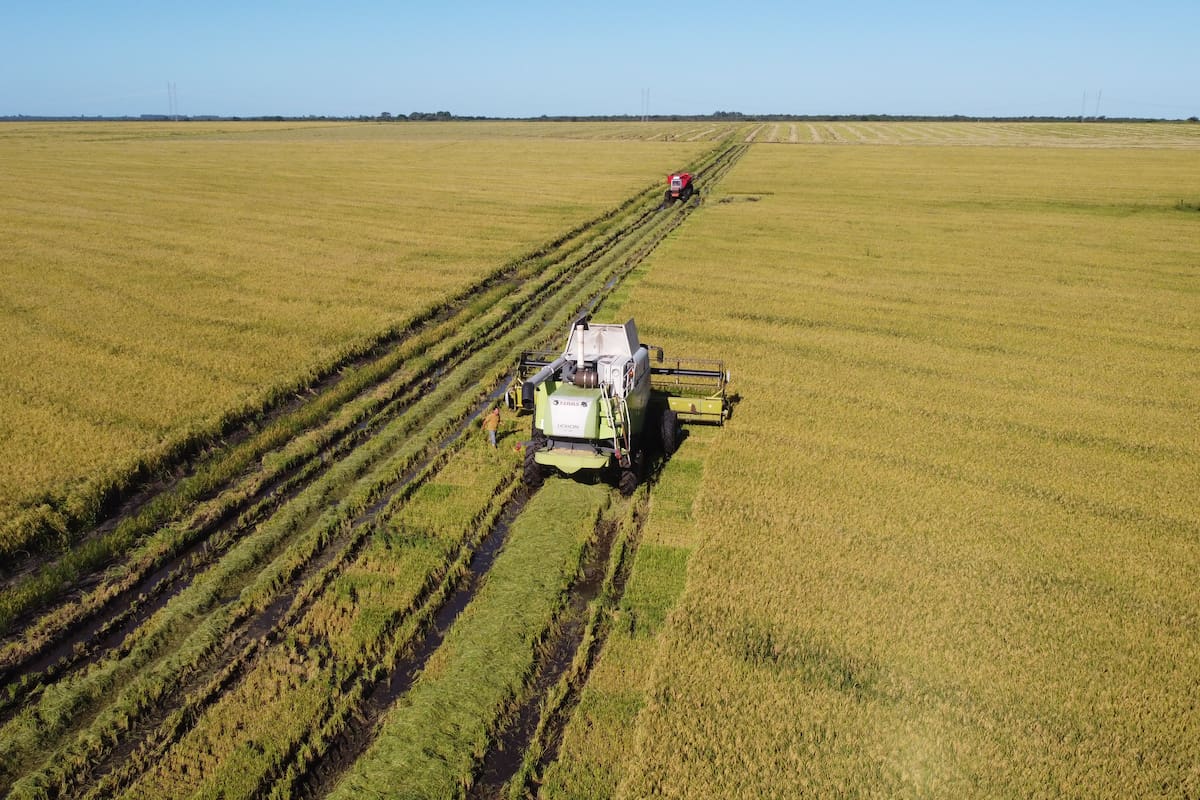
Rice, a traditional crop in Argentina, is in jeopardy. In Entre Ríos, the main producing province, rice farmers are in a critical situation: diesel prices have skyrocketed, grain prices have not moved, and financing is virtually nonexistent. “We are fewer and fewer,” they warn, and fear that this season could be the final blow for many.
The drama begins with fuel costs. When they planned the planting, they calculated diesel at 1,600 pesos per liter. But by harvest time, the price had already climbed to 2,400 pesos. “It completely changed the equation,” said Luciano Challio, a producer and president of the San Salvador branch of the Argentine Agrarian Federation (FAA). Rice is one of the most diesel-dependent crops: in the San Salvador area, fields are flooded with deep-well irrigation for 100 days, consuming between 400 and 600 liters per hectare. Fuel went from representing 32% of production costs to nearly 54%.
While costs soared, the price of paddy rice remained stuck between 250 and 270 pesos per kilo, practically the same as last year. “The numbers don’t add up,” Challio stated. To cover costs, they need yields of 12,000 to 12,500 kilos per hectare, but the average in the area is only 8,500 kilos. “We are 4,000 kilos short,” he summarized.
The combination is completed by a collapse in exports. According to a report by the Buenos Aires Grain Exchange for the Argentine Agroindustrial Council, the rice complex exported US$98.3 million between January and May 2026, 19% less than in the same period last year. In May, foreign sales fell 27% year-on-year, and the average value per ton dropped from US$515 to US$481.
Faced with this scenario, producers have been knocking on doors seeking credit. “We spoke with Regional Economies of the Nation and with Banco Nación, but we got no response,” Challio denounced. They need working capital at accessible rates to plant a hectare, which today costs around US$2,300. “If we had credit, we could plant. We believe that next year the market will improve,” he hoped.
That expectation is based on international projections: India, the world’s largest exporter, would have lower production due to weather, and the United States would reduce planted area. Additionally, buyers from Central America remain interested in Argentine rice for its quality. “The problem is not producing; the problem is that we don’t have capital to keep producing,” Challio stated.
The crisis is already being felt in employment. In the province, two decades ago there were about 900 rice producers; today only 135 remain. “We are fewer and fewer. This year, hopefully we will be half,” he warned. In San Salvador, 70% of the rice chain takes place in the region, and layoffs have already begun at the mills. “The numbers don’t add up,” he insisted.
Some are considering switching to soybeans or corn, but Challio sees it as difficult: “These lands are ideal for rice. We can grow some soybeans or corn, but they don’t have the same potential and don’t generate all the added value.” Rice is dried, processed, and moves an entire chain. “We are very good at producing, but today we are being left out of the game,” he concluded.



para mi esto es otro palo al campo todo culpa de los zurdos de mierda q no dejan laburar el gasoil por las nubes y estos viven de arriba se tienen q ir todos estos no saben ni prender fuego un arrozal voten a milei o nos fundimos del todo
Para mí esto huele a dictadura del capital otra vez. El gasoil mata al laburante del arroz y los exportadores se llenan los bolsillos mientras el gobierno de mierda no da crédito. Yo creo que hay que estatizar ya el campo, abajo el FMI y los monopolios. Sin rentabilidad el pueblo se muere de hambre.