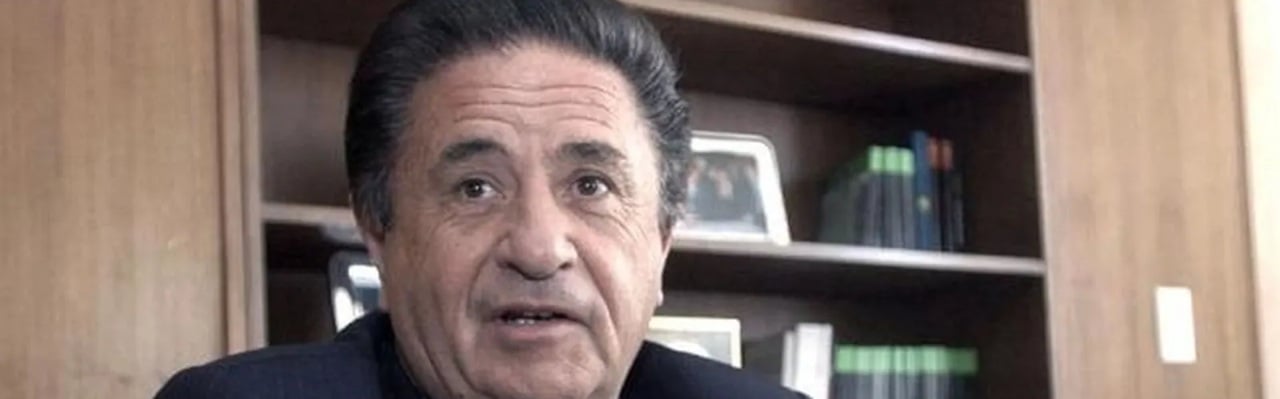
Eduardo Duhalde carries a permanent and unsettling stigma that follows him wherever he goes. It is nothing new or novel: it has accompanied him since 1973, when he jumped from councilman to mayor of Lomas de Zamora. In those days, he was nicknamed “Papá porro”… for obvious reasons.
Later, his ties would become broader and closer, especially when he became Vice President of the Nation alongside Carlos Menem in 1989. His signature on the appointment of Syrian drug trafficker Ibrahim Al Ibrahim was the first gesture. Thanks to Duhalde, a man who did not know a single word of Spanish became “Customs Inspector” at Ezeiza. Ibrahim himself would later admit that he turned a blind eye to ostentatious Duhalde suitcases that, it is presumed, carried drugs and dollars.
Duhalde’s very own private secretary, Alberto Bujía, even admitted that he carried suspicious packages from the north of the country at his boss’s request. When the time came to provide details to the courts, Bujía suffered a suspicious accident in an emblematic location: one block from the Lomas de Zamora municipal building. It was the Ides of March 1991.
Soon, fate would grant Duhalde a more accommodating place for his business: the governorship of the province of Buenos Aires. There, he managed to make drug trafficking “flourish” exponentially, with a focus on Mar del Plata, as detailed in the book “La larga sombra de Yabrán”. In that territory, some cassettes that implicated the then Buenos Aires governor and linked him to the narcotics trade were “lost”. These were compromising conversations between drug traffickers. Those wiretaps were part of a case file that also ended up shelved thanks to favors from Judge Eduardo Pettigiani, who was eventually rewarded and went on to hold first the Security Secretariat of the province of Buenos Aires, and then the Buenos Aires Supreme Court.
In 1999, Duhalde would appear implicated in another narco plot, this time involving the financing of his political campaign alongside Ramón “Palito” Ortega. Much of the funds that contributed money to both candidates came from Mexican drug trafficking, specifically from the Juárez cartel, once led by the late Amado Carrillo Fuentes.
Finally, Fernando De la Rúa thwarted Duhalde’s dreams and won the elections that year. He would not go very far: between his own mismanagement and ineptitude and the virtual “coup” attributed to him by the PJ —alongside Alfonsín and Moyano, among others— the Radical leader had to leave power in December 2001. Months earlier, in New York, Duhalde had told a group of bankers that he would be president before the end of the year. His prediction came true, though at the beginning of 2002.
That was the moment when Duhalde felt all-powerful. He would no longer be the boss of drug trafficking only in the province of Buenos Aires, but across the entire country. In fact, his main competitor in that field, Alfredo Yabrán, had disappeared in May 1998. It could be said that Duhalde was on top of the world.
However, something stood in his way: on June 26, 2002, Darío Kosteki and Maximiliano Santillán were murdered during a protest plan demanding wage increases, subsidies for the unemployed, and food for soup kitchens. Those who carried out the double crime were uniformed officers belonging to the force that Duhalde had years earlier described as “the best police in the world”. What happened forced the then interim president to abandon his re-election plans, paving the way for the arrival of another caudillo, this time from Santa Cruz, Néstor Kirchner.
What would have happened if Duhalde had managed to stay in power beyond 2003? It is impossible to know, because that would be counterfactual history. Nevertheless, imagination allows us to speculate. Anyone with doubts need only recall what Sister Marta Pelloni said just a few years ago on Mirtha Legrand’s show: “With Duhalde, drugs entered the country; with Menem, consumption began; and the cartels entered with Aníbal Fernández when he was Minister of Justice.” It is curious because, at that same table, over 30 years ago —in 1991— Mirtha herself asked Duhalde to his face: “Tell me, Governor, are you a drug trafficker?”
para mi este duhalde es un narco de mierda desde los 70 y nunca le hicieron nada xq el sistema es una cagada papá porro no es joda la oligarquia lo tapa todo los liberales y milicos son todos chorros corruptos aguante la izquierda carajo
khe pavada duhalde narco? para mi es un tipo laburante no como los zurdos de mierda q gobiernan ahora papa porro le dicen y bue sera xq siempre fue mas pillo q los chorros de hoy no me vengan con estigmas aca el unico narco es el kirchnerismo firmado tano