
Dewdrops still glisten on the grass, a light breeze carries the sunbeam that slowly threatens a hot and windy afternoon. I sit on a bench by the city’s main canal to wait. I light a cigarette, and as I finish, I see a man in the distance; I’ve seen him several times before, always wearing the same fishing vest. He always takes the same route: a forty-five-minute walk to a bar, where he reads the newspaper while the waiter brings him «the usual.» After finishing his cortado, he repeats the forty-five-minute walk back to complete the circuit. But this time, I interrupted his routine and sat down with him.
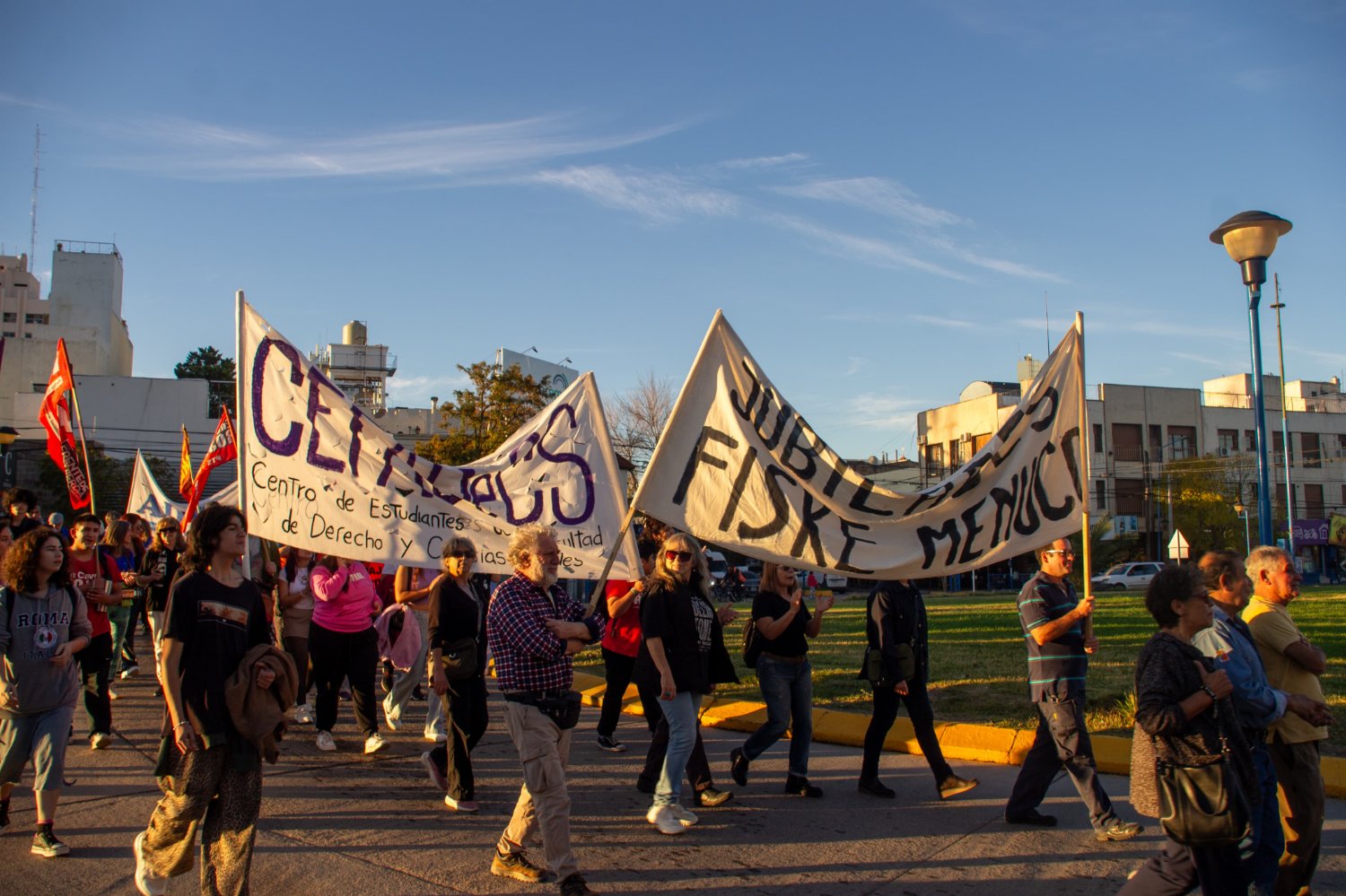
Carmelo Scala is a retiree. Every Wednesday around 5 p.m., he arrives at San Martín Square in the city of General Roca / Fiske Menuco, where he marches with his companions toward Avenida Roca and Tucumán against the austerity policies carried out by the national government. He is known for wearing his kufiya, a characteristic symbol of Palestinian resistance, and carrying his «Jubiladxs Fiske Menuco» flag. When the traffic light turns red, they step onto the street, and amid chants of struggle and honking horns, it becomes clear that fighting for a better world is possible. Carmelo has no faith; he says what gives them strength is the hope of knowing that «all this will eventually be reversed, and that is our role: you as young people in this continuity, and we as part of an experience where we keep fighting and can contribute.»
At the intersection, the joyful looks of meeting once again on a Wednesday revive their conviction. They remind you why you are there again, and as if in a choir, as they step onto the pavement, you hear: «Let them come and see, let them come and see, retirees teach the CGT how to fight.»
I recognize the thread of continuity that Carmelo spoke so much about when I see how they happily approach to greet and talk with the youth who come to converge with their demands. The national government, along with the complicity of the country’s largest trade union federation and the «opposition,» allowed the passage of the slave-like labor reform, which aims to flexibilize working conditions and benefit big business. While retirees are offered supermarket discounts, the policy is to impoverish those who have already contributed a lifetime, with pensions that do not even cover basic needs.
The group has about 25 activists, mostly retired women. They have a militant trajectory that has passed through dictatorships and multiple capitalist crises. One of them is Silvana Battaglino. She is among the first retirees to arrive on Wednesdays; I have rarely arrived before her.
With a youthful spirit, she manages to convey life energy, and it becomes imperative to change the state of things. She lived through the repressive actions of the last civic-military dictatorship and the cradle of neoliberal governments. These experiences shaped a path of activism marked by feminist and environmental sensitivities, leaving a legacy of struggle for the youth. Silvana says the situation of retirees led her to declare: «I have to be on the streets,» because she always knew that is the place for struggles, demands, and achievements. She asserts that «many of the things that young people today enjoy as natural were achieved on the streets,» and it is those «things» that governments attack.
The major trade union federations shine in their abandonment of the struggle. Silvana states: «At this age, I should be enjoying myself,» but with great conviction she adds: «We have to take to the streets for dignified pensions, medicines, and the return of the moratorium,» among other demands. History has shown that fighting works: «The best example is the Garrahan Hospital, but there must be an organized struggle plan with unions present,» she concludes.
Fifty years have passed since the last civic-military dictatorship. A meticulous plan designed to eliminate the idea that order could be questioned from below. A plan to exterminate that revolutionary working class that refused to resign itself to a life of individualism, that fought to live in a better world. Silvana had started studying medicine in Buenos Aires at a time when «military coups came and went.»
Jubiladxs Fiske Menuco concentrates a huge tradition of struggle from historic moments of the Argentine working class: seventies militants who lived through the Cordobazo, some firsthand through the Rocazo — a popular uprising in the city against the intervention of Requeijo, de facto governor of the province of Río Negro in ’72 — and even comrades exiled from Pinochet’s dictatorship in Chile, who became clandestine militants upon arriving in Argentina.
In late 1972, when he was 16, at a time of effervescence in worker struggles internationally and nationally, with a series of revolutions and resistances worldwide, Carmelo says «you had to take sides.» Thus, he began militating in high school and joined the Socialist Workers Party (PST). Later, during the de facto government, together with his fellow activists, they created a theater group called «Movimiento Teatral Roquense» and secured a theater space where militancy converged with culture. «That’s also where the Cine-Club Don Lumiere was born,» Carmelo recalls. «It was a space for discussion and debate, at a time when Rambo movies were coming out, we showed Saura, which was a plea against Francoism.»
Again and again, conversations return to the youth. To the constant need to transmit the threads of continuity of a combative and organized generation where «the strange thing was not to be militant.» Rescuing the struggle of the 30,000 disappeared revolutionary militants becomes mandatory so that the tradition and lessons drawn from those struggles materialize in a root transformation of reality.
The youth clearly understand that the way out is collective. It is time to pick up the thread of continuity of the 30,000 disappeared comrades, of that seventies youth forged amid great revolutionary feats, rehearsing the worker-student alliance. Those boys and girls who fought for a different society, for a life worth living, free from oppression and exploitation.
That was a different Wednesday; we all saw how they sprayed pepper spray in the face of a man asking for money to eat. Students, workers, and retirees began to chant against the actions of that band of armed men, who, lacking blood, are driven by hatred for the working class. Eyes stung, faces teared up, and the retirees chanted «fuera yuta» without stopping.
A cordon of retirees separates the youth from those armed men who dismount from motorcycles that gallop without stopping; with them comes a white dust cloud that escapes from the violent roar toward those who fight. Conviction is stronger, and they cannot advance. Finally, the guard dogs retreat. The unity of struggles prevents them from advancing.


para mi los jubiladxs y los pibes son los unicos q bancan la lucha los traidores venden la patria aguante fiske menuco unidad popular carajo los de arriba siempre ajustan a los de abajo viva la resistencia 🔥💪
Para mí estos jubilados son unos vivos que nunca laburaron y ahora se hacen los revolucionarios con los pibes. Me parece una joda que encima protesten, vayan a laburar en vez de joder. Esto huele a kuka puro, viva la libertad carajo.